-01.svg)
-02.svg)
-03.svg)
-04.svg)
-05.svg)
-06.svg)
-07.svg)
-08.svg)
-09.svg)
-10.svg)
-11.svg)
-12.svg)
-13.svg)
-14.svg)



blog
What Is Google’s Knowledge Graph? How It Understands Entities, Brands & Relationships
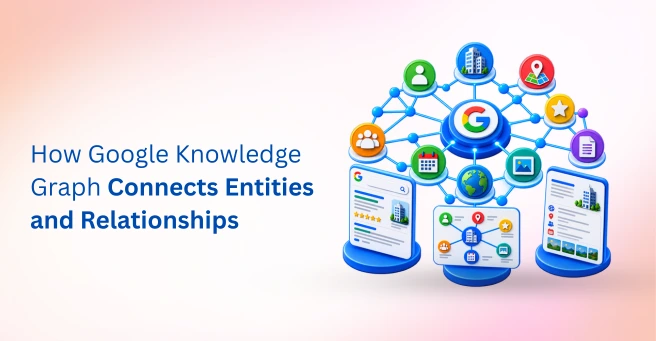
| Google’s Knowledge Graph is a massive database of entities, people, places, organizations, and things, along with the verified relationships between them. It powers Knowledge Panels, supports semantic search, and increasingly feeds AI Overviews and AI-generated answers, moving Google beyond simple keyword matching toward genuine entity understanding. |
A business searches its own name on Google and finds nothing. No Knowledge Panel, no verified logo, no summary box on the right side of the results. A much smaller competitor, meanwhile, has one fully populated, complete with a logo, a description, and links to its social profiles.
The system behind that gap is Google’s Knowledge Graph, and it works by understanding entities and the relationships between them, not by matching keywords the way traditional search once did. A brand either exists clearly inside that system or it doesn’t, and the difference shows up in exactly the kind of visibility gap described above.
This guide covers what the Google Knowledge Graph actually is, how it identifies and connects entities, and how a brand can influence its own representation inside it. A comparison table, a practical optimization checklist, and seven frequently asked questions are included as well.
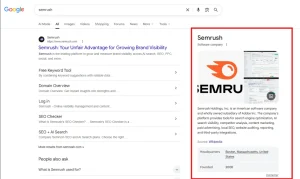
Image Source: Screenshot taken from Google SERP.
What Is Google Knowledge Graph and How Does It Work?
Google Knowledge Graph is a massive database of entities, people, places, organizations, and things, along with the verified relationships between them, that Google uses to understand search intent beyond literal keyword matching. It’s the system responsible for the summary boxes, fact panels, and instant answers that appear directly inside search results.
Google engineer Amit Singhal famously described the shift this represented as a move from “strings” to “things,” a distinction Google has used publicly since the Knowledge Graph launched in 2012. Rather than matching the literal words in a query, the system identifies the actual entity being asked about and pulls together everything it knows about that entity from across its data sources.
That data comes from several places at once: structured data and schema markup published by websites, authoritative sources like Wikipedia and Wikidata, verified business information submitted directly to Google, and Google’s own crawling and indexing systems working continuously in the background.
| Knowledge Graph Component | What It Represents | Example |
| Entity | A distinct person, place, organization, or thing | A specific brand or business |
| Entity attributes | Facts describing an entity | Founding date, headquarters, industry |
| Entity relationships | Verified connections between entities | Company to founder, product to brand |
| Knowledge Panel | The visible search result surfacing entity data | A brand’s summary box in search results |
How Google’s Knowledge Graph Identifies Entities and Relationships
Entity recognition works by cross-referencing multiple signals at once. Structured data, brand mentions across the web, backlink context, and third-party sources all get weighed together to confirm that an entity genuinely exists and to build out its known attributes.
Entity relationships specifically describe how Google connects a business entity to its founder, its products, its physical location, and other related organizations, building a web of verified associations rather than storing isolated, disconnected facts. This is what allows Google to answer a question like “who founded this company” with confidence, rather than guessing from scattered mentions.
Entity authority strengthens or weakens based on consistency. Corroborated information appearing the same way across multiple authoritative sources builds confidence, while conflicting names, descriptions, or facts across different platforms weaken it, sometimes enough to prevent a Knowledge Panel from appearing at all.
Data point: Digital Applied’s 2026 Entity SEO guide describes Google’s Knowledge Graph as the prerequisite for AI Overview citations, Knowledge Panel cards, and AI Mode answers, noting that Gemini itself is trained on the same underlying entity data, which makes accurate Knowledge Graph representation a direct input into AI visibility, not a separate consideration.
Tip: Search your own brand name on Google right now. If no Knowledge Panel appears, or the wrong logo or description shows up, that’s a direct signal of how well-established your entity currently is in Google’s understanding.
Why the Knowledge Graph Matters for SEO and AI Search
Entity confirmation is often the first step toward earning a brand or business Knowledge Panel in search results, and it’s a data problem more than a design one. There’s no application form. Google generates the panel automatically once its confidence in an entity crosses a certain threshold, and a business can then claim it. Strong Knowledge Graph signals also support entity SEO, which focuses on helping search engines clearly identify a brand, understand its attributes, and connect it with relevant people, topics, products, and organizations.
The connection to modern semantic SEO runs deeper than Knowledge Panels alone. Google increasingly ranks and surfaces content based on topical authority and entity relationships, not isolated keyword density, which means a site’s entity clarity affects far more than whether a panel appears.
AI Overviews and other AI-generated answers often draw on the same entity and relationship data that powers the Knowledge Graph, meaning strong entity signals support AI visibility just as much as they support traditional rankings. A brand that Google can’t confidently identify as a real, well-documented entity is a brand AI systems are more likely to guess about, or skip entirely. This is closely connected to Answer Engine Optimization, which focuses on structuring content so search engines and AI systems can extract useful answers
| Where It Shows Up | What It Affects |
| Knowledge Panel | Brand recognition and trust in search results |
| Traditional organic rankings | Topical authority and semantic relevance |
| AI Overviews and AI search | Entity-based citation and inclusion in generated answers |
| Voice and conversational search | Accurate, confident answers about a brand or entity |
How to Optimize for Google Knowledge Graph
Here’s how to strengthen a brand’s presence in Google Knowledge Graph through a handful of concrete, repeatable actions rather than a single one-time fix.
1. Implement Organization Schema Markup
Schema.org’s Organization schema, including name, logo, founding date, and address, gives Google a structured, machine-readable starting point for confirming an entity’s core attributes.
2. Use sameAs Properties to Connect Verified Profiles
Linking official social media accounts, a Wikipedia page, a Wikidata entry, and other verified profiles through sameAs properties strengthens entity confirmation by tying multiple independent sources back to the same identity.
3. Build Consistent Brand Mentions Across Authoritative Sources
Consistent naming, description, and factual details across press coverage, directories, and industry publications reinforce entity authority, while inconsistent details across these same sources actively undermine it.
4. Strengthen Topical Authority Through Content
Comprehensive coverage of a brand’s core subject matter helps Google associate the entity with a clear, well-defined area of expertise, rather than leaving that association ambiguous.
5. Claim and Complete a Google Business Profile
For businesses with a physical or local presence, a fully completed Google Business Profile feeds directly into local entity data and often accelerates Knowledge Panel eligibility.
6. Maintain E-E-A-T Signals Sitewide
Author bios, transparent sourcing, and verifiable credentials reinforce the trust layer Google weighs when confirming entity attributes, particularly for brands operating in more sensitive or competitive industries.
| Optimization Action | What It Strengthens |
| Organization schema markup | Structured entity data foundation |
| sameAs properties | Cross-platform entity verification |
| Consistent brand mentions | Entity authority and corroboration |
| Topical authority content | Subject-matter association |
| Google Business Profile | Local entity and Knowledge Panel data |
| E-E-A-T signals | Overall trust and credibility |
Knowledge Graph Data vs. a Traditional Search Index
It helps to separate two systems that often get conflated. A traditional search index catalogs webpages and matches them against query keywords, ranking them by relevance signals like content quality and backlinks. Google Knowledge Graph works differently: it stores verified facts about real-world entities, independent of any single webpage, and pulls from many corroborating sources at once.
This is why a Knowledge Panel can display accurate information about a company even when the company’s own website is thin or poorly optimized, and conversely, why a well-optimized website doesn’t automatically guarantee a Knowledge Panel. The two systems inform each other, but they’re evaluating fundamentally different things: page relevance in one case, entity confidence in the other.
Common Mistakes That Weaken Entity Recognition
- Inconsistent brand name, logo, or description across different platforms and directories
- Missing or incomplete Organization schema markup
- No sameAs links connecting official profiles back to the main website
- Treating entity optimization as a one-time task instead of an ongoing consistency effort
- Ignoring a wrong or outdated Knowledge Panel instead of submitting feedback or corrections through Google’s available tools
Final Thoughts
The Knowledge Graph represents a fundamental shift toward entity-based search. It increasingly supports both traditional search rankings and AI-generated answers. As a result, strong entity signals can build authority over time, much like backlinks and content authority. They are not the result of a single optimization fix.
Therefore, building a consistent and well-documented presence in Google’s Knowledge Graph is becoming increasingly important for brands. A clear entity presence can help brands appear more confidently across traditional search and AI-powered search experiences. As AI-generated answers become a larger part of search, this importance will only continue to grow.
However, maintaining entity signals, schema markup, and brand consistency across the web can be difficult to manage manually. This is where Tangence can help. As a full-service digital marketing and SEO services agency with expertise in technical and semantic SEO, Tangence helps businesses implement structured data and schema markup, strengthen entity signals, and build topical authority.
If your brand is not appearing as expected in Google Search or AI-generated answers, Tangence’s SEO team can conduct an entity SEO audit to identify gaps and recommend the right improvements.
Frequently Asked Questions
1. What is Google Knowledge Graph, and how is it different from a regular search index?
A regular search index matches keywords with indexed webpages. In contrast, Google Knowledge Graph stores information about verified entities and their relationships. This helps Google answer questions using understood facts rather than relying only on literal keyword matching.
2. How do I get my business a Knowledge Panel?
A Knowledge Panel appears automatically when Google has sufficient confidence in an entity. Organization schema, sameAs links to verified profiles, a Wikidata entry, and consistent information across authoritative sources can support entity recognition. There is no direct application process for a Knowledge Panel.
3. What is the difference between an entity and a keyword in SEO?
A keyword is a word or phrase someone enters into a search engine. An entity is a distinct person, place, organization, thing, or concept that Google can identify and connect with related facts and relationships.
4. Does schema markup guarantee a Knowledge Panel?
No. Schema markup provides structured information that can support entity recognition. However, a Knowledge Panel also depends on corroborating information from authoritative sources and consistent brand information across the web.
5. Can I edit or correct information in my brand’s Knowledge Panel?
Yes. Once a business claims its Knowledge Panel through Google’s verification process, certain information can be suggested for correction. For unclaimed panels, users can still submit feedback through Google’s available correction tools.
6. How does the Knowledge Graph affect AI Overviews and AI search results?
AI Overviews and other AI-generated search experiences can use entity and relationship information associated with the Knowledge Graph. As a result, a well-documented entity may be easier for AI systems to identify and describe accurately.
7. How long does it take for Google to recognize a new business entity?
There is no fixed timeline. Recognition depends on how quickly consistent and corroborated information builds across schema markup, business profiles, and third-party sources. For a well-documented brand, this process can take anywhere from a few weeks to several months.