-01.svg)
-02.svg)
-03.svg)
-04.svg)
-05.svg)
-06.svg)
-07.svg)
-08.svg)
-09.svg)
-10.svg)
-11.svg)
-12.svg)
-13.svg)
-14.svg)






blog
How to Get Cited in Google’s AI Overviews: A Step-by-Step Guide for 2026
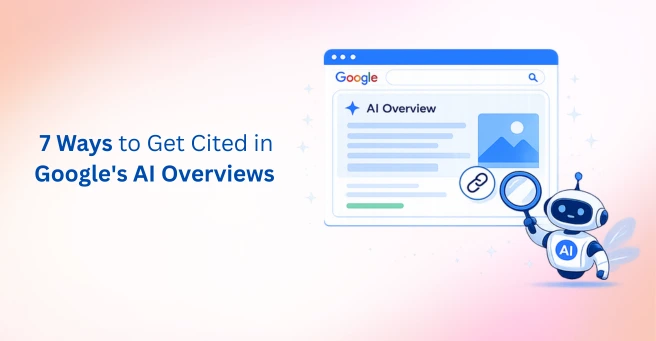
| AI Overviews are AI-generated summaries that appear at the top of Google Search results. They synthesize information from multiple sources into a single answer, with linked citations underneath or alongside the text. To get cited in Google AI Overviews, structure content to answer the query directly within the first two to three sentences, add FAQ, Article, and Author schema, and strengthen E-E-A-T with real author credentials and original insight. Build topical authority through internally linked pillar content, and keep pages updated regularly, since freshness and structured data are the strongest levers for consistent AI citation. |
Search itself has fundamentally changed shape over the last two years. Google Search is no longer a simple list of ten blue links. It’s now a layered experience. AI Overviews, Search Generative Experience, and AI Mode increasingly answer a user’s question before they ever click through. For marketers, agencies, and business owners, that shift changes the priorities. AI visibility is now just as important as ranking position.
If you want to know how to get cited in AI Overviews, here’s the short answer. Google’s AI systems reward the same things great SEO has always rewarded. That means real expertise, structural clarity, and demonstrable trust. The only difference is packaging. Content now needs to be as easy for machines to parse as it is for humans to read. AI Overviews already appear on a significant share of Google searches. Industry tracking consistently shows something important: brands cited inside them earn meaningfully more clicks and visibility. That’s a real edge over brands sitting in the traditional blue links below.
This guide breaks down exactly what it takes to earn that citation in 2026. We will cover technical foundations, schema markup, content depth, entity building, and E-E-A-T, step by step.
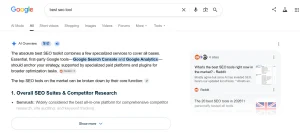
Image Source: Screenshot taken from Google SERP.
What Are Google AI Overviews and Why Citations Matter
AI Overviews are AI-generated summaries that appear at the top of Google Search results. They synthesize information from multiple sources into a single answer, with linked citations underneath or alongside the text. Industry tracking on how often these appear varies quite a bit. It depends on methodology, geography, and the mix of keywords studied. Some trackers report presence in roughly a quarter of tracked queries. Others report figures closer to half or higher, especially in informational, health, and education verticals. One thing is consistent across nearly every study: AI Overview presence has grown substantially year over year. It shows no sign of plateauing.
Unlike a classic featured snippet, an AI Overview doesn’t pull one exact passage from a single page. It blends large language models with AI retrieval to draw from several sources at once. It then generates a new, synthesized answer. A page can rank well in organic results and still never get pulled into an AI Overview. That’s because the AI system isn’t just asking is this relevant. It’s asking can I extract a clear, trustworthy, well-structured piece of this answer from this page. That distinction is the entire reason AI Overviews SEO exists as its own discipline. It sits on top of traditional SEO rather than replacing it.
| Ranking Factor | Traditional SEO | AI Overview SEO |
|---|---|---|
| Primary Goal | Rank higher in organic results | Get cited in AI-generated answers |
| Content Focus | Keywords and backlinks | Entities, semantic relevance, and extractable answers |
| Ranking Signals | Backlinks, on-page SEO, Core Web Vitals | E-E-A-T, schema markup, topical authority, and entity signals |
| Content Structure | Long-form, keyword-optimized pages | Clear answers, structured sections, and FAQs |
| User Journey | Click the search result to read | Read AI summary, then click the cited source if needed |
| Success Metric | Organic rankings and traffic | AI citations, visibility, and assisted clicks |
The Ranking Signals Behind AI Overviews SEO
AI Overviews SEO builds on classic ranking signals. It adds a machine-readability and trust-verification layer on top. Three things matter most, and each deserves a closer look.
1. Helpful content and topical authority.
Google has repeatedly emphasized rewarding content that shows genuine expertise. It should cover the full scope of a topic, not just one isolated keyword answer. This is where topical authority and pillar content strategies pay off in a concrete way.
AI systems are more likely to pull from domains that consistently cover a subject area in depth. That pattern, across multiple interlinked pages, is itself a trust signal. A single well-written article sitting in isolation on a thin site is far less likely to be treated as authoritative. The same article, backed by a cluster of related, internally linked content, performs very differently.
2. Entity SEO and the knowledge graph.
Google’s systems increasingly recognize brands, authors, and organizations as distinct entities. They’re connected inside the knowledge graph, not just matched as strings of text against a query. Building consistent entity signals helps here.
That includes a Wikipedia or Wikidata presence where relevant, consistent business name, address, and phone data across the web, detailed author profiles with verifiable credentials, and a genuinely informative “About” page. These signals make it measurably easier for AI systems to identify who you are. They also clarify what you’re an authority on, and why you deserve citation over a competitor.
3. Structured data and schema markup.
Machine-readable schema markup removes ambiguity for crawlers and AI retrieval systems. This includes Article, FAQPage, Organization, and Author schema in particular. Industry analysis from BrightEdge found something striking. Pages carrying author schema were roughly three times more likely to appear inside AI-generated answers.
Sites combining structured data with FAQ blocks saw an additional lift in AI citation rates. This is one of the highest-leverage, lowest-cost technical fixes available. It’s still under-adopted across most small and mid-sized business websites.
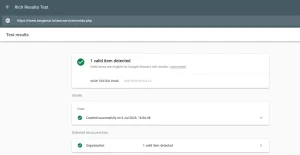
Image Source: Screenshot taken from Rich Results Test.
| Tip: Schema markup doesn’t guarantee an AI Overview citation on its own. But it removes friction at the exact moment an AI retrieval system decides whether your content is trustworthy enough to cite. |
Why E-E-A-T Is the Real Currency of AI Citations
Of everything covered in this guide, E-E-A-T deserves its own section. It’s the underlying filter behind almost every other signal an AI system evaluates. E-E-A-T stands for Experience, Expertise, Authoritativeness, and Trust. Google’s own quality guidelines treat it as central to how content is evaluated. This matters most for topics that affect a person’s health, finances, safety, or major life decisions. These are often called YMYL topics, short for “Your Money or Your Life.”
For AI Overviews specifically, E-E-A-T works almost like a credibility filter. It gets applied before the synthesis step even happens. Take a health-related answer as an example. An AI system is far more likely to draw from a page written or reviewed by a named medical professional. That’s true even if an anonymous blog post covers the same topic well and accurately. The same pattern holds in legal, financial, and other high-stakes categories.
Practically, strengthening E-E-A-T means focusing on a few concrete things:
| E-E-A-T Signal | Best Practice |
|---|---|
| Named Authors | Use real authors with credentials and a bio. |
| First-Hand Experience | Include original examples, case studies, or expert insights. |
| Transparent Sources | Cite official sources, research, and trusted references. |
| Consistent Entity Signals | Keep author and business information consistent across your website, profiles, and structured data. |
How to Get Cited in AI Overviews: A Step-by-Step Framework
This is the core of how to get cited in AI Overviews. It’s a repeatable framework that applies whether you are publishing a single page or managing a full content program.
Step 1:-
Build topical authority with pillar content. Don’t scatter thin posts across dozens of loosely related keywords. Instead, cluster content around one core topic with a strong pillar page. Add several supporting articles, all internally linked back to the pillar. This concentrates topical signal in one place instead of diluting it.
Step 2:-
Answer the query directly in the first two to three sentences. AI retrieval systems favor content that gives a clear, self-contained answer early on. Save the supporting detail for later in the page. This also improves eligibility for featured snippets. It aligns naturally with strong search intent matching. The reader, and the AI system reading on their behalf, shouldn’t have to dig for the answer.
Step 3:-
Add structured data across your key pages. Implement FAQPage, Article, and Author schema so your content is machine-readable, not just human-readable. This is a one-time technical investment. Its payoff compounds across every future piece of content on the domain.
Step 4:-
Strengthen E-E-A-T signals on every page, not just cornerstone content. Use genuine author bios, visible credentials, and original insight. Show real information gain, not repackaged summaries of what’s already ranking. This is what separates cited sources from ignored ones.
Step 5:-
Earn mentions and links from trusted, authoritative sources. Digital PR and citations from high-trust domains help a lot here. Think recognized industry publications, professional associations, or .edu and .gov sources where genuinely relevant. These reinforce your entity’s credibility across the web, not just on your own site.
Step 6:-
Optimize for semantic SEO, not just exact-match keywords. Cover the related entities, sub-questions, and terminology a topic naturally includes. This is the foundation of semantic SEO. It’s what allows one well-built page to answer dozens of related query variations, not just one.
Step 7:-
Use clear headers and strong internal linking. Reinforce topical relevance across the whole site, not just within a single page. Internal linking is one of the most overlooked levers here. It tells both users and AI systems which page is the definitive resource on a topic.
How to Track and Measure AI Overviews Visibility
You can’t improve AI visibility if you’re not measuring it. This is a step most small business owners skip entirely. A few practical approaches work well:
| Tool | What to Measure |
|---|---|
| Google Search Console | Impressions & CTR |
| AI Visibility Tools | Citation tracking |
| Manual SERP Checks | AI Overview presence |
| Google Analytics | Organic traffic changes |
Content Depth, Search Intent, and Information Gain
Content depth alone isn’t enough to earn an AI Overview citation. Your content must also align with search intent and provide unique value. AI systems are designed to synthesize the most relevant and trustworthy answer, which means they favor comprehensive, original content over keyword-heavy or superficial pages.
Just as important is matching your content to user intent. Informational queries require clear explanations and structured answers, while commercial searches benefit from honest comparisons and actionable insights. According to Semrush, nearly 90% of queries that trigger AI Overviews have informational intent, making well-organized educational content especially valuable.
Finally, focus on information gain, the unique insights your content adds beyond what’s already available. Original research, case studies, expert opinions, first-hand experience, and local context all strengthen your content’s value. Rather than repeating existing information, aim to contribute something genuinely useful. Pages written by qualified professionals with real-world experience are far more likely to earn AI citations than generic content that simply summarizes what others have already published.
The Future of AI Search Optimization
AI-powered search will continue to evolve as Google expands AI Overviews and AI Mode, while platforms like ChatGPT, Perplexity, and Copilot refine their own search experiences. Although these AI systems will develop differently, one trend remains consistent: websites with strong topical authority, structured data, and genuine E-E-A-T signals earn more citations across AI-powered search. Rather than chasing short-term tactics, businesses should focus on building lasting authority through high-quality content, clear entity signals, and technical SEO. Investing in AI search optimization today creates a long-term competitive advantage, helping your brand remain visible and trusted as AI-driven search continues to reshape how users discover information.
Common Mistakes That Keep Brands Out of AI Overviews
| Mistake | Better Alternative |
|---|---|
| Keyword stuffing | Natural semantic writing |
| Missing schema | Add structured data |
| Anonymous authors | Use expert author bios |
| Weak internal links | Build topic clusters |
| Thin content | Publish comprehensive guides |
| Outdated pages | Refresh content regularly |
Conclusion
Getting cited in AI Overviews isn’t about finding a shortcut or relying on a single SEO tactic. It’s the result of building topical authority, demonstrating E-E-A-T, implementing structured data, and publishing content that’s easy for both users and AI systems to understand. As AI-powered search continues to evolve, these fundamentals will become even more important for long-term visibility. Brands that consistently invest in high-quality, well-structured, and trustworthy content will be better positioned to earn citations across Google’s AI experiences.
If you are ready to strengthen your AI search presence, Tangence can help. From technical SEO audits and schema implementation to content strategy and authority building, our experts provide end-to-end SEO services support needed to improve your visibility in Google Search, AI Overviews, and other AI-driven search platforms.
Frequently Asked Questions
1. How can a small business get cited in AI Overviews?
Focus on quality over quantity. Build a few comprehensive pillar pages, add FAQ and Author schema, and publish content backed by real expertise. Strengthen your local or niche authority instead of competing with larger websites on publishing volume alone.
2. What’s the difference between AI Overviews and Search Generative Experience (SGE)?
Search Generative Experience (SGE) was Google’s experimental AI search feature. AI Overviews is the production version that now appears directly in Google Search results, providing AI-generated answers with citations from trusted sources.
3. Does schema markup guarantee an AI Overview citation?
No. Schema markup doesn’t guarantee a citation, but it helps Google understand, verify, and attribute your content more accurately. Combined with high-quality content and strong E-E-A-T, it can improve your chances of being cited.
4. How important is E-E-A-T for AI Overviews?
E-E-A-T is one of the strongest trust signals for AI-powered search. Content created by qualified authors, supported by credible sources, and backed by real experience has a much higher chance of earning AI citations, especially in YMYL industries.
5. Can older blog posts appear in AI Overviews?
Yes. Google can cite older content if it remains accurate and relevant. Regularly updating statistics, examples, and best practices helps maintain freshness and improves citation potential.
6. How long does it take to improve AI Overview visibility?
Results vary by industry and competition. However, websites that consistently improve technical SEO, topical authority, and content quality often see measurable progress within one to two quarters.
7. Is Generative Engine Optimization different from traditional SEO?
Generative Engine Optimization (GEO) builds on traditional SEO rather than replacing it. It emphasizes structured, entity-rich, and machine-readable content while relying on the same core principles of authority, relevance, and trust.