-01.svg)
-02.svg)
-03.svg)
-04.svg)
-05.svg)
-06.svg)
-07.svg)
-08.svg)
-09.svg)
-10.svg)
-11.svg)
-12.svg)
-13.svg)
-14.svg)






blog
How to Write Answer-First Content: The Format That Gets You Cited by AI Engines
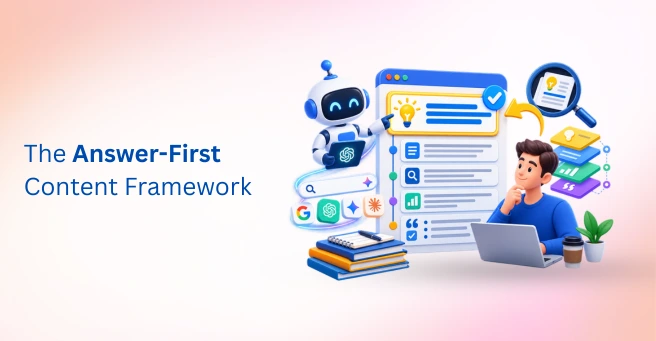
| Answer-first content states the complete, direct answer to a question within the first one to three sentences of a section, before adding supporting detail or nuance. This structure aligns with how AI engines like ChatGPT, Perplexity, and Google AI Overviews extract and cite passages, since these systems favor self-contained answers over ones buried under narrative buildup. |
Two blog posts cover the exact same topic, written by two different teams with roughly the same level of expertise. Both rank on page one of Google. Only one of them gets quoted by ChatGPT, and only one shows up inside Google AI Overviews. The other, despite ranking just as well, never gets cited at all, and nobody on that team can quite explain why.
The difference usually isn’t the quality of the research. It’s the format. Answer-first content is built to be lifted cleanly out of a page and quoted on its own, while traditional narrative writing often buries the actual answer three paragraphs deep, after a slow build-up an AI engine has no patience for. Answer-first writing is part of a broader AI SEO strategy that focuses on making content easier for AI-powered search systems to understand, interpret, and surface.
This guide covers what this writing approach actually means, how AI answer engines decide which passages to extract and cite, and a practical, repeatable process for rewriting existing content into this format. A before-and-after example, a content-type breakdown, and seven frequently asked questions are included as well.
Data point: According to Frase’s 2026 Answer Engine Optimization guide, AI engines extract the first one to two sentences of a section to determine whether it answers a query, and a vague or context-heavy opening often causes the engine to move on to a competing source entirely.

Image Source: Created using Napkin AI.
What Is Answer-First Content and Why Does It Get Cited by AI?
Answer-first content is a writing approach that states the direct, complete answer to a question within the first few sentences of a section, before any supporting detail, context, or nuance gets added. The answer comes first. Everything else, however valuable, comes after.
This format aligns closely with how retrieval-augmented generation systems actually work. An AI engine scans indexed content for a self-contained passage that answers a query cleanly, and a delayed or buried answer is genuinely harder to extract with confidence. When the AI system has to piece together a response from scattered sentences across several paragraphs, it often skips the source altogether in favor of one that made the answer easy to lift.
Traditional narrative or SEO writing habits work against this. Long introductions, storytelling build-ups, and answers that only become clear in the final paragraph of a section were once considered good writing craft. They now actively work against a page’s chances of being cited, even when the underlying information is excellent. This approach closely connects with Generative Engine Optimization (GEO), which focuses on improving how content is understood and referenced across AI-powered search experiences.
| Traditional Content Structure | Answer-First Structure |
| Context and buildup, then answer | Answer first, then context and nuance |
| Answer implied across several paragraphs | Answer stated in one self-contained passage |
| Long narrative introductions | Direct opening sentence addressing the query |
| Conclusion reveals the point | Point stated upfront, elaborated after |
How Answer Engines Actually Select and Cite Content
AI search tools and answer engines pull candidate passages from indexed content, then favor the ones that most directly and confidently answer the query without requiring further interpretation. Clear content structure and content hierarchy, especially question-based headings, help an AI system quickly locate the right passage before it even needs to evaluate the quality of the answer itself.
E-E-A-T and source credibility compound this effect rather than acting as a separate, unrelated factor. A well-structured answer from a credible, experienced source is favored over an equally well-structured answer from an anonymous or thin one, since answer engines are increasingly designed to weigh trust alongside extractability.
Data point: A 2026 arXiv study analyzing 55,393 Google AI Overview queries found that adding clear citations, quotations, and statistics to a page improved its visibility in AI-generated answers by roughly 30 to 40%, reinforcing that structure and evidence work together rather than as separate levers.
How to Write Answer-First Content: A Step-by-Step Process
Here’s exactly how to write answer-first content that holds up whether a human reader or an AI engine encounters it first.
| Steps | What to Do | Key Rule |
|---|---|---|
| 1. Identify the question | Determine the exact query each section answers | Use question-based headings |
| 2. Answer first | Give the complete answer in the first 1–3 sentences | Don’t delay the answer |
| 3. Add supporting detail | Follow the answer with evidence, context, and nuance | Depth comes after the answer |
| 4. Improve structure | Use short paragraphs, lists, and appropriate schema | Make content easy to scan |
| 5. Test in isolation | Read only the heading and opening sentences | The passage should make sense alone |
Step 1: Identify the Exact Question Each Section Answers
Question-based headings that mirror real search queries make this step almost automatic. A heading like “How long should a direct answer be?” forces the section beneath it to actually answer that question, rather than drift into related but unfocused territory.
Step 2: Write the Complete Answer in the First 1-3 Sentences
No throat-clearing, no “it depends” without immediately following up with the actual dependency, and no context before the core answer lands. The answer should be understandable even if nothing else on the page gets read.
Step 3: Add Supporting Detail and Nuance After the Answer
This is where information gain, original data, and genuine insight belong, once the core answer has already been delivered. Depth still matters. It simply gets sequenced differently than it would in a traditional narrative structure.
Step 4: Reinforce With Structure
Short paragraphs, scannable formatting, and structured data like FAQ schema all help both human readability and AI parsing simultaneously. Neither audience benefits from a wall of unbroken text.
Step 5: Test the Passage in Isolation
A simple question settles this step: does this paragraph make complete sense if it were the only thing an AI engine quoted? If the answer requires the paragraph before or after it to make sense, the structure still needs work.
Here’s a quick before-and-after example of the same information, restructured:
Before (buried answer): When it comes to how often you should post on social media, there are a lot of factors to consider, including your industry, audience, and available resources. Many businesses struggle with consistency, and posting too often or too rarely can both create problems. Generally speaking, after weighing all of this, most experts suggest posting three to five times per week.
After (answer-first): Most businesses should post on social media three to five times per week. This range balances audience visibility against content quality, and it holds up across most industries, though posting frequency should flex based on available resources and audience engagement patterns.
Applying This Format Across Different Content Types
Blog posts and guides benefit most when the answer-first format sits directly under each question-based H2 or H3 heading, rather than only at the top of the page. Product and service pages should lead with what the product or service does and who it’s for, before diving into a feature list that means little without that context.
FAQ sections deserve particular attention, since each answer should be a complete, standalone response. FAQ content is heavily favored by both featured snippets and AI-generated answers precisely because it’s already structured as a question paired with a self-contained answer, which is the exact shape an answer engine is looking for anyway.
| Content Type | Where the Answer Goes | Common Mistake to Avoid |
| Blog posts / guides | First 1-3 sentences under each heading | Long intros before the actual point |
| Product/service pages | Opening paragraph, above the fold | Feature lists before explaining the what and who for |
| FAQ sections | The entire answer, self-contained | Vague answers that reference see above |
| Comparison content | Verdict or key difference stated first | Building suspense before revealing the result |
Common Mistakes That Undermine This Content Strategy
A strong direct answer sometimes gets written, then buried under three paragraphs of unrelated context before a reader, or an AI engine, ever reaches it. Vague, clickbait-style headings that don’t mirror an actual searchable question undercut the entire structure before a single sentence gets read.
This format is sometimes treated as inherently robotic or thin when done poorly, rather than paired with genuine content depth and information gain once the direct answer has been delivered. Strong E-E-A-T signals still matter here too, since a direct answer from an uncredible source remains less likely to be cited than an equally direct one from a trusted, experienced source. Skipping the final step, testing headings and opening sentences alone before publishing, is often what allows these mistakes to slip through unnoticed. Answer-first content should still provide original, useful information and demonstrate real expertise, because Google’s systems prioritize helpful, reliable, people-first content.
Final Thoughts
Answer-first content isn’t a gimmick or a one-time formatting trick. It’s a structural approach that can strengthen a site’s AI visibility over time. The sites that apply it consistently can create more opportunities for AI engines to understand, extract, and cite their content.
This format also benefits human readers. Clear, direct answers make content easier to scan and understand. An answer-first strategy across key pages can help brands improve their visibility as AI search continues to change how people find information.
Restructuring an entire website into an answer-first format can take time and expertise. That’s where Tangence Solutions can help. As a full-service digital marketing and SEO services agency with strong SEO and content expertise, Tangence helps businesses restructure content around answer-first principles. The team also strengthens E-E-A-T and topical authority across the site to support both traditional rankings and AI visibility.
Not sure whether your content is structured for AI search? Tangence’s content team can audit your content structure and identify the sections that need improvement.
Frequently Asked Questions
1. What is answer-first content, and why does it matter for AI search?
Answer-first content gives a direct, complete answer within the first few sentences of a section. It then provides supporting context and details. This structure makes the answer easier for AI search engines to identify and extract.
2. How is this approach different from writing a good introduction?
A traditional introduction may build context before addressing the main question. Answer-first writing does the opposite. It gives the core answer within the first one to three sentences and follows it with supporting information.
3. Does this writing style hurt SEO by making content less engaging?
No. Answer-first writing does not mean making content shorter or less detailed. It simply changes the order of information. Readers get the answer quickly, while supporting details, examples, and deeper insights follow.
4. How long should the direct answer be before adding supporting detail?
For most sections, one to three sentences work well. The answer should provide enough information to stand on its own. More complex questions may require a slightly longer response.
5. Do question-based headings improve AI citation chances?
Question-based headings can make content easier to understand and match with search queries. They clearly identify the question that the following section should answer. The content beneath the heading must still provide a clear, useful, and accurate response.
6. Can this format still rank well in traditional Google Search, not just AI Overviews?
Yes. Answer-first content can support traditional SEO as well as AI search visibility. Clear headings, concise answers, and scannable content can also make information easier for search engines and users to understand.
7. How do I test whether my content is truly answer-first?
Read the heading and the first one to three sentences beneath it. Ignore the rest of the section. If those sentences answer the question completely, the section follows an answer-first structure. If the reader needs to continue reading to understand the answer, move the key information higher.