-01.svg)
-02.svg)
-03.svg)
-04.svg)
-05.svg)
-06.svg)
-07.svg)
-08.svg)
-09.svg)
-10.svg)
-11.svg)
-12.svg)
-13.svg)
-14.svg)






blog
Domain Authority vs Page Authority: What’s the Difference?
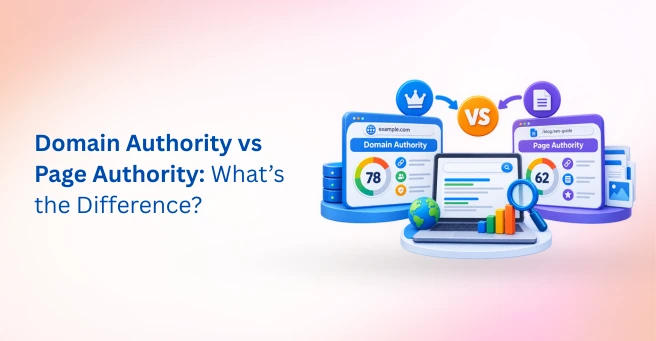
| Domain authority (DA) predicts how well an entire website is likely to rank, based on its overall backlink profile, while page authority (PA) predicts how well one specific page is likely to rank, based on that page’s own links. Both are Moz-developed, third-party metrics on a 1-100 logarithmic scale, and neither is a direct Google ranking factor, though both correlate with genuine link equity. |
A marketer checks a competitor’s domain authority score, sees it sitting comfortably below their own, and still watches that competitor’s individual page outrank theirs for a target keyword. There’s no obvious explanation on the surface, and it’s the kind of mismatch that sends a lot of people down a confused rabbit hole of screenshots and Slack messages.
The confusion usually traces back to conflating two different metrics. Understanding Domain Authority vs Page Authority means recognizing that one measures the whole site while the other focuses on a single URL, and this distinction can directly influence internal linking strategy and link-building priorities.
This guide covers what each metric actually measures, how each score gets calculated, whether either one affects real Google rankings, and practical ways to improve both.

Image Source: Created using Napkin AI.
Domain Authority vs Page Authority: What’s the Difference?
Domain authority (DA) is a Moz-developed score from 1 to 100 predicting how well an entire website is likely to rank in search results, based on the overall strength of its backlink profile. It looks at the site as a whole, not any single page on it.
Page authority (PA) is a Moz-developed score from 1 to 100 predicting how well one specific page, not the whole domain, is likely to rank, based on that page’s own link signals. It’s calculated independently for every individual URL, even on the same domain.
The core distinction is worth stating plainly. DA looks at a whole domain’s link equity, while PA looks at one URL’s link equity specifically. A strong domain can still carry individually weak pages that have earned very few direct links of their own, and a relatively unknown domain can occasionally host one standout page with a genuinely strong, focused backlink profile.
| Metric | What It Measures | Scale | Developed By |
| Domain Authority (DA) | Predicted ranking strength of an entire domain | 1-100, logarithmic | Moz |
| Page Authority (PA) | Predicted ranking strength of a single page or URL | 1-100, logarithmic | Moz |
How Domain Authority Is Calculated
Domain authority draws on several link-graph signals aggregated across an entire site: total linking root domains, total number of links, MozRank and MozTrust scores, Spam Score adjustments, and anchor text distribution, all fed into a machine learning model trained against actual search rankings.
The logarithmic scale matters more than it might first appear. Moving a site from DA 20 to DA 30 is meaningfully easier than moving from DA 70 to DA 80, since the scale compresses considerably at the higher end, requiring disproportionately more link equity for each additional point near the top.
A common misunderstanding deserves a direct correction here. DA does not directly measure content quality, on-page SEO, or user experience. It’s a link-equity metric specifically, built from backlink signals alone, not a holistic predictor of everything that influences a page’s actual performance in search.
How Page Authority Is Calculated
Page authority draws on a narrower set of inputs than DA: the specific page’s own linking root domains, the internal and external links pointing directly to that URL, and how those links are distributed across the page’s link profile specifically.
PA tends to fluctuate more visibly than DA for a simple reason. A single strong backlink to one blog post can shift that page’s PA noticeably, since the calculation is isolated to that one URL, while the same link barely moves the domain-wide DA score, which is averaged across every page on the site.
A practical implication follows from this directly. A page sitting on a high-DA domain doesn’t automatically inherit a high PA, since PA is still calculated at the individual URL level. A brand-new blog post on an established, high-authority domain can still carry a modest PA until it earns its own direct links.
Does Domain Authority or Page Authority Affect Google Rankings?
This deserves a direct, unambiguous answer, since it’s one of the most searched questions on this entire topic. Neither DA nor PA is a Google ranking factor, and Moz itself has stated this explicitly. Google’s algorithm doesn’t read or use either score when deciding how to rank a page.
What they actually are instead is a pair of third-party, Moz-created predictive metrics, useful for competitive benchmarking and internal SEO tracking, not signals pulled directly from Google’s own ranking systems. They exist to approximate ranking potential from the outside, based on publicly observable link data.
They still matter practically, despite not being a direct ranking input. DA and PA correlate reasonably well with the underlying link equity that genuinely does influence rankings, even though the scores themselves aren’t read by Google’s algorithm. A domain with a strong, relevant backlink profile tends to score well on DA and also tends to rank well, though one doesn’t cause the other directly.
| Question | Answer |
| Is DA a Google ranking factor? | No, it’s a third-party Moz metric |
| Is PA a Google ranking factor? | No, it’s a third-party Moz metric |
| Do they correlate with ranking ability? | Yes, loosely, since both reflect link equity |
| Should they replace tracking real rankings/traffic? | No, use alongside, not instead of, real performance data |
How to Improve Domain Authority and Page Authority
Here’s how to approach improving domain authority vs page authority in practice, since the two respond to slightly different combinations of effort even though they share the same underlying foundation.
1. Earn High-Quality, Relevant Backlinks
Both scores respond most strongly to backlinks from topically relevant, reasonably authoritative sites, not to link volume alone. A handful of genuinely earned, relevant links consistently outperforms a large batch of low-effort ones.
2. Build Strong Internal Linking
Internal links redistribute existing link equity across a site, which can lift PA on individual pages without requiring any new external links at all, simply by directing more of a site’s own authority toward pages that need it. For larger websites, organizing related pages into a structured hierarchy can make internal linking more intentional, which is where a silo structure SEO approach can be useful.
3. Remove or Disavow Toxic Backlinks
Low-quality or spammy links can drag down both metrics, and the effect tends to show up more sharply at the page level, where a small number of bad links makes up a larger share of a single URL’s total link profile.
4. Strengthen Content Quality and Topical Authority
Strong content indirectly supports both scores by making a site and its individual pages more naturally link-worthy over time, which is ultimately what drives the earned backlinks both metrics are built to measure.
5. Fix Technical SEO Issues
Broken links, redirect chains, and orphan pages can interfere with how link equity flows through a site, which is why a technical SEO audit should identify these issues alongside crawlability and indexing problems.
| Action | Primarily Improves | Effort Level |
| Earning relevant backlinks | Both DA and PA | High |
| Internal linking | PA (redistributes existing equity) | Low to Medium |
| Disavowing toxic links | Both DA and PA | Medium |
| Content quality / topical authority | Both DA and PA, indirectly | Ongoing |
| Fixing technical SEO issues | Both DA and PA | Medium |
What Counts as a Good DA or PA Score, in Context
A DA or PA number means very little without context, since the right benchmark shifts considerably depending on industry, competition, and how long a site has been actively building links. A new local business site and an established national publication are never realistically working toward the same target.
Research into top-ranking pages offers a useful reference point. Studies analyzing the average DA of sites occupying Google’s top 10 results have found scores typically clustering in the 50 to 70 range, though this varies significantly by niche, and plenty of pages rank well with considerably lower scores when the surrounding competition is thin or the content is genuinely strong.
A more useful exercise than chasing an arbitrary number is benchmarking against direct competitors in the same space. If most competing sites in a given niche sit around DA 30, reaching DA 40 is a meaningful, achievable improvement. That same DA 40 would represent comparatively little progress in a niche where competitors routinely sit above DA 60.
| Score Range | General Interpretation |
| 1-20 | New or emerging site, limited link profile |
| 21-40 | Established site, moderate competitive backlink profile |
| 41-60 | Strong, well-linked site, competitive in most niches |
| 61-100 | Highly authoritative, often large publishers or major brands |
Common Mistakes When Using DA and PA Metrics
- Treating DA as a direct Google ranking factor instead of a third-party predictive metric
- Comparing DA scores across tools inconsistently, since Ahrefs’ Domain Rating and Moz’s DA are calculated differently and aren’t interchangeable
- Chasing a higher DA number through low-quality, bulk link building instead of relevant, earned links
- Ignoring PA entirely and only tracking domain-level metrics, missing page-level link equity gaps
- Using DA/PA as the sole metric in client reporting instead of pairing them with real rankings, traffic, and conversion data
Final Thoughts
Domain authority and page authority measure different things, a whole-site score and a single-page score, and neither is a direct Google ranking factor, even though both correlate with genuine link equity that does influence real performance.
The real value of these metrics is comparative and directional. They’re best used for benchmarking against competitors and tracking a site’s own progress over time, not for treating either number as a ranking guarantee or a target to chase for its own sake. Understanding domain authority vs page authority correctly helps prioritize link building and content decisions based on what these scores actually measure, rather than chasing numbers that don’t directly move rankings. Once that domain authority vs page authority distinction is clear, reporting conversations become considerably easier to have honestly, with clients and internal teams alike.
If building a link strategy grounded in real ranking and traffic outcomes, rather than vanity metrics alone, sounds like the kind of clarity your reporting could use, that’s exactly the kind of work Tangence handles for clients regularly. As a full-service digital marketing and SEO services agency with deep SEO expertise, link building and content strategies are built by Tangence around genuine ranking outcomes, backlink profiles are audited for both domain and page-level authority, and client reporting is grounded in real performance data rather than a single score.
Frequently Asked Questions
1. What is the difference between DA & PA, and why does domain authority vs page authority confuse so many marketers?
Domain authority predicts how well an entire website is likely to rank, based on its overall backlink profile. Page authority predicts how well one specific page is likely to rank, based on that page’s own individual link signals. The confusion usually comes from assuming a strong domain-wide score guarantees strong individual pages, which isn’t how either metric works.
2. Does domain authority affect Google rankings?
No. Domain authority is a third-party Moz metric, and Google has confirmed it doesn’t use DA or PA as a ranking factor. Both scores correlate loosely with the link equity that genuinely does influence rankings, without being a direct input themselves.
3. Can a page have a high PA on a low-DA domain?
Yes. Page authority is calculated at the individual URL level, so a single page with a strong, focused backlink profile can score well even on a domain that hasn’t built up much overall authority elsewhere.
4. What is a good domain authority score?
It depends heavily on the industry and competitive landscape. Research on top-ranking pages suggests DA scores in the 50 to 70 range are common among strong competitors, though newer or niche sites can rank well with considerably lower scores.
5. How often does Moz update DA and PA scores?
Domain Authority typically refreshes every 2 to 4 weeks as Moz’s Link Explorer index updates. Page Authority tends to update on a slower, less predictable cycle, sometimes only every few months, depending on Moz’s crawling and reprocessing schedule.
6. Is Domain Authority the same as Ahrefs’ Domain Rating?
No. They’re similar in concept, both are third-party, link-based authority scores on a 1-100 scale, but they’re calculated using different methodologies and data sources, so scores from the two tools aren’t directly comparable or interchangeable.
7. How can I check my website’s domain authority and page authority?
Moz offers a free domain analysis tool at moz.com that reports both DA and PA for any URL. Several third-party SEO platforms also display these scores, though Moz’s own tool remains the original, authoritative source for both metrics.