-01.svg)
-02.svg)
-03.svg)
-04.svg)
-05.svg)
-06.svg)
-07.svg)
-08.svg)
-09.svg)
-10.svg)
-11.svg)
-12.svg)
-13.svg)
-14.svg)






blog
What Is Semantic SEO? How Google Understands Content Like a Human
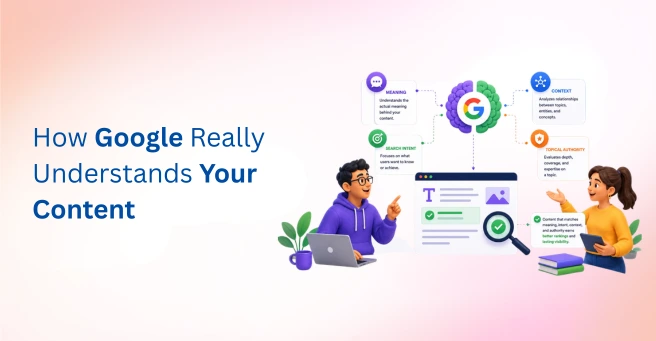
| Semantic SEO is the practice of optimising content around topics, meanings, and user intent rather than exact-match keywords alone. It helps Google understand the full context of a page by mapping semantic relationships between concepts, satisfying search intent, and building topical authority. Unlike traditional keyword-based SEO, semantic SEO aligns with Google’s natural language understanding algorithms, including BERT and MUM to deliver more relevant, contextually rich search results. |
Google processes over 8.5 billion searches every single day. And for most of those searches, it no longer just looks for a matching string of words, it tries to understand what the user actually means. That shift is the entire premise behind semantic SEO, and it is reshaping how smart marketers and content strategists approach organic search in 2026.
If you have been writing content around exact-match keywords and wondering why your rankings have plateaued, this blog is for you. The rules of search have fundamentally changed. Google has evolved from a simple keyword-matching engine into a sophisticated semantic search engine, one that evaluates context, intent, and topical relationships the way a human reader would.
In this semantic SEO guide, we break down exactly what is semantic SEO, why it matters for your rankings, and which semantic SEO techniques you can apply right now to create content that Google genuinely understands and rewards.
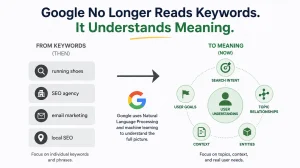
Image Source: AI-generated illustration
What Is Semantic SEO?
Semantic SEO is the practice of optimising your content around topics, meanings, and user intent rather than isolated keywords alone. Instead of asking ‘how many times have I used this keyword?’, semantic SEO asks a more intelligent question: ‘Does this content comprehensively cover the topic and genuinely satisfy what the user is looking for?’
The word ‘semantic’ comes from the study of meaning in language. Applied to search, semantic SEO meaning refers to the alignment between your content and the contextual relevance signals that search engines use to evaluate and rank pages. It is the bridge between how humans communicate naturally and how search engines interpret that communication.
Semantic SEO in SEO represents a fundamental departure from the old keyword-density playbook. Rather than optimising a single page for a single keyword, semantic SEO builds content ecosystems, interconnected pages that together demonstrate deep topical authority on a subject.
In practical terms, semantic SEO means:
- Writing content that answers the full spectrum of a user’s questions around a topic
- Using naturally related terms, synonyms, and co-occurring concepts, not just your target keyword
- Structuring your site so that Google can map your topical authority clearly
- Implementing structured data (schema markup) to help search engines understand entities and relationships
How Google Understands Content Semantically
To understand why semantic SEO matters, you need to understand how Google reads content today. It is a very different process from what it was even five years ago.
The Role of NLP and Google’s Core Algorithm Updates
Google’s shift to semantic understanding was powered by a series of landmark algorithm updates. The Hummingbird update (2013) was the first major signal. It introduced conversational search, allowing Google to interpret full queries rather than just matching individual words. RankBrain (2015) added machine learning to interpret unfamiliar queries using contextual understanding.
But the real breakthrough came with BERT (2019) and later MUM (2021). BERT – Bidirectional Encoder Representations from Transformers gave Google genuine natural language understanding. It reads sentences in both directions simultaneously, grasping context the way a human does. MUM (Multitask Unified Model) went further, processing information across languages, formats, and topics to answer complex search queries.
The result? Google today is a true semantic search engine. It evaluates semantic relationships between words, concepts, and entities on your page and compares that to the dominant search query intent it identifies for any given topic.
From Keywords to Concepts: How Google Builds Understanding
Google does not read your page in isolation. It reads it in the context of its vast Knowledge Graph. A database of billions of entities (people, places, organisations, concepts) and the relationships between them. When Google crawls your content, it attempts to map what you have written to entities and topics it already understands.
This means contextual search is fundamentally about co-occurrence. If you write about ‘marathon training’, Google expects to also see references to race nutrition, weekly mileage, injury prevention, tempo runs, and rest days. These co-occurring terms form the semantic fingerprint of a topically authoritative page. A page that only contains the phrase ‘marathon training’ repeated twelve times, without these related concepts, registers as thin and contextually shallow.
Traditional SEO vs Semantic SEO: A Direct Comparison
| Traditional SEO | Semantic SEO |
|---|---|
| Targets exact-match keywords | Targets topics and search intent |
| Optimises for keyword density | Optimises for topical depth and contextual relevance |
| One page per target keyword | Pillar pages with interconnected topic clusters |
| Reads pages in isolation | Maps content to Knowledge Graph entities |
| Limited use of structured data | Uses schema markup for entity and relationship clarity |
| Measures individual keyword rankings | Measures topical visibility across keyword clusters |
Why Semantic SEO Matters for Rankings
Understanding what is semantic SEO is one thing. Understanding why it is now non-negotiable for organic search performance is another.
Google’s Ranking Signals Have Shifted
Google has stated repeatedly that its systems evaluate content quality, relevance, and helpfulness over technical keyword placement. The Helpful Content System, rolled out across 2023 and 2024, specifically rewards content written for humans with genuine expertise, experience, and contextual richness. A solid semantic SEO strategy directly aligns with these criteria.
Voice Search and Conversational Queries
Over 27% of the global online population now uses voice search. Voice queries are inherently conversational, they reflect natural language patterns rather than keyword fragments. ‘What is the best way to treat a running knee injury?’ is how people speak to Google Assistant, not ‘knee injury running treatment’. Semantic search optimization is the only approach that reliably addresses this shift in search behaviour.
AI Overviews and SGE Favour Semantic Depth
Google’s AI Overviews (formerly Search Generative Experience) pull directly from content that demonstrates strong contextual understanding and topical authority. Pages that cover a topic with semantic depth, addressing related subtopics, answering follow-up questions, and structuring information clearly are significantly more likely to be sourced in AI-generated answers. Semantic optimization SEO is therefore now critical not just for traditional blue-link rankings, but for emerging AI search visibility.
E-E-A-T and Topical Authority
Google’s Quality Rater Guidelines place enormous weight on E-E-A-T – Experience, Expertise, Authoritativeness, and Trustworthiness. Semantic content optimization is the practical mechanism through which E-E-A-T is demonstrated at scale. When your site covers a topic cluster with depth, consistency, and accuracy, it signals to Google that you are a credible, authoritative source which directly influences how your pages are evaluated and ranked.
Core Semantic SEO Techniques to Implement
Knowing the theory is valuable. But what is semantic SEO worth without a clear action plan? Here are the six core semantic SEO techniques that should form the backbone of your content strategy.
| Semantic SEO Technique | Primary Goal |
|---|---|
| Topic Clusters | Build topical authority |
| Search Intent Optimisation | Match user expectations |
| Semantic Keywords | Improve contextual relevance |
| Schema Markup | Help Google understand entities |
| E-E-A-T Signals | Increase trust and expertise |
| Conversational Queries | Capture voice search traffic |
1. Build Topic Clusters and Pillar Pages
The topic cluster model is the structural foundation of any effective semantic SEO strategy. A pillar page provides broad, comprehensive coverage of a core topic for example, ‘Technical SEO’. Cluster pages dive deep into subtopics: crawlability, site speed, Core Web Vitals, structured data, and so on. Each cluster page links back to the pillar, and the pillar links out to each cluster.
Practical tip: Audit your existing content and map it to a cluster model before writing anything new. Fill gaps, update thin pages, and build internal links to reinforce the topical web.
2. Optimise for Search Intent & Not Just Keywords
Search query intent is the single most important signal in Google’s ranking evaluation. Every search query carries one of four primary intent types: informational (learning), navigational (finding a specific site), transactional (buying), or commercial investigation (comparing before buying). Your content must match that dominant intent or it will not rank, regardless of how well it is written.
Contextual search optimisation means auditing the top five results for your target keyword and identifying the intent pattern.
Practical tip: Use Google’s ‘People Also Ask’ and ‘Related Searches’ sections as a live map of the semantic territory around any keyword. Every PAA question is a subtopic your content should address.
3. Use LSI Keywords and Semantic Co-Occurrence
LSI (Latent Semantic Indexing) keywords are topically related terms that appear naturally alongside your primary keyword. They are not synonyms, they are the concepts and vocabulary that collectively define a topic’s semantic fingerprint. For a page about ’email marketing’, LSI terms would include open rates, segmentation, A/B testing, unsubscribe rates, drip campaigns, and deliverability.
Semantic content optimization means weaving these terms throughout your content naturally, not forcing them in, but writing with enough topical depth that they appear organically.
Practical tip: Avoid treating LSI keywords as a second keyword list to stuff. Write for humans first. If you cover the topic thoroughly, semantic co-occurrence happens naturally.
4. Implement Schema Markup for Entity Clarity
Structured data is the most direct way to communicate semantic information to Google. Schema markup, using the vocabulary from Schema.org, allows you to label the entities and relationships on your page explicitly, removing ambiguity and helping Google connect your content to its Knowledge Graph.
For a blog post optimised for semantic search, the minimum recommended schema types are Article, FAQPage, BreadcrumbList, and Author. For service pages, add LocalBusiness or Service schema. Each of these signals to the semantic search engine exactly what type of content it is reading and who produced it.
Practical tip: Always validate your schema with Google’s Rich Results Test before publishing. Invalid markup sends no signal and sometimes a negative one.
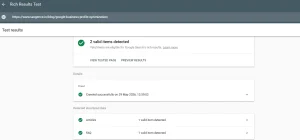
Image Source: Rich Results Test Screenshot
5. Establish E-E-A-T Signals Throughout Content
Google’s algorithms increasingly reward content that demonstrates genuine experience and expertise. This is where semantic SEO and E-E-A-T converge. Contextual understanding is not just about covering topics broadly, it is about covering them with the depth and accuracy that only comes from real expertise.
Practical E-E-A-T signals for semantic content optimization include: citing primary sources (Google Search Central, peer-reviewed research, government data), including author bios with verifiable credentials, adding original data or case study insights where possible, and ensuring factual accuracy on every claim.
Practical tip: Add an author byline to every blog post with a link to a detailed author bio page. This single change significantly strengthens E-E-A-T signals site-wide.
6. Optimise for Conversational and Long-Tail Queries
Natural language understanding in modern search means that long-tail, conversational queries are now a major source of organic traffic, often with higher conversion intent than head keywords. ‘What is semantic SEO and how do I use it for my ecommerce site?’ is a high-intent query that a purely keyword-focused strategy would miss entirely.
Practical tip: Use AnswerThePublic or AlsoAsked.com to map the full question landscape around your topic. Each question is a potential H3, a potential PAA box win, and a potential AI Overview citation.
How to Build a Semantic SEO Strategy: Step-by-Step
Ready to implement? Here is a practical seven-step semantic SEO strategy you can begin executing today.
1. Identify your core topics
List the 3–5 primary subject areas your business needs to own in search. For a digital marketing agency, these might be Technical SEO, Content Marketing, Google Ads, Local SEO, and Link Building.
2. Map your content to a pillar-cluster architecture
Assign each core topic a pillar page. Identify 5–10 subtopics for each pillar and create (or repurpose existing) cluster pages for each.
3. Research semantic terms using NLP-based tools
Use Surfer SEO, Frase, or Clearscope to identify the semantic vocabulary that top-ranking pages use for your target topics. Build this into your content briefs.
4. Rewrite or expand thin content with semantic content optimization
Audit pages under 800 words or with high bounce rates. Expand them with semantic depth: add FAQs, cover related subtopics, improve internal linking.
5. Add and validate schema markup on all key pages
Implement Article, FAQPage, BreadcrumbList, and entity-specific schema across your site. Validate everything with Google’s Rich Results Test.
6. Build internal links that reinforce semantic relationships
Every cluster page should link to its pillar. Related cluster pages should cross-link where topically relevant. Anchor text should use natural, descriptive language and not generic ‘click here’.
7. Run a semantic SEO audit quarterly
Track topical visibility, how many keywords in each cluster you rank for and not just your head keyword rankings. Tools like Semrush’s Topical Authority report and Ahrefs’ Content Gap tool are invaluable here.
Final Thoughts
The shift from keyword-based to meaning-based search is not a trend, it is the permanent architecture of modern information retrieval. Google has invested billions in natural language processing, entity understanding, and contextual search capabilities precisely because keyword matching was an inadequate proxy for relevance. Understanding what is semantic SEO and applying it systematically is now the baseline requirement for competitive organic visibility.
Tangence is a full-service digital marketing and SEO services agency helping brand build topical authority, improve organic visibility, and drive measurable results through data-driven, E-E-A-T optimised content strategies. From pillar page architecture and semantic content optimisation to schema markup implementation and quarterly SEO audits, the Tangence team delivers SEO that compounds.
Frequently Asked Questions
1. What is semantic SEO?
Semantic SEO is the process of optimising content around topics, context, and user intent rather than focusing only on exact-match keywords. It helps Google understand the meaning behind content and rank pages more accurately.
2. How is semantic SEO different from traditional SEO?
Traditional SEO targets specific keywords and keyword density, while semantic SEO focuses on topical authority, contextual relevance, and search intent. It helps pages rank for multiple related searches instead of a single keyword.
3. Why is semantic SEO important for rankings?
Google’s algorithms, including BERT and MUM, use natural language understanding to evaluate content quality and relevance. Semantic SEO improves visibility in Featured Snippets, AI Overviews, and voice search results.
4. What are the best semantic SEO techniques?
Effective techniques include building topic clusters, optimising for search intent, using semantic keywords naturally, implementing schema markup, and improving internal linking.
5. What tools are used for semantic SEO?
Popular semantic SEO tools include Surfer SEO, Clearscope, Frase, Semrush, Ahrefs, and Google’s People Also Ask feature for discovering related topics and search queries.
6. Does semantic SEO help with voice search?
Yes. Semantic SEO improves conversational content structure and natural language optimisation, making pages more likely to appear in voice search and AI-generated answers.
7. How long does semantic SEO take to show results?
Most websites start seeing measurable SEO improvements within 60–120 days, depending on competition, content quality, domain authority, and topical depth.