-01.svg)
-02.svg)
-03.svg)
-04.svg)
-05.svg)
-06.svg)
-07.svg)
-08.svg)
-09.svg)
-10.svg)
-11.svg)
-12.svg)
-13.svg)
-14.svg)






blog
How to Build a Topic Cluster from Scratch: A Step-by-Step Guide for Digital Marketers
| A topic cluster groups one broad pillar page with several focused cluster pages, connected through two-way internal links. HubSpot’s own research shows clustered sites see up to 43% more organic traffic than sites without one. To build a topic cluster, map keywords by intent, pick a pillar topic, list cluster subtopics, structure your URLs, interlink every page, optimize on-page SEO, and refresh the cluster every few months. |
Most websites don’t struggle because they publish too little content, they struggle because they publish content without a strategy. After a few hundred blog posts, organic traffic often plateaus, rankings become harder to improve, and new articles compete against existing ones instead of strengthening them.
The solution is a topic cluster strategy. By organizing related content around a central pillar page and connecting it with supporting cluster pages, you create a clear content ecosystem that search engines and AI-powered search platforms can easily understand. According to HubSpot, websites using topic clusters can see up to 43% more organic traffic than sites without them, while independent SEO studies consistently report gains of 30%–40% across industries.
In this guide, you will learn how to build a topic cluster from scratch using a proven seven-step framework. You will also discover real-world benchmark data, pillar page vs. cluster page comparisons, a sample keyword map, internal linking best practices, and the common mistakes that prevent websites from building topical authority. Whether you’re starting a new website or restructuring an existing blog, this guide will help you transform scattered content into a scalable content hub designed for long-term SEO growth and AI visibility.
What Is a Topic Cluster?
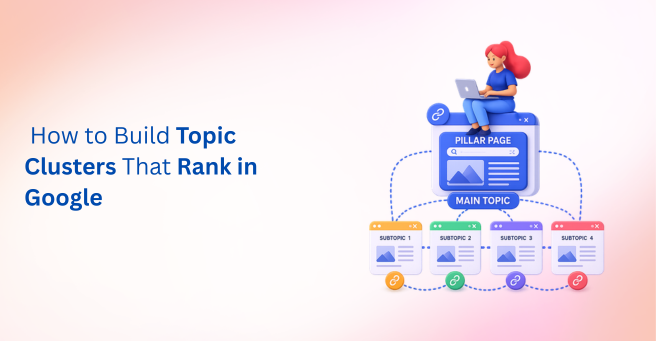
A topic cluster groups related web pages around one core subject. One central pillar page anchors the group, and several cluster pages support it. Each cluster page covers a narrower subtopic in depth.
Internal links tie every piece together. Cluster pages link back to the pillar page, and the pillar page links out to each cluster page in return. That two-way linking separates a real topic cluster from a random pile of blog posts.
Picture a bicycle wheel. The pillar page forms the hub, and each cluster page acts as a spoke. Internal links hold the wheel together. Remove the spokes, and the hub loses its support, a pillar page works the same way without cluster content behind it.
This model creates a content hub, reinforces content hierarchy, and strengthens website architecture. Search engines also get a clear map of your silo structure instead of a scattered list of unrelated URLs.
| Attribute | Pillar Page | Cluster Page |
| Scope | Broad, overview-level | Narrow, one specific subtopic |
| Typical length | 2,500–4,000 words | 1,200–2,500 words |
| Search intent | Broad informational | Specific informational or transactional |
| Keyword target | Head term (e.g., “topic cluster”) | Long-tail (e.g., “how to build a topic cluster”) |
| Linking role | Hub – links to every cluster page | Spoke – links back to the pillar page |
| Update cadence | Every 3–6 months | As new questions emerge |
Why Topic Clusters Matter for SEO in 2026
Search engines no longer rank pages in isolation. They rank sites on topical authority, how completely a domain covers a subject.
This shift rewards structure over sheer volume. Twenty interlinked articles covering one subject from different angles often outrank a single long guide, even when that guide reads well on its own. Isolated content struggles to rank, no matter how well it’s written. Structure is what search engines and AI systems reward.
Semantic SEO plays a role too. Modern algorithms understand meaning and relationships between concepts, not just exact keyword matches. Grouping related content around one entity reinforces entity SEO signals and helps search engines classify your site’s expertise correctly.
AI visibility adds a newer layer. AI Overviews and chat-based assistants pull answers from clearly structured, well-linked content. Marketers now call this practice Generative Engine Optimization, or GEO. A tightly connected content hub gives AI systems the context they need to trust and cite your pages.
How to Build a Topic Cluster From Scratch:- Step-by-Step Process
Here’s exactly how to build a topic cluster, from initial research through long-term maintenance.
Step 1: Conduct Keyword Research and Search Intent Analysis
Start by mapping every keyword connected to your core subject. This process is called keyword mapping, and it forms the foundation of the entire cluster.
Group similar terms through keyword clustering so you don’t build overlapping content later. Check search intent for every keyword, too. Informational queries need educational content, while transactional queries need product or service pages instead.
Google Search Console shows what your site already ranks for. Ahrefs and SEMrush reveal gaps competitors haven’t covered yet. Combine both tools for accurate content planning.
| Pillar Keyword | Sample Cluster Keyword | Search Intent |
| topic cluster | how to build a topic cluster | Informational |
| topic cluster | topic cluster examples | Informational |
| topic cluster | pillar page vs. cluster page | Informational |
| topic cluster | content cluster tools | Commercial investigation |
| topic cluster | topic cluster template | Informational / transactional |
Step 2: Choose Your Pillar Topic
Pick a theme with strong search volume and clear business relevance. It needs enough depth to support eight to twelve cluster pages.
Avoid picking something too broad. A term like “marketing” can’t work as a pillar topic; it’s too vague to rank for. Avoid picking something too narrow, a topic that only supports two or three subtopics won’t sustain a full cluster.
Aim for the middle ground instead. Email marketing automation works well. So does topic cluster SEO. Both are specific enough to own, yet broad enough to expand.
Step 3: Identify Cluster Subtopics
Break the pillar into long-tail, specific subtopics. Each one should answer a single, clear question.
Focus on information gain here. Cover an angle, data point, or example that competing pages miss. Thin, repetitive cluster pages dilute topical authority instead of building it.
List every subtopic before writing, then check for overlap. Two cluster pages targeting the same keyword will compete against each other instead of supporting the pillar page.
Step 4: Map Out Website Taxonomy and Content Hierarchy
Plan your URL structure before publishing. A clean silo structure looks like this: /topic-name/pillar-page/ and /topic-name/cluster-page/.
This structure reinforces content hierarchy across the entire site. It also makes the relationship between pages obvious to both users and crawlers.
Update your navigation and category pages, too. A cluster page buried three clicks deep loses crawl priority, even with strong internal links pointing to it.
Step 5: Build Internal Linking Between Pillar and Cluster Pages
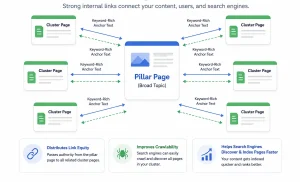
Link every cluster page back to the pillar page. Use descriptive, keyword-relevant anchor text instead of generic phrases like “click here.”
Link the pillar page out to every cluster page in return. This bidirectional internal linking distributes link equity evenly across the group.
Strong internal linking also improves crawlability. Search engines discover and index new cluster pages faster when an established pillar page already links to them directly.
Step 6: Optimize Each Piece for On-Page SEO
Write a unique title tag and meta description for every page. Keep header tags logical, with one H1 followed by properly nested H2s and H3s.
Add schema markup where it applies. FAQ schema, article schema, and breadcrumb schema all help search engines parse the content correctly.
Treat every page as part of a larger content ecosystem. No single post should compete against another page on your own site.
Step 7: Measure, Update, and Expand the Cluster
Track rankings, traffic, and engagement for each page in the cluster. Google Search Console and GA4 both work well for this.
Refresh outdated cluster pages every six months. Add new subtopics as search behavior shifts and new questions emerge.
Topic clusters aren’t a one-time project. They compound in value the longer you maintain them.
Common Mistakes to Avoid When Building Topic Clusters
| Mistake | Why It Hurts Rankings | How to Fix It |
| Thin cluster content | No information gain over pages already ranking | Add data, examples, or original insight |
| Search intent mismatch | Pillar and cluster pages confuse users and crawlers | Match content format to the query’s intent |
| Weak internal linking | Orphaned pages and poor crawlability | Link every cluster page both ways |
| Keyword cannibalization | Pages compete against each other in search results | Assign one target keyword per page |
| Publish-and-forget | Rankings decay as competitors update their content | Refresh cluster pages every 3–6 months |
Topic Clusters vs. Traditional Blog Structure
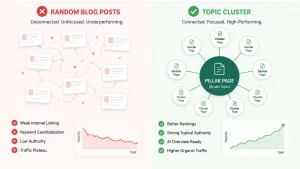
A traditional blog typically consists of standalone articles that are published over time with little strategic connection between them. While individual posts may rank for specific keywords, inconsistent internal linking and overlapping topics often lead to keyword cannibalization and make it difficult for search engines to understand the site’s overall expertise.
A topic cluster strategy takes a different approach. Instead of treating every article as an isolated asset, it organizes content around a central pillar page supported by multiple related cluster pages. Every page has a clear purpose and is connected through structured, bidirectional internal links, creating a logical content hierarchy that reinforces topical authority.
This structured approach offers several SEO advantages. It minimizes content overlap by assigning a unique keyword and search intent to each page, distributes link equity more effectively through internal linking, and helps search engines crawl and understand your content more efficiently. As a result, websites using topic clusters often experience more consistent organic growth. HubSpot reports that businesses implementing topic clusters can achieve up to 43% higher organic traffic, while independent agency studies have observed similar improvements. In addition, recent AI visibility research suggests that well-structured topic clusters are approximately 3.2 times more likely to be cited in AI Overviews and other AI-powered search experiences than standalone blog posts.
In short, a traditional blog focuses on publishing individual articles, whereas a topic cluster strategy builds an interconnected content ecosystem that improves rankings, strengthens topical authority, and delivers sustainable long-term organic growth.
Conclusion
Learning how to build a topic cluster isn’t a one-off task. It’s a long-term investment in topical authority and sustainable organic rankings. Every step, from keyword mapping to internal linking, adds another layer to your content ecosystem.
Tangence offers end to end digital marketing and SEO services for businesses that want expert execution instead of guesswork. Its services span topic cluster strategy, entity SEO, and semantic SEO frameworks tailored to real business goals. Whether you’re starting from scratch or restructuring an existing site, Tangence’s SEO services can turn a scattered blog into a genuine content hub built for long-term growth.
Frequently Asked Questions
1. What is a topic cluster in SEO?
A topic cluster in SEO is a group of related pages built around one pillar page and several cluster pages, connected through internal linking. This structure signals topical authority to search engines and improves organic rankings across the entire group.
2. How do I choose a pillar page topic?
Choose a pillar topic with strong search volume, clear business relevance, and enough depth to support eight to twelve cluster pages. It should feel broad enough to introduce the subject, yet specific enough to establish real subject authority.
3. How many cluster pages should a pillar page have?
Most effective topic clusters include eight to twelve cluster pages per pillar, though this depends on the subject’s size. Prioritize topic relevance and information gain over hitting an exact number.
4. What is the difference between a topic cluster and a content silo?
A silo structure organizes content into separate categories with limited cross-linking. A topic cluster actively interlinks pillar and cluster pages in both directions, which makes it more flexible and better suited to semantic SEO.
5. How does internal linking impact topic clusters?
Internal linking connects cluster pages to the pillar page and back again, distributing link equity across the group. Without it, search engines struggle to understand how pages relate, which weakens the entire content ecosystem.
6. Can topic clusters improve AI or LLM visibility (GEO)?
Yes. Well-structured topic clusters give AI systems clear contextual signals about a site’s subject authority. Research from 2026 puts AI citation rates for clustered content at roughly 3.2 times higher than standalone posts.
7. How long does it take to see SEO results from topic clusters?
Most sites see measurable ranking and crawlability improvements within 60 to 90 days. Full topical authority typically builds over 6 to 12 months, as the cluster expands and internal linking matures.