-01.svg)
-02.svg)
-03.svg)
-04.svg)
-05.svg)
-06.svg)
-07.svg)
-08.svg)
-09.svg)
-10.svg)
-11.svg)
-12.svg)
-13.svg)
-14.svg)






blog
Silo Structure SEO: Organizing Content with Internal Links

Modern SEO is no longer just about publishing blog posts consistently. It’s about building authority around topics in a structured, intentional way. Many websites create great content but fail to rank because their content lacks organization. Pages compete with each other. Internal links are random. Google struggles to understand which page should rank.
This is where silo structure SEO becomes essential.
A well-planned internal linking and content hierarchy strategy helps search engines understand topic relationships, distribute link equity effectively, and establish topical authority. When implemented correctly, silo structuring transforms scattered content into a powerful ranking ecosystem.
What Is Silo Structure SEO?
Silo structure SEO is a strategic website architecture method that organizes content into tightly themed categories and connects related pages through intentional internal linking.
Think of your website as a library.
Instead of placing books randomly across shelves, you arrange them by subject:
- SEO
- Paid Ads
- Social Media
- Email Marketing
Here is an example of a website architecture hierarchy showing how content is organized into structured silos from the homepage to specific SEO subtopics.
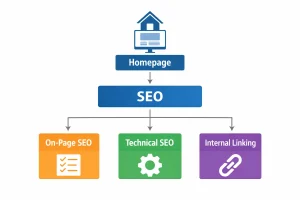
Image Source: Custom graphic created.
Within the SEO section, you further break topics down into focused areas:
- On-page SEO
- Technical SEO
- Link Building
- Internal Linking
Each category becomes a dedicated content silo built around a core topic. Pages inside the same silo are interlinked more frequently than pages outside that group. This structured linking pattern signals strong contextual relationships to search engines.
As a result, Google can better understand topic depth, relevance, and authority, helping improve crawl efficiency, prevent keyword cannibalization, and strengthen overall rankings through a clearly defined content hierarchy.
Types of Silo Structures
There are three primary approaches:
| Silo Type | How It’s Structured | SEO Advantage | Best For |
|---|---|---|---|
| Physical Silo | Organized using clear URL hierarchy | Strong hierarchy signals to search engines | Large structured websites |
| Virtual Silo | Built through internal linking only | Flexible implementation | Existing sites without URL restructuring |
| Hybrid Silo | Combines URLs + strategic internal links | Maximum crawl clarity and topical authority | Modern SEO strategies |
Why Silo Structure SEO Matters for Rankings
Google evaluates websites based on topical authority and contextual relationships.
When your internal linking structure is random, you dilute authority signals. But when you use silo structure SEO correctly, you send clear signals about topic depth and expertise.
Here’s how it impacts rankings:
1. Improves Crawlability
Search engines follow links. A structured hierarchy reduces crawl depth and ensures important pages are indexed quickly.
2. Distributes Link Equity Strategically
Internal links pass authority. A silo funnels link equity from supporting pages to pillar pages.
3. Builds Topical Authority
When multiple pages cover related subtopics and link together, Google sees expertise.
4. Reduces Keyword Cannibalization
Clear hierarchy defines which page targets which keyword.
5. Enhances User Experience
Users find related content easily, increasing dwell time and reducing bounce rates.
Search engines reward clarity. Silo architecture provides that clarity.
How Silo Structure SEO Builds Topical Authority
Topical authority is built when your site demonstrates depth around a subject.
Instead of writing 50 unrelated blog posts, silo structure SEO encourages you to:
- Create one comprehensive pillar page
- Publish multiple supporting articles
- Interlink them strategically
The Role of Pillar Pages
A pillar page is a long-form, authoritative guide covering a broad topic.
For example:
Pillar: “Complete Guide to SEO”
Supporting Articles:
- On-page SEO checklist
- Technical SEO audit guide
- Internal linking strategies
- Link building fundamentals
Each supporting article links back to the pillar page, reinforcing its importance.
Supporting Content and Subtopics
Supporting content targets long-tail keywords like:
- how to organize website content for SEO
- internal linking best practices
- SEO site architecture guide
These pages link vertically (child → parent) and horizontally (within the same silo).
The result? A tightly connected network that strengthens topical relevance.
Step-by-Step Guide to Implementing Silo Structure SEO
Now let’s build your structure.
Step 1: Perform Keyword Research by Topic Clusters
Instead of researching isolated keywords, group them by themes.
Here is an example of Technical SEO keyword clustering showing how related subtopics strengthen topical authority within a structured content silo.
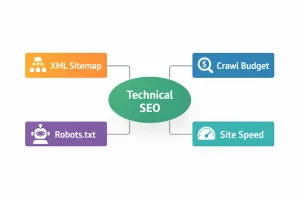
Image Source: Custom graphic created.
Example:
Main Topic: Technical SEO
Subtopics:
- XML sitemap optimization
- Crawl budget management
- Robots.txt best practices
- Site speed optimization
Cluster keywords based on intent:
- Informational
- Commercial
- Transactional
This prevents content overlap and keyword cannibalization.
Step 2: Design the Website Architecture
Map categories and subcategories before publishing.
Best practices:
- Keep important pages within 3 clicks from homepage
- Use breadcrumb navigation
- Maintain logical URL hierarchy
A clean structure supports effective silo structure SEO.
Step 3: Create a Comprehensive Pillar Page
Your pillar page should:
- Be 2000+ words
- Cover the topic broadly
- Include internal links to subtopics
- Target high-volume head keywords
It acts as the authority anchor of the silo.
Step 4: Build Supporting Articles
Each supporting page should:
- Target one specific long-tail keyword
- Add depth to the main topic
- Link back to the pillar
- Link to related pages within the same silo
Avoid linking excessively to unrelated topics. Cross-silo linking weakens thematic clarity.
Step 5: Implement Strategic Internal Linking
Internal linking is the backbone of silo structure SEO.
Types of linking:
- Vertical linking (pillar ↔ subpages)
- Horizontal linking (related subpages)
- Controlled cross-linking (only when contextually necessary)
Anchor text should be natural and descriptive. Avoid repetitive exact-match anchors.
Best Practices for Internal Linking in Silo Structure SEO
Internal linking is not just about quantity, it is about relevance, context, and strategic authority flow.
| Best Practice | Why It Matters |
|---|---|
| Contextual linking | Improves relevance signals |
| Anchor diversity | Avoids over-optimization |
| Avoid orphan pages | Ensures full indexation |
| Controlled link volume | Preserves link equity |
| High pillar accessibility | Strengthens authority flow |
1. Use Contextual Links
Insert links naturally within the body content where they genuinely add value. Contextual links help search engines understand relationships between pages and improve user navigation.
2. Maintain Anchor Text Diversity
Use:
Partial match anchors
Branded anchors
Generic anchors when appropriate
A varied anchor profile prevents over-optimization and keeps your internal linking pattern natural.
3. Avoid Orphan Pages
Ensure every page receives at least one internal link. Orphan pages are harder to crawl and often struggle to rank.
4. Control Link Volume
Adding too many links on a single page can dilute authority signals. Prioritize relevance over volume.
5. Keep Important Pages High in Hierarchy
Pillar pages should be easily accessible and not buried deep within your site structure.
Well-executed silo structure SEO depends on disciplined, intentional linking patterns. Industry research on internal linking best practices consistently shows that contextual links improve ranking stability.
Silo Structure SEO vs Topic Clusters: Are They the Same?
The terms are often used interchangeably but they are not identical.
Silo Structure SEO emphasizes website architecture, clear hierarchy, and controlled internal linking patterns that define topic boundaries.
Topic Clusters focus primarily on grouping related content around a central pillar page to strengthen semantic relevance and depth.
Modern SEO strategies combine both approaches:
- Structured URL hierarchy
- Pillar and supporting cluster content
- Strong, context-driven internal linking
When integrated correctly, this hybrid model enhances topical authority, improves crawl efficiency, and provides clearer contextual signals to search engines for sustainable rankings.
Tools to Build and Audit Your Silo Structure
To ensure your structure is optimized, use:
1. Screaming Frog
- Crawl depth analysis
- Internal link mapping
2. Ahrefs
- Internal backlink report
- Anchor text distribution
3. Google Search Console
- Index coverage
- Internal linking report
4. SEMrush Site Audit
- Crawl errors
- Structural issues
5. Visual Sitemap Tools
- Architecture planning
- Hierarchy visualization
Regular audits maintain structure integrity.
Measuring the Success of Your Silo Structure SEO
| Metric | What It Indicates |
| Keyword Rankings by Cluster | Shows whether individual silos are gaining topical authority and improving visibility for target keywords. |
| Organic Traffic Growth per Category | Measures how well each content silo attracts search traffic over time. |
| Crawl Stats | Indicates how efficiently search engines are discovering and indexing your structured content. |
| Time on Page | Reflects user engagement and content relevance within each silo. |
| Pages per Session | Demonstrates how effectively internal linking guides users through related content. |
| Internal Link Count Distribution | Reveals whether link equity is evenly and strategically distributed across important pages. |
Improvement across these metrics signals strong topical consolidation and effective silo implementation. You can monitor structural performance using the Google Search Console internal links report to evaluate link distribution across pages.
Future of Silo Structure SEO
Search engines are rapidly evolving toward entity-based indexing and AI-driven contextual understanding. Algorithms now evaluate how well content pieces connect within a broader topical framework rather than ranking isolated pages.
Future-proof strategies include:
- Semantic keyword coverage
- Structured data markup
- Clear content relationships
- Context-driven internal linking
Covering related entities and LSI keywords and semantic SEO principles strengthens contextual depth within each content silo. As AI systems become better at interpreting topical depth and entity relationships, structured architecture will play an even larger role in rankings. Silo structure SEO will move from being a best practice to a necessity. Websites that demonstrate organized expertise, logical hierarchy, and strong contextual linking will build sustainable authority and consistently outperform competitors in search visibility.
Common Mistakes That Break Your Silo Structure SEO
| Mistake | Why It Hurts SEO |
|---|---|
| Over-Linking Across Silos | Confuses search engines about topical boundaries and weakens thematic relevance. |
| Thin Supporting Content | Low-quality subpages reduce the authority of the entire silo. |
| Duplicate Categories | Multiple pages targeting the same topic create keyword cannibalization. |
| Poor URL Structure | Disorganized or messy URLs weaken hierarchy and contextual signals. |
| Ignoring Search Intent | Pages that don’t match distinct intent struggle to rank effectively. |
Signs your structure needs improvement:
- Rankings fluctuate frequently
- Pages compete for same keywords
- Crawl depth exceeds 4–5 clicks
- Internal link distribution is uneven
Fixing architecture often unlocks ranking potential without new backlinks.
Conclusion
Content alone does not rank. Structure does. Without a clear hierarchy and intentional internal linking, even great content struggles to perform. Implementing silo structure SEO transforms your website from a collection of isolated pages into a powerful topical authority engine.
At Tangence, we specialize in designing scalable SEO architectures that leverage silo structure frameworks, advanced internal linking strategies, and data-driven optimization. Our SEO services combine technical audits, content clustering, enterprise-level architecture planning, and measurable performance tracking to help brands dominate their niche.
If your website content feels scattered or underperforming, restructuring your internal links might be the breakthrough your SEO strategy needs.
Frequently Asked Questions
1. What is silo structure SEO in simple terms?
It’s a way of organizing website content into themed groups and connecting them with strategic internal links to improve rankings and topical authority.
2. How does silo structure SEO improve website rankings?
It improves crawlability, distributes link equity efficiently, strengthens topical signals, and prevents keyword cannibalization.
3. What is the difference between a content silo and topic cluster?
A content silo focuses on architectural hierarchy and internal linking, while topic clusters emphasize semantic grouping. Most modern SEO strategies combine both.
4. How many internal links should be in a silo structure?
There’s no fixed number. Focus on relevance. Typically, 3–8 contextual links per 1000 words work well when placed naturally.
5. Can silo structure SEO work for small websites?
Yes. In fact, smaller websites benefit greatly because they can build authority faster with structured content planning.
6. How long does it take to see results from silo structuring?
Depending on crawl frequency and domain authority, improvements can appear within 4–12 weeks after restructuring and reindexing.
7. What tools can help audit silo structure SEO?
Screaming Frog, Ahrefs, SEMrush, and Google Search Console are highly effective for analyzing internal link structure and crawl depth.