-01.svg) SEO Services
SEO Services-02.svg) Local SEO Services
Local SEO Services-03.svg) AI SEO Services
AI SEO Services-04.svg) Technical SEO Services
Technical SEO Services-05.svg) Performance Marketing
Performance Marketing-06.svg) Social Media
Social Media-07.svg) Content Marketing
Content Marketing-08.svg) Web Development
Web Development-09.svg) App Development
App Development-10.svg) Marketing Automation
Marketing Automation-11.svg) Real Estate
Real Estate-12.svg) Ecommerce
Ecommerce-13.svg) Education
Education-14.svg) Healthcare
Healthcare B2B
B2B SAAS
SAASblog
What Is llms.txt? Does It Actually Help Your SEO and AI Visibility in 2026?
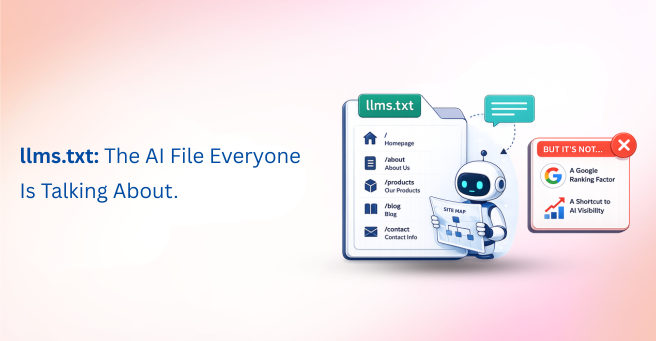
| llms.txt is a plain-text Markdown file placed at a website’s root domain that gives AI crawlers and large language models a clean, curated summary of a site’s key pages and purpose. It is not an official web standard, and Google has confirmed it does not affect Search rankings, AI Overviews, or AI Mode. Its real value lies in helping AI coding agents and developer tools navigate documentation-heavy sites more efficiently. |
If you have noticed more website owners talking about a new file sitting quietly at the root of their domain, you have probably wondered: what is llms.txt, and should your website have one? As artificial intelligence continues to reshape how people discover information online, website owners are looking for new ways to make their content easier for AI systems to understand.
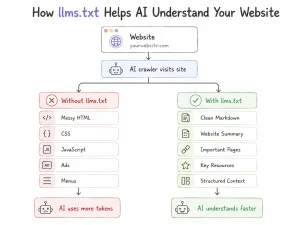
One of the latest developments is llms.txt, a simple Markdown file designed to give AI crawlers and large language models a clear, structured overview of a website instead of forcing them to navigate complex HTML, scripts, menus, and other unnecessary elements.
Although it may seem like a minor technical addition, llms.txt has become a popular topic in discussions around AI visibility, Generative Engine Optimization (GEO), Answer Engine Optimization (AEO), and the future of search in 2026.
However, there is also a great deal of confusion surrounding its purpose. Some believe it can improve Google rankings or boost visibility in AI Overviews, while others dismiss it as unnecessary. The truth lies somewhere in between.
In this guide, you will learn what is llms.txt, why it was created, how it differs from robots.txt and XML sitemaps, what Google has officially said about it, and whether implementing it is actually worth your time.
What Is llms.txt?
So, what is llms.txt at its core? It is a community-proposed Markdown file, introduced by Answer.AI’s Jeremy Howard in September 2024, designed to help large language models understand a website faster. Unlike a regular webpage, it strips away navigation menus, cookie banners, scripts, and ads, leaving only a short, structured summary of what a site offers and where its most important pages live.
The file is served at the domain root, for example yoursite.com/llms.txt, in a similar spirit to robots.txt or an XML sitemap. It typically opens with an H1 title, a short summary blockquote, and then a series of H2 sections linking out to key pages such as documentation, product pages, or core service offerings.
There is also a companion format called llms-full.txt, which contains a much deeper, full-content version of a site in one Markdown document. Most regular business websites only need the basic version; documentation-heavy SaaS products tend to benefit from maintaining both.
One important clarification before going further: llms.txt explained correctly is not a ratified web standard. It has no IETF approval, no enforcement mechanism, and no formal obligation on any platform to read it. It is best understood as an emerging convention, not a rule that AI systems must follow.
llms.txt vs robots.txt vs XML Sitemap vs Schema Markup
Here is a quick side-by-side comparison of the key files and signals website owners often confuse with one another:
| Feature | llms.txt | robots.txt | XML Sitemap | Schema Markup |
|---|---|---|---|---|
| Primary purpose | Helps AI understand important pages | Controls crawler access | Lists pages for discovery | Explains page meaning |
| Format | Markdown | Plain text | XML | JSON-LD |
| Used by Google Ranking | No | Crawl control | URL discovery | Rich Results & AI |
| Used by AI Agents | Yes | Partial | Limited | Yes |
| Best for | AI readability | Crawl management | Indexing | Entity understanding |
Why llms.txt Was Created
The original problem was simple: when an AI agent fetches a webpage, it receives raw HTML filled with structural noise, menus, footers, scripts, and tracking code. For systems working inside a fixed context window, that noise crowds out the content that actually matters. llms.txt for AI was proposed as a token-efficient fix, giving agents a short, clean index instead of a cluttered page.
Does Google Actually Use llms.txt for SEO?
This is the question most people searching “what is llms.txt” actually want answered. As of Google’s own May 2026 guidance on optimizing for generative AI features, the answer is direct: Google Search does not use llms.txt for ranking, AI Overviews, or AI Mode.
Google’s Search Relations team, including Gary Illyes and John Mueller, has confirmed this on record, with Mueller comparing llms.txt to the long-abandoned keywords meta tag, a signal site owners once relied on that search engines simply stopped using.
There is a nuance worth understanding here. llms.txt files do get crawled and occasionally indexed by Google, which is why some show up in a site: search. But being crawled is not the same as being used as a ranking or AI citation signal. For llms.txt for SEO purposes specifically, the honest, evidence-based answer in 2026 is that it offers no confirmed ranking benefit.
What About AI Overviews and AI Mode?
Google’s generative AI optimization documentation groups llms.txt alongside content chunking and AI-specific rewriting as tactics that do not move the needle for AI Overviews or AI Mode. What actually drives AI visibility on Google’s surfaces is far less novel: structured data, schema markup, entity SEO, semantic SEO, and genuine topical authority built through consistent, well-organized content.
How to Create llms.txt: A Step-by-Step Guide
Understanding how to create llms.txt is straightforward once the structure is clear. Here is the practical process:
| Step | Action |
|---|---|
| Step 1 | Create a Markdown (.md) file |
| Step 2 | Add H1 title |
| Step 3 | Write a short website summary |
| Step 4 | Organize important pages under H2 headings |
| Step 5 | Upload to /llms.txt |
| Step 6 | Test the URL |
| Step 7 | Keep it updated |
Step 1. Understand the required Markdown structure: an H1 title, a short summary blockquote, and H2 sections linking to your most important pages.
Step 2. Decide whether you need a basic llms.txt or the deeper llms-full.txt for content-heavy documentation.
Step 3. Prioritise pages thoughtfully: key docs, product or service pages, and your about/contact page, not your entire sitemap.
Step 4. Save the file as plain Markdown and upload it to your domain root (yoursite.com/llms.txt).
Step 5. Optionally submit the URL via Google Search Console, then monitor server logs for AI crawler activity from bots like GPTBot, ClaudeBot, and PerplexityBot.
Step 6. Pair it with strong technical SEO fundamentals:- a clean robots.txt, an updated XML sitemap, and proper schema markup so it supports your AI indexing efforts rather than standing alone.
If you are on WordPress, both Yoast SEO and Rank Math now generate llms.txt automatically from your published content, which makes implementation a matter of minutes rather than hours.
Where llms.txt Actually Helps: AI Agents and GEO
None of this means llms.txt is worthless, it simply operates in a different layer than traditional search. The clearest, best-documented use case is developer and agent tooling. Coding assistants such as Cursor, GitHub Copilot, Claude Code, Cline, and Windsurf routinely fetch /llms.txt when pointed at a documentation site, using it to identify relevant pages without wasting tokens crawling an entire site.
Chrome’s Lighthouse 13.3 update, released in May 2026, added an “Agentic Browsing” audit category that checks whether a site provides llms.txt, a forward-looking signal tied to browser agents rather than classic search rankings. This is where llms.txt for AI starts to matter: not for Google’s ranking algorithm, but for the growing ecosystem of agents that read and act on web content directly.
This is also where the broader discipline of Generative Engine Optimization, or GEO, and answer engine optimization come in. GEO is concerned with how content gets cited, summarised, or surfaced inside AI-generated answers across platforms like ChatGPT, Perplexity, Gemini, and Claude. llms.txt is one small, low-cost tactic inside that larger strategy and not a replacement for it.
It can also play a minor supporting role in retrieval augmented generation workflows, where AI systems pull external content to ground their answers; a clean, well-structured llms.txt can reduce friction during that retrieval step, even if it does not guarantee a citation.
Adoption data backs up this cautious framing. Independent studies have found llms.txt adoption sitting around 10% of analysed domains, and most major AI providers including OpenAI and Google have not formally committed to treating it as a production signal.
The realistic verdict: low implementation cost, uncertain payoff for search, and situational upside for sites with genuine agent or developer traffic.
Who Should Actually Create One?
| Website Type | Should You Use llms.txt? | Reason |
|---|---|---|
| SaaS | Yes | Helps AI agents navigate documentation |
| API Documentation | Yes | Better context for coding assistants |
| Developer Tools | Yes | Frequently accessed by AI agents |
| Large Ecommerce | Optional | Limited proven benefit |
| Local Business Website | Low Priority | Technical SEO has higher ROI |
| Blog Website | Optional | Nice to have but not essential |
Smaller local or service businesses with little to no agent-driven traffic will usually see a better return from investing in core technical SEO, content discoverability, and topical authority instead.
llms.txt and the Bigger Picture of AI Discoverability
To understand llms.txt properly, you need to view it within the broader AI discoverability landscape. It serves as one small, low-cost technical signal rather than a complete SEO strategy. Brands earn AI citations by combining multiple best practices, not by relying on a single file. Strong AI visibility comes from entity-focused content, schema markup, topical authority, and a trusted presence on platforms like Reddit, YouTube, and Wikipedia.
Many businesses make the mistake of treating llms.txt as a shortcut to AI visibility. In reality, successful brands focus on long-term fundamentals. They publish original, experience-driven content, maintain strong technical SEO, and monitor how AI platforms cite their content over time. These efforts deliver far greater results than any standalone technical implementation.
Conclusion
So, what is llms.txt, and does it deserve your attention in 2026? It is a simple, low-cost Markdown file that helps AI agents understand your website more efficiently. However, Google does not use it as a ranking signal for Search, AI Overviews, or AI Mode.
If you want lasting AI visibility, focus on the fundamentals. Build strong technical SEO, implement structured data, strengthen your entity signals, and develop topical authority. Think of llms.txt as a supporting enhancement rather than a complete AI SEO strategy.
If you are unsure how llms.txt fits into your broader SEO strategy, Tangence can help. As a full-service digital marketing and SEO services agency, Tangence helps combines technical SEO, structured data, entity optimization, and content strategy to improve visibility across both traditional search and AI-powered discovery platforms. Instead of chasing every new trend, we build a strong technical and content foundation that supports sustainable growth.
Frequently Asked Questions
1. What is llms.txt in simple terms?
llms.txt is a Markdown file that sits in your website’s root directory. It provides AI systems and large language models with a clear summary of your site’s purpose and most important pages.
2. Does llms.txt improve Google rankings?
No. Google has confirmed that llms.txt does not influence Search rankings, AI Overviews, or AI Mode.
3. Is llms.txt the same as robots.txt?
No. robots.txt controls crawler access to your website, while llms.txt provides AI systems with a curated summary of your content. One manages access, and the other improves content understanding.
4. Do ChatGPT, Claude, and Perplexity use llms.txt?
Support varies across platforms. AI coding assistants and developer tools currently offer the strongest documented support. Consumer AI search engines have not confirmed consistent production use.
5. How do I create an llms.txt file for my website?
Create a Markdown file with an H1 heading, a short website summary, and links to your most important pages. Upload the file to your domain root. If you use WordPress, plugins like Yoast SEO and Rank Math can generate it automatically.
6. Is llms.txt worth implementing in 2026?
Yes, because it is simple to implement and carries very little risk. However, you should not expect direct ranking improvements. It offers the greatest value for websites that receive AI agent or developer traffic.
7. What is the difference between llms.txt and llms-full.txt?
llms.txt contains a concise summary with links to important pages. llms-full.txt includes a consolidated version of a website’s content for deeper AI processing. Documentation-heavy SaaS products benefit the most from the full version.