-01.svg)
-02.svg)
-03.svg)
-04.svg)
-05.svg)
-06.svg)
-07.svg)
-08.svg)
-09.svg)
-10.svg)
-11.svg)
-12.svg)
-13.svg)
-14.svg)






blog
How to Build Topical Authority: The SEO Advantage That Builds Trust and Rankings
| Topical authority is built by consistently publishing in-depth, well-linked content that covers a subject from every angle and not just by targeting individual keywords. To build topical authority, start with comprehensive topic research, organize content into pillar pages and topic clusters connected through internal linking, prioritize content depth over volume, and reinforce E-E-A-T through accurate, experience-backed content. |
Imagine publishing fifty blog posts a year, yet your rankings barely move. You are not alone in this, it is one of the most common frustrations digital marketers face today. Search engines have evolved far beyond simple keyword matching. They now reward websites that demonstrate deep, consistent expertise on a subject, rather than scattered posts chasing individual keywords. This is exactly why understanding how to build topical authority has become essential for modern SEO success.
Topical authority is not a shortcut or a one-time trick; it is the foundation of sustainable, compounding rankings. In this blog, we will break down what topical authority means, why semantic SEO and search intent matter more than ever, and the practical, repeatable steps you can follow to turn your website into a trusted, authoritative source that both users and search engines rely on.
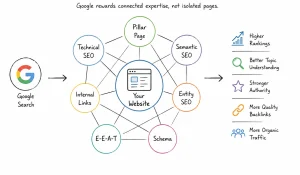
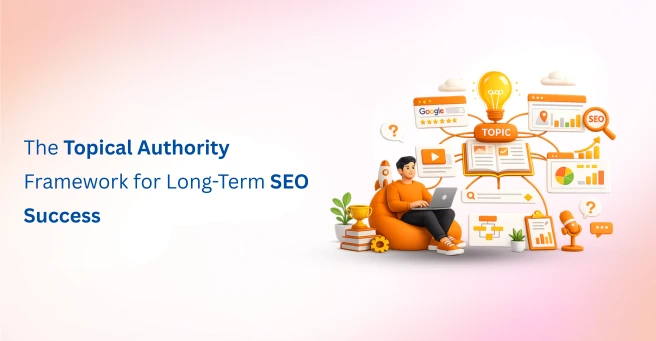
Image Source: Created using AI.
What Is Topical Authority and Why Does It Matter?
Topical authority is the level of trust search engines place in a website as a comprehensive, reliable source on a specific subject. It is different from simply ranking for one keyword. A site with strong topical authority SEO ranks for dozens, even hundreds, of related queries because it covers a subject from every meaningful angle and not just the most obvious or highest-volume search term.
Modern algorithms like BERT and MUM no longer rely purely on exact keyword matches. They evaluate semantic SEO signals, context, and topic relevance to understand what a page is really about, how it relates to other pages on the same site, and whether it genuinely answers the underlying question a user is asking. Google’s knowledge graph also plays a role here, mapping entities like people, places, brands, concepts and the relationships between them. This is where entity SEO comes in: it helps Google recognise your brand or website as a credible entity connected to a specific subject, almost the way a human expert would be recognised within their field.
Topical authority did not emerge overnight. It grew out of Google’s long-running effort to move from a ‘strings’ model of search, where pages were matched to literal keyword strings, to a ‘things’ model, where pages are matched to real-world concepts and entities. Every major update since Hummingbird has pushed search further in this direction, which is exactly why content strategies built purely around keyword density have steadily lost ground to strategies built around comprehensive topic coverage.
- Improves rankings across multiple related keywords, not just one
- Builds long-term trust signals with search engines and readers
- Reduces dependency on chasing single, highly competitive keywords
- Increases resilience against algorithm updates that penalise thin content
How to Build Topical Authority: A Step-by-Step Framework
Building real authority around a subject takes structure, not guesswork. Below is a practical, repeatable framework on how to build topical authority that works for blogs, service pages, and entire content ecosystems, regardless of industry or website size.
1. Start With Comprehensive Topic Research
Before writing a single article, map out your core subject and every related subtopic. This is where keyword clustering becomes valuable, grouping similar search terms together so you can plan content that covers a topic completely rather than in fragments. Always study the search intent behind each query: is the user looking for information, comparing options, or ready to take action? Skipping this step is one of the most common reasons content plans fail to build any real topical expertise.
A useful exercise here is to list every question a genuine beginner, an intermediate user, and an industry expert might ask about your subject. This single exercise alone often reveals dozens of subtopics that competitors have never covered, giving you a realistic roadmap for the next six to twelve months of content rather than a list of disconnected blog ideas.
| Tool | Purpose |
|---|---|
| Google Search Console | Identify content gaps and existing opportunities |
| Ahrefs / SEMrush | Build keyword clusters and topic maps |
| AnswerThePublic | Discover user questions and FAQs |
| Google Trends | Identify seasonal and emerging topics |
2. Build a Topic Cluster and Pillar Content Structure
Pillar content is a broad, in-depth guide that introduces a subject fully. Topic clusters are the supporting articles that dive into specific subtopics and link back to that pillar page. This hub-and-spoke structure, connected through strong internal linking, signals to search engines that your website offers genuine content depth rather than scattered, disconnected posts.
In practice, a pillar page rarely tries to answer every question in full detail. Instead, it gives a confident, complete overview and then hands off to cluster pages for the granular detail. For example, a pillar page titled ‘The Complete Guide to SEO’ might briefly introduce technical SEO, on-page SEO, and link building, while dedicated cluster articles go deep on each of those areas individually. Done well, a reader can start at the pillar page and navigate through an entire learning path without ever leaving your site, which is itself a strong engagement and trust signal.
3. Prioritize Content Depth Over Content Volume
Ten thoroughly researched articles will consistently outperform fifty shallow ones. Content depth means addressing a topic from beginner, intermediate, and expert-level angles within your overall content ecosystem. Answering related ‘people also ask’ questions inside your articles is one of the simplest ways to demonstrate topical expertise.
A practical way to test depth before publishing is to ask whether the article could stand in for a knowledgeable colleague answering the question in person. If a reader still has to search elsewhere for basic follow-up questions, the article has not gone deep enough. Depth also means anticipating objections and edge cases, pricing concerns, common misconceptions, regional differences, or industry-specific exceptions, rather than only covering the textbook version of a topic.
4. Strengthen E-E-A-T Across Your Content
E-E-A-T stands for Experience, Expertise, Authoritativeness, and Trustworthiness. These four pillars guide how Google evaluates content quality, especially for topics that affect a reader’s health, finances, or wellbeing.
| E-E-A-T Pillar | How to Strengthen It |
|---|---|
| Experience | Share first-hand insights, case studies, and real-world examples. |
| Expertise | Publish accurate, well-researched content with author credentials. |
| Authoritativeness | Earn quality backlinks, brand mentions, and industry citations. |
| Trustworthiness | Keep content accurate, cite reliable sources, secure your website, and update content regularly. |
Together, these signals act as trust signals and authority signals that tell Google your website deserves to rank for an entire subject, not just one keyword. Many sites focus only on backlinks while ignoring experience and trustworthiness but Google increasingly cross-checks all four pillars together, especially for YMYL (Your Money or Your Life) topics like health, finance, and law. A single strong article rarely fixes a weak E-E-A-T profile; it has to be reinforced consistently across the entire content ecosystem, including author pages, about pages, and policy pages.
5. Optimize for Semantic SEO and Entity Relationships
Write naturally using related terms, synonyms, and contextual phrases instead of repeating one exact keyword. Structured data, such as Article, FAQPage, and LocalBusiness schema, helps search engines understand topic relevance and entity relationships more clearly, reinforcing your place within Google’s knowledge graph.
Semantic SEO also means thinking beyond your own website. Linking out to authoritative external sources, referencing recognised industry terminology correctly, and ensuring your brand is consistently named and described across the web all strengthen the entity profile that Google associates with your content. Over time, this consistency is what allows a brand name itself to start carrying search-engine trust, independent of any single page.
6. Maintain and Update Your Content Ecosystem
Topical authority is not a one-time project. Regularly audit older content, merge thin pages, refresh outdated statistics, and fix broken internal linking. A well-maintained content ecosystem keeps compounding its SEO value year after year, while a neglected one slowly loses both rankings and credibility as competitors publish fresher, more complete coverage.
A realistic maintenance cadence is a quarterly content audit: identify pages that have dropped in rankings or traffic, check whether the information is still accurate, and decide whether to update, merge, or retire each page. This single habit prevents topical authority from eroding silently over time.
Benefits of Building Topical Authority for SEO and Branding
Businesses that invest consistently in building topical authority see compounding returns well beyond rankings alone. Once a content ecosystem reaches a critical mass of well-linked, in-depth pages, new articles tend to rank faster because the surrounding cluster already signals topic relevance to search engines.
| Benefit | Impact |
|---|---|
| Improved Rankings | Ranks for a broader range of related keywords |
| Increased Organic Traffic | Drives visitors through long-tail and semantic searches |
| Stronger Brand Recognition | Establishes your brand as a trusted industry resource |
| Better User Engagement | Improves engagement with comprehensive, valuable content |
| Natural Backlink Growth | Earns quality backlinks through content depth and credibility |
| Algorithm Resilience | Maintains rankings during updates targeting thin or low-quality content |
Perhaps the most underrated benefit is sales and lead-quality improvement: readers who arrive through a comprehensive content ecosystem tend to be further along in their decision-making process, having already absorbed your perspective on the subject across multiple touchpoints before they ever speak with your team.
Topical Authority and the Future of Search: AI Visibility and GEO
Search is no longer limited to the traditional results page. AI Overviews, ChatGPT, and Perplexity now pull answers directly from sources they consider topically authoritative. This growing field is often called GEO, or Generative Engine Optimization, the practice of structuring content so AI tools are more likely to cite it.
Strong AI visibility depends heavily on the same fundamentals: topical expertise, clear structure, and well-connected internal linking. Websites that have already built genuine topical authority SEO are simply better positioned to be referenced by these generative engines as they continue to shape how people search.
It is worth noting that GEO does not replace traditional SEO, it builds on top of it. The same pillar content, topic clusters, and structured data that help you rank in classic search results also make your content easier for AI systems to parse, summarize, and cite. Content that is clearly organised under descriptive headings, with direct answers near the top of each section, tends to be quoted more often by AI Overviews than content that buries the answer inside long, unstructured paragraphs. In other words, investing in topical authority today is also an investment in staying visible as search itself continues to change.
Common Mistakes That Weaken Topical Authority
Even well-intentioned content strategies can undermine topical authority if a few structural mistakes go unchecked. The table below outlines the most frequent ones.
| Common Mistake | Impact on SEO |
|---|---|
| No Internal Linking | Weakens topic clusters and page authority |
| Ignoring Search Intent | Reduces relevance, engagement, and rankings |
| Thin or Duplicate Content | Dilutes topical authority and confuses search engines |
| No Schema Markup | Limits entity recognition and AI visibility |
| Outdated Content | Reduces trust and freshness signals |
| Inconsistent Publishing | Slows topical authority growth |
Conclusion
Topical authority is the long-term SEO strategy that ties together content depth, semantic relevance, and trust signals into one cohesive approach. Learning how to build topical authority is not a one-time tactic, it is a sustained content and internal linking strategy that pays off for years. Businesses that take this seriously, both for classic search and emerging AI-driven search, need a structured, expert-backed content approach to stay ahead.
This is exactly where Tangence can help. As a full-service SEO and digital marketing agency, Tangence specializes in building topic clusters, pillar content, and E-E-A-T-optimized content ecosystems designed to drive sustainable, long-term rankings. From in-depth keyword clustering and content audits to technical SEO and schema implementation, Tangence’s SEO services are built to turn scattered content into a genuine topical authority.
Frequently Asked Questions
1. What is topical authority in SEO?
Topical authority is the trust search engines place in a website that covers a subject comprehensively. Instead of focusing on a single keyword, authoritative websites publish well-structured, interconnected content that answers related user queries and demonstrates expertise.
2. How long does it take to build topical authority?
Building topical authority typically takes 3–6 months, depending on your niche, content quality, publishing consistency, competition, and internal linking strategy. Competitive industries may require more time to establish authority.
3. What is the difference between topical authority and domain authority?
Topical authority measures expertise in a specific subject, while domain authority reflects the overall strength of a website based largely on backlinks. A website can have strong topical authority in one niche without having a high domain authority.
4. How do topic clusters help build topical authority?
Topic clusters connect a pillar page with multiple related articles through internal links. This structure helps search engines understand your expertise on a subject while improving user navigation and content discoverability.
5. Does topical authority improve AI search visibility?
Yes. AI search engines and Google AI Overviews prefer content from websites that demonstrate expertise, clear structure, and comprehensive topic coverage. Strong topical authority increases the likelihood of being referenced in AI-generated answers.
6. Why is internal linking important for topical authority?
Internal linking connects related pages, helping search engines understand relationships between topics. It also distributes page authority, strengthens topic clusters, and improves the user experience by guiding visitors to relevant content.
7. Can small businesses build topical authority?
Absolutely. Small businesses can build topical authority by focusing on a specific niche, publishing high-quality content consistently, creating topic clusters, and maintaining strong internal linking. A focused content strategy often outperforms large volumes of generic content.