-01.svg)
-02.svg)
-03.svg)
-04.svg)
-05.svg)
-06.svg)
-07.svg)
-08.svg)
-09.svg)
-10.svg)
-11.svg)
-12.svg)
-13.svg)
-14.svg)






blog
Trust Signals in SEO: What Makes Google Trust Your Website?
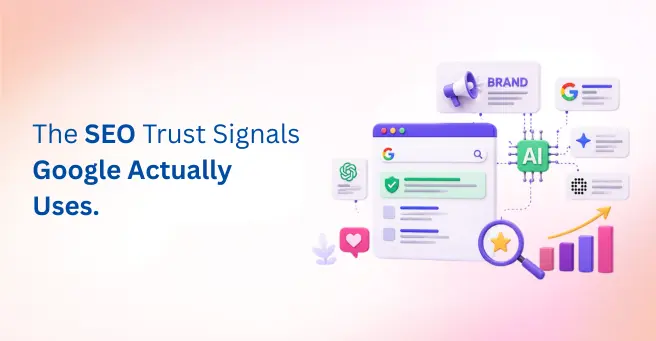
| Trust signals in SEO are on-page, off-page, and technical cues that help Google evaluate a website’s credibility, authority, and safety. Key trust signals include HTTPS security, E-E-A-T (Experience, Expertise, Authoritativeness, Trustworthiness), high-quality backlinks, named author bios, structured data markup, Core Web Vitals performance, and positive online reviews. Websites that consistently demonstrate these signals earn higher rankings, stronger click-through rates, and more sustainable search visibility. |
Why do two websites covering identical topics rank so differently on Google? The answer often has nothing to do with word count or keyword density. It comes down to one thing: trust. Google has become remarkably sophisticated at distinguishing credible, authoritative websites from low-quality ones and it rewards the former with better rankings.
Trust signals in SEO are the on-page, off-page, and technical cues that tell Google your website is safe, reliable, and genuinely valuable to users. They work quietly in the background, but their impact on your search visibility is anything but subtle. Whether you run a healthcare portal, an e-commerce store, or a B2B service company, understanding these signals is essential for sustainable ranking performance.
This guide breaks down every major category of trust signals in SEO from E-E-A-T content standards to backlink authority, technical security, and user behavior so you can audit your site and build credibility that Google recognises and rewards.
What Are Trust Signals in SEO?
Trust signals in SEO are measurable indicators that help search engines assess how credible, authoritative, and user-safe a website is. Google does not rely on a single “trust score.” Instead, its algorithm aggregates hundreds of individual signals across multiple dimensions to form a holistic picture of a site’s quality.
These signals fall into three broad categories:
| Trust Signal Type | What It Includes | Why It Matters |
|---|---|---|
| On-Page Trust Signals | Content quality, author bios, internal linking, headings | Helps Google evaluate topical credibility |
| Off-Page Trust Signals | Backlinks, brand mentions, reviews | Builds authority and reputation |
| Technical Trust Signals | HTTPS, Core Web Vitals, schema markup | Improves security, crawlability, and UX |
Together, these trust signals form the foundation of how Google evaluates your website and how consistently it chooses to rank your pages over competitors. Ignoring even one category can create vulnerabilities in your overall SEO health.
E-E-A-T: Google’s Official Trust Framework
No discussion of trust signals in SEO is complete without E-E-A-T. It stands for Experience, Expertise, Authoritativeness, and Trustworthiness and it is the framework Google’s Quality Raters use to manually evaluate websites across the web. While E-E-A-T itself is not a direct ranking algorithm, it heavily influences the updates and refinements that Google makes to its core systems.
Breaking Down Each Pillar
- Experience: Does the content creator have first-hand, real-world experience with the topic? Google now explicitly rewards original insights over recycled summaries.
- Expertise: Is the author demonstrably knowledgeable? Credentials, professional background, and publication history all contribute.
- Authoritativeness: Is the website a recognised source in its niche? Third-party citations, mentions, and backlinks signal authority.
- Trustworthiness: Is the site transparent, secure, and accurate? This is the most critical pillar, Google’s own documentation states that trust is the central pillar of E-E-A-T.
How to Demonstrate E-E-A-T on Your Website
Translating E-E-A-T into actionable website improvements means focusing on:
- Publishing content under named authors who have verifiable credentials and professional profiles.
- Including detailed author bios that link to LinkedIn profiles, published work, or industry certifications.
- Adding an About page that explains who runs the site, your team’s expertise, and your editorial process.
- Citing authoritative external sources such as government publications, peer-reviewed research, and established industry reports.
- Including original data, case studies, or first-hand perspectives that only a genuine expert could produce.
E-E-A-T matters most in YMYL (Your Money or Your Life) niches like healthcare, finance, legal, and safety. If your website operates in any of these spaces, E-E-A-T optimisation is non-negotiable.
Backlinks: The Backbone of Off-Page Trust
Since Google’s earliest days, backlinks have been a primary trust signal in SEO. A link from another website to yours is effectively a third-party endorsement. But not all endorsements carry equal weigh and Google has grown increasingly sophisticated at distinguishing authoritative links from manipulative ones.
Why Link Quality Matters More Than Quantity
A single backlink from a high-authority publication in your niche – a DR 80+ industry journal, a respected news outlet, or a leading educational institution carries more trust weight than 200 links from low-quality, unrelated directories. Google evaluates links on several dimensions:
| Backlink Factor | Good Signal | Bad Signal |
|---|---|---|
| Relevance | Link from same industry | Random unrelated site |
| Authority | Trusted publication or DR 70+ site | Spammy directory |
| Anchor Text | Natural branded anchors | Exact-match keyword stuffing |
| Placement | Editorial body content | Footer/sidebar links |
How to Build Trust-Signalling Backlinks
Earning high-quality backlinks that genuinely build website credibility for SEO requires a strategic approach:
- Contribute expert commentary through digital PR and platforms like HARO (Help a Reporter Out) or Connectively.
- Publish original research, surveys, or industry reports that other sites will naturally cite and link to.
- Guest post on niche-relevant publications with genuine editorial oversight, not link farm networks.
- Create linkable assets: comprehensive guides, data visualisations, free tools, and authoritative resource lists.
- Build relationships with industry journalists, bloggers, and podcast hosts who cover your space.
Off-page trust signals in SEO extend beyond just links. Unlinked brand mentions where publications reference your brand name without hyperlinking, are also processed by Google as soft authority signals. Monitoring and cultivating these mentions through brand tracking tools is an underutilised trust-building strategy.
On-Page Trust Signals Google Actually Evaluates
On-page trust signals are the elements within your own website that Google’s crawlers and quality systems evaluate directly. Getting these right is foundational, no amount of external link building compensates for weak on-page trust.
Content Quality and Topical Depth
Google rewards content that fully satisfies search intent with depth and accuracy. Thin content, duplicate content, and keyword-stuffed pages actively erode trust. High-quality content that builds on-page trust includes:
- Clear, well-structured writing that directly answers the user’s query without padding.
- Updated publication and revision dates that show content is actively maintained.
- Original statistics, expert quotes, and proprietary insights rather than regurgitated information.
- Logical heading structure (H1 > H2 > H3) that helps both users and crawlers navigate the content hierarchy.
Author Transparency and Bio Signals
Anonymous content is a significant trust liability. Google’s systems and quality raters look for clear author attribution on every key page. Best practices include:
- Displaying the author’s full name on every article or service page.
- Linking to a dedicated author profile page with credentials, published work, and professional links.
- Implementing Author schema markup so Google can associate content with a verified author entity.
Internal Linking Architecture
A well-planned internal link structure demonstrates to Google that your website has genuine topical depth and not isolated content islands. The pillar-cluster model is the most effective architecture:
- Pillar pages: Comprehensive guides covering broad topics (e.g., “The Complete Guide to SEO”).
- Cluster pages: Detailed posts on specific subtopics that link back to the pillar (e.g., “Trust Signals in SEO”, “Keyword Research”, “Technical SEO Audit”).
This architecture tells Google you’re an authority on an entire topic and not just a single keyword, which is one of the most powerful on-page trust signals in SEO strategy.
Technical Trust Signals: The Foundation Layer
Technical trust signals are often invisible to users but are among the clearest quality indicators for Google’s crawlers. A technically sound website signals professionalism, security, and commitment to user experience.
HTTPS and Site Security
HTTPS is a confirmed Google ranking signal, introduced as a lightweight factor in 2014 and progressively weighted since. Beyond its ranking impact, HTTPS and website trust are intertwined from a user perspective: browsers label HTTP sites as “Not Secure,” which directly increases bounce rates, another negative signal Google tracks.
Every website in 2026 should have:
- A valid SSL certificate from a trusted certificate authority.
- All HTTP URLs permanently redirected (301) to HTTPS equivalents.
- Mixed content issues resolved, no HTTP resources loaded on HTTPS pages.
Core Web Vitals and Page Experience
Google’s Page Experience update made Core Web Vitals an official ranking consideration. These metrics, Largest Contentful Paint (LCP), Interaction to Next Paint (INP), and Cumulative Layout Shift (CLS) – measure how fast and stable your pages feel to real users.
| Metric | Ideal Score | What It Measures |
|---|---|---|
| LCP (Largest Contentful Paint) | Under 2.5s | Loading speed |
| INP (Interaction to Next Paint) | Under 200ms | Responsiveness |
| CLS (Cumulative Layout Shift) | Under 0.1 | Visual stability |
Structured Data and Schema Markup
Structured data removes ambiguity. When you implement schema markup, you directly tell Google what your page is, what your organisation does, and what your content contains. Key schemas for building trust include:
- Organization schema: Confirms your brand identity, logo, contact details, and social profiles.
- Article schema: Associates content with an author, publication date, and headline.
- Review schema: Surfaces star ratings in SERPs, increasing click-through and perceived credibility.
- FAQ schema: Earns rich result placement for question-based content, like this very blog.
These technical trust signals in SEO may be invisible to users, but they speak directly to how Google crawls, understands, and evaluates your site. Neglecting them leaves significant ranking potential untapped.
User Behavior Signals: What Your Visitors Tell Google
Google has access to enormous amounts of behavioral data from Chrome, Google Search, and Android devices. How real users interact with your site after clicking a search result is one of the most honest signals of quality and Google knows it. Google Search Central regularly publishes guidance on creating people-first content that prioritizes user satisfaction over search engine manipulation.
Key user behavior signals Google tracks include:
- Dwell time: The time a user spends on your page before returning to the SERP. Longer dwell time indicates the content satisfied the query.
- Bounce rate: A high bounce rate on informational pages can signal that content failed to meet user expectations.
- Click-through rate (CTR): If your page earns a higher CTR than expected for its position, Google may interpret your title and meta description as highly relevant and reward you with higher rankings.
- Pogo-sticking: When a user clicks your result, immediately returns to the SERPs, and clicks a competitor’s link instead, this is a clear relevance failure signal.
- Branded search volume: When users search your brand name directly, Google interprets this as a signal of awareness, reputation, and trust.
To improve user behavior signals, focus on three things: write titles and meta descriptions that accurately match the content (to prevent disappointed clicks), structure content with clear headings and quick answers for scanners, and make the first 100 words of every page immediately compelling and useful.
Brand Signals and Online Reputation
Brand signals are among the most underrated trust signals in SEO, especially for local and service businesses. Google increasingly uses brand strength as a proxy for trustworthiness, drawing on signals across the open web.
- Unlinked brand mentions: When established publications reference your brand name without a hyperlink, Google’s systems process these as soft authority signals through its entity recognition technology.
- NAP consistency: For local businesses, consistent Name, Address, and Phone information across Google Business Profile, directories, and your website is a fundamental local trust signal.
- Online reviews: Review velocity, sentiment, and response rate on platforms like Google Business Profile, Trustpilot, and G2 all contribute to perceived authority. Actively responding to reviews signals engagement and accountability.
- Social media presence: Verified profiles on major platforms, consistent content, and genuine audience engagement reinforce brand legitimacy in Google’s entity graph.
- Knowledge Panel presence: Earning a Google Knowledge Panel is one of the strongest brand trust signals available, it means Google has classified your brand as a recognised entity.
Trust Signals SEO Audit Checklist
Use this checklist to quickly identify gaps in your website’s trust profile:
| Area | Trust Signal |
|---|---|
| Security | HTTPS enabled |
| Content | Expert-written pages |
| Technical SEO | Fast Core Web Vitals |
| Authority | High-quality backlinks |
| Local SEO | Consistent NAP details |
| Brand | Positive online reviews |
| Structured Data | Schema markup implemented |
Conclusion
Trust signals in SEO operate across four interconnected layers – content quality, technical health, off-page authority, and user behavior. Strengthening only one layer while ignoring the others creates an unstable ranking foundation. Google’s algorithms are designed to reward websites that demonstrate genuine credibility comprehensively and consistently over time.
The important thing to remember is that Google doesn’t trust websites because they ask for it, it trusts websites that prove their worth through consistent signals, transparent practices, and genuine value delivery to real users. Every trust signal in SEO you optimise today is a long-term ranking asset for tomorrow.
Building trust signals systematically requires expertise, strategy, and consistent execution which is exactly what Tangence specialises in. As a full-service digital marketing and SEO sevices agency, Tangence helps businesses across industries strengthen their website’s credibility through comprehensive technical SEO audits, E-E-A-T content strategy, authoritative link building, and structured data implementation.
Frequently Asked Questions
Q1. What are trust signals in SEO?
Trust signals in SEO are on-page, off-page, and technical cues that help search engines like Google determine whether a website is credible, authoritative, and safe for users. They include factors such as HTTPS security, backlink quality, author expertise, E-E-A-T indicators, and user behavior metrics.
Q2. Does Google have an official trust score for websites?
No, Google does not use a single composite trust score. Instead, its algorithm aggregates hundreds of individual trust signals, including backlink quality, E-E-A-T indicators, HTTPS status, site speed, and user engagement metrics to assess overall website quality holistically.
Q3. How does E-E-A-T relate to trust signals in SEO?
E-E-A-T (Experience, Expertise, Authoritativeness, Trustworthiness) is Google’s quality evaluation framework and is directly tied to trust signals. Sites that demonstrate real first-hand experience, verifiable expertise, third-party authority endorsements, and transparent editorial practices rank more consistently and recover more quickly after algorithm updates.
Q4. Is HTTPS really a Google ranking factor?
Yes. Google confirmed HTTPS as a ranking signal in 2014 and it continues to function as a baseline technical trust signal. Beyond ranking, sites without HTTPS are marked as ‘Not Secure’ in Chrome browsers, which significantly damages user trust, increases bounce rates, and negatively impacts conversion rates.
Q5. How long does it take to build strong trust signals for SEO?
Trust signals accumulate at different rates. Technical signals such as HTTPS and structured data can be implemented within days. On-page E-E-A-T improvements take weeks to be re-crawled and evaluated. Domain authority through backlink acquisition and brand signal development typically requires six to twelve months of consistent effort to produce measurable ranking impact.
Q6. Can a brand new website build strong trust signals quickly?
Yes, to a meaningful degree. New websites can accelerate trust-building by publishing expert content under credentialed named authors, earning a handful of high-quality backlinks from day one, implementing comprehensive structured data, maintaining strong technical SEO from launch, and building an active Google Business Profile with early reviews.
Q7. Do social media signals count as trust signals in SEO?
Indirectly. Social media activity does not directly influence Google rankings as a confirmed ranking factor. However, verified brand profiles, consistent content engagement, and social sharing drive referral traffic, increase branded search volume, and reinforce your brand entity in Google’s knowledge graph, all of which positively correlate with trust and rankings over time.