-01.svg)
-02.svg)
-03.svg)
-04.svg)
-05.svg)
-06.svg)
-07.svg)
-08.svg)
-09.svg)
-10.svg)
-11.svg)
-12.svg)
-13.svg)
-14.svg)






blog
What Is Agentic AI SEO? A Beginner’s Guide to the Future of SEO
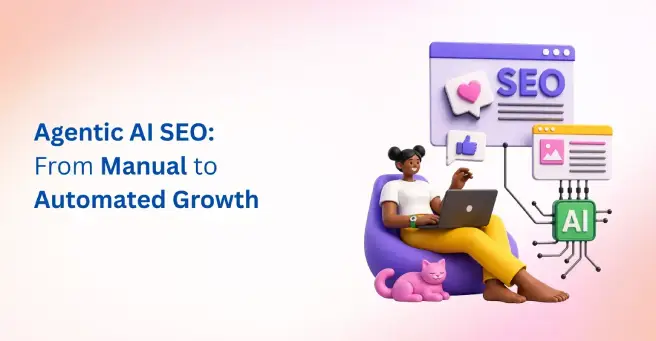
SEO has always evolved but nothing has changed the game quite like agentic AI SEO. Just a few years ago, optimizing a website meant hours of manual keyword research, competitor analysis, and content audits. Today, intelligent AI systems are taking over those tasks and going much further.
If you have ever felt overwhelmed by the sheer volume of SEO tasks on your plate, you are not alone. Most marketers and business owners struggle to keep up with algorithm updates, content gaps, and technical issues simultaneously. That is exactly the problem agentic AI is designed to solve.
In this beginner’s guide, we will break down what agentic AI SEO is, how it works, why it matters for your business, and how you can start leveraging it. Whether you run a startup or manage SEO for an established brand, this guide will help you stay ahead of the curve.
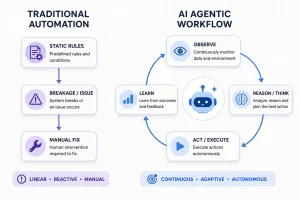
Image Source: AI-generated illustration
What Is Agentic AI?
Agentic AI refers to artificial intelligence systems that can set their own sub-goals, take multi-step actions, and self-correct, all without constant human instruction at every stage. Unlike traditional AI tools that respond to a single prompt and stop, agentic AI operates in a continuous loop: plan, act, evaluate, and iterate.
| Think of traditional AI as a calculator, it does exactly what you tell it, nothing more. Agentic AI is more like a virtual employee who understands the end goal, figures out the steps to get there, and adjusts course when something does not work. |
You have likely already seen early versions of this in tools like AutoGPT, OpenAI’s GPT-4 with function calling, or even Google’s AI Overviews. These systems do not just answer a question they take action, retrieve data, and combine multiple reasoning steps to produce a result.
In the context of digital marketing, this shift is enormous. It means autonomous SEO tools can now perform complex, multi-layered tasks that previously required a dedicated team of specialists.
What Is Agentic AI SEO?
Agentic AI SEO is the application of agentic AI systems to search engine optimisation tasks where the AI autonomously handles processes like keyword research, content gap analysis, technical site audits, internal linking, and performance monitoring, all with minimal human intervention.
It is important to distinguish this from the AI SEO tools most marketers already use. Tools like Semrush, Ahrefs, or SurferSEO are powerful but they assist humans in making decisions. They surface data, suggest improvements, and generate reports. You still need to act on them.
Agentic AI SEO is different. It does not just recommend, it executes. An agentic system given the goal of “improve organic traffic for this blog section” will crawl your site, analyse the SERPs, identify keyword gaps, draft content briefs, flag technical issues, and track the results, all on its own.
This represents a fundamental change in how SEO work gets done, shifting from a human-led, tool-assisted process to an AI-led, human-supervised one. For agencies, in-house teams, and small businesses alike, this shift has major implications for speed, scale, and cost-efficiency. As search continues to evolve, Google’s generative AI search updates are reshaping how users discover and interact with content, making AI-driven results more prominent than ever.
How Does Agentic AI SEO Actually Work?
Understanding the mechanics helps you appreciate both the power and the limitations of this technology. Here is a simplified breakdown of how a typical agentic AI SEO workflow operates.
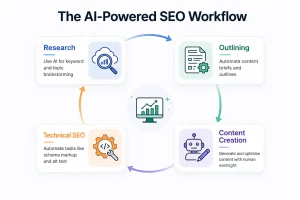
Image Source: AI-generated illustration
Step 1 – Goal Setting and Site Crawling
It starts with a goal. You (or a system administrator) give the agent a directive: for example, “Increase organic traffic to the /blog section by targeting informational keywords in the healthcare space.” The agent then crawls your website and the search engine results pages (SERPs) to establish a baseline, understanding your current content, existing rankings, and the competitive landscape.
Step 2 – Data Analysis and Gap Identification
This is where machine learning SEO capabilities really shine. The agent processes enormous volumes of data simultaneously: competitor page structures, backlink profiles, keyword difficulty scores, content depth, Core Web Vitals, and more. It identifies gaps your human team might overlook, thin content, cannibalised keywords, missed long-tail opportunities, and pages with high potential but poor optimisation.
Step 3 – Action Execution
This is the defining step of AI search optimization, the agent does not just flag issues, it acts. Depending on its access level, it may draft content briefs for writers, generate structured data markup, suggest (or implement) internal linking changes, and initiate outreach sequences for link building. The agent handles tasks that would normally consume hours of specialist time.
Step 4 – Self-Evaluation and Iteration
After execution, the agent monitors outcomes. Did the updated page improve in rankings? Did bounce rate improve? Or did organic clicks increase? Based on these signals, it refines its approach. This is how agentic AI improves search rankings over time, not through a single optimisation, but through a continuous feedback loop that evolves with your site and the algorithm.
Top Benefits of Agentic AI SEO for Businesses
The business case for adopting agentic AI in your SEO strategy is compelling. Here are the most significant advantages:
| Benefit | Impact on Business |
|---|---|
| Time Saving | Tasks done in minutes instead of days |
| Reduced Errors | Data-driven decisions minimize mistakes |
| Scalability | Optimize thousands of pages simultaneously |
| Faster Adaptation | Quickly responds to Google updates |
| Smarter Keyword Strategy | Identifies semantic keyword clusters |
| Cost Efficiency | Reduces dependency on large teams |
Taken together, these advantages make agentic AI SEO one of the most efficient investments a business can make in its digital marketing strategy right now.
Real-World Use Cases of Agentic AI SEO
Agentic AI is not a hypothetical future technology, it is already being applied across industries. Here is how different types of businesses are using it today:
E-Commerce
Large online retailers use agentic AI to auto-optimise thousands of product pages based on seasonal search trends, inventory changes, and competitor pricing. Instead of manually updating meta titles and descriptions at scale, agents handle it continuously.
Healthcare and Medical
Medical websites which fall under Google’s strict YMYL (Your Money or Your Life) guidelines use AI agents to identify content gaps and ensure pages meet AI-powered SEO and EEAT compliance standards. Agents flag outdated medical information and suggest updates aligned with current guidelines.
SaaS Companies
Software companies use agentic AI for programmatic SEO at scale, generating and optimising hundreds of targeted landing pages autonomously, each tailored to a specific keyword cluster or user persona.
Local Businesses
Local service businesses use agents to monitor local pack rankings, track competitor Google Business Profile changes, and auto-update their own local SEO signals in near real-time.
Content Marketing Teams
Content teams use agentic AI SEO tools to generate detailed content briefs informed by live SERP analysis, ensuring writers have everything they need to produce high-ranking articles without the team needing to conduct manual research each time.
Challenges You Should Know Before Adopting Agentic AI SEO
In the interest of giving you a complete and honest picture, it is important to address the real limitations and risks of agentic AI in SEO.
| Challenge | What It Means |
|---|---|
| Over-automation Risk | AI may make wrong decisions without guardrails |
| Content Quality | Needs human review for accuracy and tone |
| Data Privacy | Requires access to sensitive SEO data |
| Setup Complexity | Not plug-and-play; needs strategy |
| Unpredictability | Can behave unexpectedly in edge cases |
The key takeaway is that agentic AI is a force multiplier for skilled SEO professionals, not a replacement for them. Used with the right oversight, it dramatically improves output. Used carelessly, it can create new problems.
Agentic AI SEO vs. Traditional SEO: What Is the Difference?
To understand just how significant this shift is, here is a direct comparison of the two approaches:
| Feature | Traditional SEO | Agentic AI SEO |
|---|---|---|
| Execution | Manual | Autonomous |
| Speed | Slow | Fast |
| Scalability | Limited | High |
| Optimization | Periodic | Continuous |
| Adaptability | Reactive | Proactive |
| Cost | Higher long-term | More efficient |
Unlike traditional methods that react to problems after they occur, agentic AI SEO continuously learns, adapts, and optimises, creating a compounding advantage for businesses that adopt it early.
How to Get Started with Agentic AI SEO
If you are ready to explore this technology, here is a practical roadmap for getting started:
- Audit your current SEO baseline. Before introducing any automation, understand where you stand. Pull your top-performing pages, current keyword rankings, and core technical health metrics from Google Search Console and Analytics.
- Identify your most time-consuming SEO tasks. Where does your team spend the most time? Content briefing? Internal link audits? Rank tracking? These are your best candidates for agentic automation.
- Explore agent-enabled SEO platforms. Look for tools that offer autonomous execution, not just reporting. Categories to explore include content intelligence agents, technical SEO agents, and full-suite AI SEO platforms.
- Start with a controlled pilot. Do not hand over your entire site to an AI agent on day one. Begin with a single section, a blog category or a set of service pages and monitor results closely.
- Set KPIs and review agent outputs regularly. Track organic traffic, ranking improvements, and crawl health at 30, 60, and 90-day intervals. Review what the agent is producing before it goes live, at least in the early stages.
Looking ahead, the future of SEO with agentic AI will likely see these systems handling the majority of routine SEO execution, while human strategists focus on brand positioning, audience insight, and creative differentiation.
The Future of SEO Is Agentic – Are You Ready?
The signals are everywhere. Google’s AI Overviews are reshaping the top of the SERP. Zero-click searches are increasing. Voice search and conversational AI are changing how users discover content. In this environment, the slow, manual approach to SEO is simply not sustainable for businesses that want to compete.
Businesses that invest in intelligent SEO automation today will have a compounding advantage over those who wait. The learning curve is real but so is the payoff. AI agents will not just help you keep up with SEO changes. They will help you get ahead of them.
Final Thoughts
Here are the three things every marketer and business owner should take away from this guide:
- Agentic AI SEO refers to AI systems that autonomously plan, execute, and optimise SEO tasks, going far beyond what traditional tools offer.
- The benefits are real and significant: time savings, scalability, faster iteration, and smarter keyword strategy.
- Success requires the right balance of AI automation and human oversight. The technology amplifies great strategy, it does not replace it.
As you take your next steps, remember that the most effective SEO strategies combine the efficiency of AI with the creativity and judgment of experienced professionals.
If you are looking to integrate AI-driven strategies into your SEO without the guesswork, Tangence can help. As a full-service digital marketing and SEO agency, Tangence combines cutting-edge AI tools with expert human strategy to deliver measurable results. Whether you are just getting started or looking to scale, our SEO services are designed to keep you ahead of the curve.
Frequently Asked Questions
Q1. What is agentic AI SEO in simple terms?
Agentic AI SEO refers to AI systems that autonomously perform search engine optimisation tasks, like auditing websites, identifying keyword gaps, optimising content, and tracking rankings – without requiring step-by-step human instructions at every stage.
Q2. How is agentic AI different from regular AI SEO tools?
Regular AI SEO tools like Semrush or SurferSEO assist humans by surfacing data and making suggestions but a human still needs to act on those suggestions. Agentic AI systems go further: they plan a sequence of actions, execute them, monitor outcomes, and adjust strategy autonomously. The key difference is execution versus recommendation.
Q3. Is agentic AI SEO suitable for small businesses?
Yes, especially for automating repetitive, time-consuming tasks that small teams cannot handle at scale, such as content gap analysis or technical audits. However, small businesses should start with guided, well-configured tools and maintain human oversight to ensure quality, relevance, and brand voice are preserved.
Q4. Can agentic AI SEO replace human SEO specialists?
No and it should not be viewed that way. Agentic AI excels at execution at scale, data processing, and continuous monitoring. Human SEO specialists provide strategy, creative judgment, brand direction, client communication, and accountability. The most effective approach combines both: AI handles the volume, humans provide the vision.
Q5. What are the best agentic AI SEO tools available in 2026?
The landscape is evolving rapidly. Key categories to explore include autonomous content intelligence agents (built on large language model frameworks), technical SEO agents that crawl and fix site issues, and multi-agent SEO platforms that coordinate across content, links, and performance. Consult your SEO agency or partner for tool recommendations tailored to your specific goals and budget.
Q6. How does agentic AI SEO impact Google rankings?
When implemented correctly, agentic AI can have a positive impact on rankings by identifying and closing content gaps faster, optimising pages at a scale that manual processes cannot match, and responding to algorithm shifts more quickly. The key is ensuring that AI-generated and AI-optimised content remains genuinely helpful, accurate, and aligned with Google’s quality guidelines.
Q7. Is agentic AI SEO safe to use for Google compliance?
Yes, provided it is used responsibly. Google’s guidelines focus on whether content is helpful and people-first, not on whether AI was involved in producing it. Agentic SEO tools must be monitored to prevent the creation of spammy, thin, or misleading content. Human editorial review remains essential, particularly for YMYL (Your Money or Your Life) topics such as healthcare, finance, and legal content.