-01.svg)
-02.svg)
-03.svg)
-04.svg)
-05.svg)
-06.svg)
-07.svg)
-08.svg)
-09.svg)
-10.svg)
-11.svg)
-12.svg)
-13.svg)
-14.svg)






blog
How to Do Local SEO in 2026: The Complete Guide to Ranking on Google Maps, AI Search, and Beyond
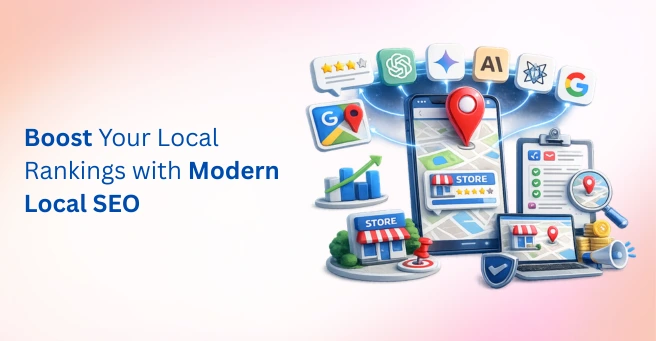
| To do local SEO in 2026, fully complete and verify Google Business Profile, keep NAP details consistent everywhere, build steady review velocity with fast responses, create dedicated location pages with LocalBusiness schema, and maintain entity consistency across AI platforms like ChatGPT, Perplexity, and Gemini, plus India-specific directories like JustDial and Sulekha where relevant. |
A business owner checks Google, and things look fine. The website ranks reasonably well for a general search. Then a search for best [service] near me comes up, and the business is missing from the map pack entirely. Worse, when someone asks ChatGPT or Google’s AI Overviews the same question, the business doesn’t get mentioned there either, while a smaller competitor down the street does.
This is the moment more business owners are running into as they learn how to do local SEO the right way in 2026. While many businesses still associate local SEO with Google Maps alone, modern local SEO services now focus on building visibility across Google Search, AI-powered search experiences, and local discovery platforms. AI Overviews, ChatGPT, Perplexity, and Gemini each have their own way of surfacing local businesses now, and a strategy built for Google Maps alone leaves real visibility on the table.
This guide covers Google’s core local ranking factors, the expanding world of AI and multi-platform local visibility, on-page and content tactics, off-page and review strategy, and a dedicated section on India-specific platforms and search behavior. A full action checklist and seven frequently asked questions close things out.
Data point: Google’s own research shows that 76% of people who perform a near-me search visit a business within 24 hours, and near-me search volume has grown roughly 400% since 2020 according to Google Trends data, making local visibility one of the fastest paths from search to real-world action.
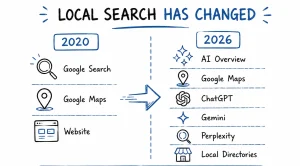
What Is Local SEO and How Does It Work?
Local SEO is the practice of optimizing a business’s online presence so it appears in location-based search results, the Google Maps 3-pack, and increasingly, AI-generated local answers. It’s no longer a single-channel effort. It now spans Google’s local algorithm, multiple AI search engines, and region-specific platforms simultaneously.
A quick distinction from general SEO is worth making here. Local SEO intent is tied to physical location and immediacy, and success gets measured in calls, visits, and direction requests just as much as in rankings themselves. A business can rank beautifully in organic search and still lose customers daily if it’s invisible in the local pack or absent from AI-generated recommendations.
| Local SEO Channel | Primary Signal Source | What It Surfaces |
| Google Maps / local pack | GBP data, reviews, citations | 3-pack, map results |
| Google Search (organic) | Website content, backlinks | Local landing pages, service pages |
| AI Overviews / Ask Maps | GBP + web content + reviews | AI-generated local recommendations |
| ChatGPT / Perplexity / Gemini local | Web content, entity consistency | Conversational local answers |
| India-specific platforms | JustDial, Sulekha, IndiaMART, Practo | Local directory visibility, leads |
Google’s Core Local Ranking Signals: Relevance, Distance, and Prominence
Google names three foundational local ranking factors: relevance, how well a listing matches the search; distance, how close the business is to the searcher or searched location; and prominence, how well-known and well-reviewed the business is. Nearly every other local signal falls under one of these three categories.
A complete and accurate Google Business Profile, correct primary and secondary category selection, review count and rating, citation volume, and backlink authority all feed into these three factors in different proportions. A branded search behaves differently from a generic “plumber near me” search, and the local algorithm weighs relevance and prominence accordingly.
| Ranking Factor | Key Signals | Practical Action |
| Relevance | GBP categories, keywords in business description, service list | Complete every GBP field accurately |
| Distance | Searcher and search location proximity | Accurate address, service area settings |
| Prominence | Reviews, citations, backlinks, brand mentions | Build review velocity and local citations |
Data point: Whitespark’s 2026 Local Search Ranking Factors survey of 47 local SEO experts found that Google Business Profile signals account for roughly 32% of local pack ranking weight, followed by review signals at 20%, on-page SEO at 19%, and link signals at 15%, with proximity to the searcher separately estimated at around 55% of overall ranking decisions.
AI and Multi-Platform Local Signals: Ranking Beyond Google Maps
The local search landscape now includes Google’s Ask Maps feature, AI Overviews for local queries, and conversational local answers from ChatGPT, Perplexity, and Gemini. Each platform pulls from a slightly different mix of data, but they all share one requirement in common: consistency.
Entity consistency is the connective signal running across every platform. A business’s name, address, phone number, description, and category all need to match wherever the business appears online for AI systems to recommend it with confidence. A mismatch in even one of these details can quietly disqualify a business from being mentioned at all.
AI citation for local businesses tends to draw from a mix of Google Business Profile data, website content, and third-party review platforms when a recommendation gets generated. Zero-click local search is a growing part of this picture too. Many local queries are now answered directly inside an AI Overview or the Ask Maps interface, with no click to the business’s website required at all.
On-Page and Content Strategy for Local SEO
Dedicated location landing pages, one per city or service area served, consistently outperform a single generic “service areas” page. Each location page should carry unique content, not a duplicated template with the city name swapped out, since thin, near-identical pages tend to dilute rather than strengthen local relevance.
City and service keyword combinations should be worked naturally into titles, headers, and body content. LocalBusiness schema markup should be implemented on every location page so search engines and AI systems can parse business details accurately, including address, hours, and service area.
Service area pages differ from location pages in one important way: businesses that serve a region without a public storefront should never list a fake or borrowed address just to create a location page. A clearly defined service radius, communicated honestly, serves both users and Google’s guidelines far better.
Geo-tagged content, meaning content that references specific neighborhoods or landmarks, reinforces local relevance and tends to attract local backlinks more naturally than generic content. A local FAQ section answering hyperlocal questions, such as “Do you serve [neighborhood]?” or “How far do you travel for [service]?”, directly serves long-tail, voice, and AI-generated queries.
| Content Type | Best For | Key Element |
| Location landing page | Multi-city businesses | Unique content per city, LocalBusiness schema |
| Service area page | Region-served businesses without storefronts | Clear service radius, no fake addresses |
| Geo-tagged blog content | Community relevance, local backlinks | Neighborhood or landmark references |
| Local FAQ section | Long-tail, voice, and AI queries | Direct, conversational answers |
Off-Page Local SEO: Reviews, Citations, and Local Backlinks
NAP consistency, meaning a business’s name, address, and phone number, must match exactly across every directory, citation, and platform. Even small formatting differences, like “St.” versus “Street,” can create confusion for both search engines and AI systems trying to confirm a business’s identity.
Review velocity and review response rate matter more than a single early burst of reviews. A consistent, ongoing flow of new reviews signals an active, trustworthy business, and responding to reviews, both positive and negative, demonstrates engaged management to users and algorithms alike.
Local citations across relevant directories reinforce prominence and trust, while local backlinks from other businesses, local news outlets, chambers of commerce, and community organizations carry outsized local relevance compared to generic, non-local links. Community mentions, including sponsorships, local event participation, and organic mentions on platforms like Reddit, increasingly factor into how both traditional search and AI systems assess local authority.
India-Specific Local SEO: Platforms and Search Behavior
Google Business Profile remains the foundation for local visibility in India, just as it is everywhere else, but it works alongside, not instead of, several India-specific platforms that carry real local search weight. JustDial and Sulekha function as major local directory platforms with strong lead generation for service-based businesses and contractors, while IndiaMART carries particular weight for B2B and wholesale local visibility.
Practo plays a similarly central role for healthcare-specific local visibility, and clinics, doctors, and diagnostic centers generally can’t afford to treat it as optional. Citations across these platforms, with NAP details matching exactly, reinforce the same prominence signals Google itself is trying to assess.
Hinglish voice search is a growing part of local search behavior in India, with a meaningful share of local voice queries blending Hindi and English naturally. Content that anticipates natural Hinglish phrasing, rather than assuming every query arrives in formal English, captures a segment of search intent that’s easy to miss otherwise.
| Platform | Primary Use in India | Notes |
| Google Business Profile | Core local visibility, Maps, AI Overviews | Foundation for all other efforts |
| JustDial | High-intent local directory leads | Strong for services, contractors |
| Sulekha | Service-based local leads | Overlaps with JustDial in category coverage |
| IndiaMART | B2B and wholesale local visibility | Less relevant for consumer-facing local businesses |
| Practo | Healthcare-specific local search | Essential for clinics, doctors, diagnostics |
Data point: Research on Indian local search behavior shows that over 80% of local searches in India lead to some form of action within 24 hours, closely mirroring Google’s global near-me benchmark, which suggests local intent converts just as reliably in Indian markets as it does globally.
How to Do Local SEO: A Step-by-Step Action Checklist
Here’s exactly how to do local SEO in a way that covers Google, AI platforms, and region-specific directories together, rather than treating each as a separate project.
- Claim and fully complete Google Business Profile, including categories, services, and business description
- Ensure NAP consistency across the website, GBP, and every local citation
- Build dedicated location landing pages with LocalBusiness schema for each city or service area served
- Implement a consistent review generation system, including WhatsApp requests where relevant
- Respond to all reviews within a consistent, reasonable timeframe
- Build local citations across relevant directories, including India-specific platforms where applicable
- Earn local backlinks through community involvement, local press, and partnerships
- Monitor AI visibility by directly querying ChatGPT, Perplexity, and Gemini for relevant local searches
The Growing Role of Reddit and Community Platforms in Local Search
Reddit local threads, neighborhood Facebook groups, and community forums are increasingly factored into how both Google and AI systems assess local authority. A business genuinely recommended in an organic Reddit thread, without being the business’s own promotional post, carries a kind of trust signal that’s difficult to manufacture artificially.
This matters more for AI-generated answers than it might for traditional Google Maps rankings. When ChatGPT or Perplexity generates a local recommendation, it’s often drawing on a broader mix of sources than Google’s local pack alone considers, and genuine community mentions on Reddit local threads increasingly show up in that mix. Encouraging honest customer conversations, rather than attempting to plant reviews or mentions, remains the only sustainable way to benefit from this signal.
Common Local SEO Mistakes to Avoid
- Inconsistent NAP data across directories and platforms
- Ignoring negative reviews instead of responding professionally
- Using a single generic “areas we serve” page instead of dedicated location pages
- Keyword-stuffing city names unnaturally into content
- Neglecting AI platforms entirely while focusing only on traditional Google Maps rankings
- Treating India-specific directories as optional rather than complementary to Google Business Profile
Final Thoughts
Local SEO has expanded well beyond the Google Maps 3-pack into a genuinely multi-platform discipline spanning AI search, conversational answer engines, and region-specific directories. Entity consistency, ongoing review management, and quality local content remain the foundation, regardless of which platform is being optimized for.
Learning how to do local SEO properly in 2026 means thinking beyond Google Maps alone and building visibility across every platform a local customer might actually use, whether that’s a Google search, a question typed into ChatGPT, or a listing checked on JustDial before making a call.
If managing Google Business Profile, location pages, reviews, citations, and AI visibility across multiple platforms sounds like more than your team can track consistently, that’s exactly the kind of work Tangence Solutions handles for clients regularly. As a full-service digital marketing and SEO services agency with deep local SEO expertise, Google Business Profile optimization is managed by Tangence, location landing pages are built, review and citation strategy is handled end to end, and visibility is maintained across AI search platforms and India-specific directories alike.
If your business isn’t showing up where local customers are actually looking, Tangence’s SEO team can run a full local SEO audit and show you exactly where the gaps are.
Frequently Asked Questions
1. How do I do local SEO for a small business in 2026?
Start by fully completing and verifying Google Business Profile, keeping NAP details consistent everywhere your business is listed, and building a steady stream of reviews with prompt responses. From there, dedicated location pages and consistent local citations round out the foundation.
2. How is local SEO different from regular SEO?
Local SEO ties intent to physical location and immediacy, and success is measured through calls, visits, and direction requests as much as rankings. Regular SEO focuses more broadly on organic visibility without that location-based, action-oriented component.
3. Do I need a Google Business Profile if I already rank well organically?
Yes. Organic rankings and the local pack are governed by different, though related, ranking systems. A business can rank well organically and still be entirely absent from the Google Maps 3-pack without an optimized, verified Google Business Profile.
4. How do I get my business recommended by ChatGPT or AI Overviews for local searches?
Entity consistency matters most here: your business name, address, phone number, and category need to match exactly across your website, Google Business Profile, and every directory listing, since AI systems cross-reference this data before making a recommendation.
5. Are JustDial and Sulekha still worth using alongside Google Business Profile?
Yes, particularly for service-based businesses in India. These platforms generate high-intent local leads independently of Google, and consistent NAP data across them also reinforces the prominence signals Google itself relies on.
6. How many reviews does a business need to rank in the local pack?
There’s no fixed number, but most competitive local categories require at least 15 to 20 genuine reviews to be competitive, alongside steady review velocity and a strong response rate, rather than a single large batch collected all at once.
7. What’s the fastest way to fix inconsistent NAP data across the web?
Start with a manual audit of your top 10 to 15 most important directory listings and your Google Business Profile, correcting any mismatches first, then use a citation management tool to catch and fix smaller, less prominent listings over time.