 SEO Services
 Local SEO Services
 AI SEO Services
 Technical SEO Services
 Performance Marketing
 Social Media
 Content Marketing
 Web Development
 App Development
 Marketing Automation
 Real Estate
 Ecommerce
 Education
 Healthcare
blog
How to Do Programmatic SEO: A Step-by-Step Guide to Scaling Organic Traffic in 2026

| Programmatic SEO is a scalable content strategy that uses page templates combined with structured data to automatically generate hundreds or thousands of SEO-optimised landing pages. Instead of writing each page manually, marketers build one master template and populate it with a database of variables like cities, products, categories, or use cases to create unique, indexable pages at scale. |
Most websites hit a content ceiling. You publish 30, 50, maybe 80 pages and growth stalls. Manual content production takes time, budget, and headcount that most teams simply do not have. That is where knowing how to do programmatic SEO becomes a genuine competitive advantage. Programmatic SEO lets you build hundreds or even thousands of optimised, database-driven pages from a single framework. If done right, it can transform your organic traffic trajectory in a matter of months.
In 2026, the stakes are higher than ever. Google is actively penalising thin, AI-spun content while rewarding sites that demonstrate topical authority strong and E-E-A-T signals at scale. The brands winning in organic search are not writing one blog post at a time. They are building scalable content systems and programmatic SEO is the engine powering them.
This step-by-step guide covers everything you need to know: from keyword research and data architecture to page generation, technical SEO, and quality control. Whether you are an SEO manager, a growth marketer, or a founder building organic reach, this programmatic SEO guide will show you exactly how to execute it.
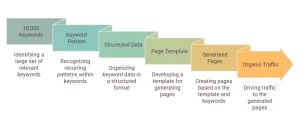
Image Source: Created using Napkin AI.
What Is Programmatic SEO?
Programmatic SEO is a strategy for creating a large volume of SEO-optimised pages using page templates combined with structured data. Instead of writing each page manually, you design one master template then populate it with rows of data to generate unique landing pages at scale.
Think of it as a formula: Template + Data = Scalable Pages. Each row in your database becomes a live, indexable page on your website.
Real-World Examples
Some of the most trafficked websites in the world are built on programmatic SEO frameworks:
- Zillow generates millions of property listing pages, one per address, city, and zip code.
- Canva creates template pages like ‘Free Instagram Story Templates for Real Estate Agents’.
- TripAdvisor builds city, hotel, and restaurant pages dynamically from their database.
- G2 produces software comparison pages like ‘Salesforce vs HubSpot’ at massive scale.
What makes programmatic SEO different from traditional SEO is automation. Traditional content requires manual writing, editing, and publishing for every page. A programmatic SEO workflow builds the system once and lets the data do the heavy lifting.
How Dynamic Pages Are Generated
The technical mechanism behind programmatic SEO is database-driven content. You store your variable data (cities, categories, products, keywords) in a structured source, a Google Sheet, Airtable, CSV, or SQL database. A CMS or custom script then reads that data and renders individual pages from your template.
Each generated page inherits the same structure but contains unique variables: a different city name, product type, or use case. This content architecture allows one team to maintain thousands of pages with the same effort it would take to manage ten.
When Should You Use Programmatic SEO?
Programmatic SEO is a powerful tool but it is not the right fit for every situation. Understanding when to deploy this strategy (and when not to) will save you from wasted development time and potential Google penalties.
| Use Programmatic SEO When… | Avoid Programmatic SEO When… |
|---|---|
| Keywords follow a repeatable pattern | Search intent varies widely |
| You have structured data | Data is limited or incomplete |
| Thousands of similar pages are needed | Only a few pages are required |
| Pages can be personalized with unique information | Pages would be mostly duplicate content |
| You need scalable organic growth | You need highly customized content |
How to Do Programmatic SEO: A Complete Step-by-Step Process
Now let us get into the actual execution. This programmatic SEO process is broken into six actionable steps, from identifying the right keywords to monitoring your pages after launch.
Step 1: Keyword Research
Programmatic SEO begins with identifying a keyword pattern that has both volume and repetition. You are not looking for one keyword, you are looking for a formula.
The most effective patterns follow a modifier + variable structure:
- [Service] in [City]:- ‘digital marketing agency in Mumbai’
- [Product] for [Use Case]:- ‘CRM software for real estate agents’
- Best [Category] for [Persona]:- ‘best accounting software for freelancers’
- [Tool A] vs [Tool B]:- ‘Asana vs Monday’
Use tools like Google Search Console, Ahrefs, or Semrush to identify these patterns. Filter by keyword clusters that share the same search intent. If 200 keywords follow the same structure and each gets at least 50–100 monthly searches in aggregate, you have a viable programmatic SEO target.
| Validation Step
Before building anything, verify that Google is already ranking pages for this pattern. Search a few combinations manually. If you see results, the intent is real. If Google shows generic homepages or nothing relevant, the keyword pattern may not be worth pursuing. |
Step 2:- Build Your Data Source
Your data source is the foundation of your entire programmatic SEO framework. It must be structured, comprehensive, and rich enough to make each generated page genuinely unique.
Choose the right database format for your setup:
- Google Sheets or Airtable – ideal for no-code and small-to-medium scale projects
- PostgreSQL or MySQL – better for large-scale projects with thousands of rows
- CSV files useful for simpler builds or one-time imports into a CMS
For each row (which will become one page), include at minimum:
- The primary variable (city, product, category, keyword)
- A unique data point or statistic specific to that variable
- Secondary content fields: a local description, use-case note, or relevant feature
- Any media references (images, local maps, ratings)
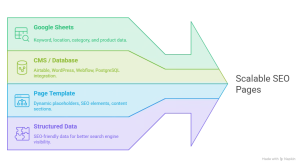
Image Source: Created using Napkin AI.
The rule of thumb: if your data source has only one column of variables and everything else is identical, your pages will be flagged as duplicate content. You need at least 3–5 unique fields per row to pass Google’s content quality standards.
Step 3: Design Your Landing Page Template
Your template is the skeleton that every generated page will inherit. It defines structure, layout, and the SEO elements that remain consistent, while your database variables fill the dynamic gaps.
A well-structured programmatic SEO template includes:
- H1: Contains the primary keyword with the variable (e.g., ‘SEO Services in {{city}}’)
- Intro paragraph: 2–3 sentences including the variable and a relevant local or contextual hook
- Feature/benefit block: Consistent service or product details with dynamic variable woven in
- Unique data block: Stats, local information, or use-case details pulled from your database
- FAQ block: 3–5 questions dynamically generated or pre-written per category
- CTA section: Consistent call-to-action with variable-specific personalisation
Step 4: Generate Your Pages
With your data source ready and your template built, it is time to generate pages. How you do this depends on your CMS and technical setup.
CMS Options for Programmatic Page Generation
- WordPress with Advanced Custom Fields (ACF): Create a custom post type, map ACF fields to your database columns, and use a page template to render content dynamically.
- Webflow CMS: Connect a CSV or Airtable source to Webflow’s CMS collections for no-code page generation.
- js or Gatsby: Ideal for developer teams. Use getStaticPaths and getStaticProps to generate pages from any data source at build time.
- Custom builds: A Python or Node.js script that reads your database and writes static HTML files to your hosting environment.
URL Structure Best Practices
Your URL structure is critical for both SEO and crawl efficiency. Follow these rules:
- Use clean, readable slugs: /seo-services/mumbai/ not /page?id=123&city=mumbai
- Create logical parent-child hierarchy: /[category]/[variable]/
- Keep URLs short and descriptive, avoid keyword stuffing in the URL
- Ensure every generated page has a unique, non-duplicated URL
Step 5: Handle Indexing and Crawl Budget
Generating thousands of pages is only valuable if Google can find, crawl, and index them efficiently. This is where technical SEO becomes critical to your programmatic SEO strategy.
- XML Sitemap: Generate a dynamic sitemap that auto-updates whenever new pages are added. Submit it via Google Search Console.
- Crawl budget: If you are generating thousands of pages, not all of them will be crawled immediately. Prioritise high-value pages and use noindex on low-value variations (pagination pages, filter combinations).
- Internal linking: Create programmatic index pages, category hubs or location directories that link to all child pages. This passes link equity and signals the relationship between pages.
- Canonical tags: Set self-referencing canonical tags on every generated page to prevent duplicate content issues caused by URL parameters.
Step 6: Quality Control and Content Uniqueness
This is the step most programmatic SEO implementations get wrong and it is the most important. Google’s Helpful Content system specifically targets sites where a significant portion of pages provide little original value.
Before you launch (and on a rolling audit basis), check for:
- Thin content: Is each page delivering genuine information beyond just swapping a variable? Set a minimum threshold of 300 words of unique, substantive content per page.
- Duplicate content: Run a sample of pages through a similarity checker. If pages are more than 80% identical in content, your template needs more unique data fields.
- Search intent match: Does each page actually satisfy what someone searching that keyword wants to find? Test a sample manually.
- User experience: Load speed, mobile responsiveness, and readability all affect how Google evaluates your programmatic pages.
A strong quality control process is what separates programmatic SEO that compounds over time from programmatic SEO that gets hit by a manual action or a core update.
Measuring the Success of Your Programmatic SEO Strategy
Launching your pages is the beginning, not the end. A programmatic SEO strategy requires ongoing measurement to identify what is working, what needs improvement, and where new opportunities exist.
| KPI | Healthy Benchmark |
|---|---|
| Index Ratio | 60%+ |
| Organic Clicks | Growing month-over-month |
| Average Position | Trending toward Top 10 |
| Crawl Rate | Stable or increasing |
| Conversion Rate | Improving over time |
| Engagement Time | 30+ seconds |
AI and Automation in Programmatic SEO in 2026
The rise of AI-generated content has both supercharged and complicated the programmatic SEO landscape. Used correctly, AI workflows allow you to generate content variations that are genuinely unique at scale. Used carelessly, AI becomes the fastest route to thin content penalties.
Where AI Adds Real Value
- Generating unique intro paragraphs per page using a structured prompt + variable data
- Creating dynamic FAQ content tailored to each page’s keyword and context
- Writing localised or use-case-specific content blocks from a data template
- Summarising database fields into natural-language descriptions
Agentic AI Workflows for Programmatic SEO
In 2026, agentic AI pipelines are changing how advanced teams implement programmatic SEO. An agentic AI workflow might automatically pull keyword data from GSC, identify new programmatic opportunities, generate content variations, push them to a CMS via API, and flag underperforming pages for revision all without manual intervention.
Tools supporting these data-driven SEO pipelines include Make (formerly Integromat), n8n, Zapier, and custom Python agents built on LLM APIs.
| AI Content Warning
Pure AI content generation without unique structured data is not programmatic SEO, it is content spam. Always anchor AI-generated content to real, unique data points per page. Google’s classifiers are increasingly effective at identifying low-value AI content at scale. |
Common Programmatic SEO Pitfalls and How to Avoid Them
| Mistake | Solution |
|---|---|
| Thin Content | Add unique data fields |
| Duplicate Pages | Use canonical tags |
| Crawl Budget Waste | Noindex low-value pages |
| Wrong Search Intent | Match page type to query |
| Weak Internal Linking | Create hub pages |
| Ignoring GSC | Monitor indexing weekly |
Final Thoughts
Knowing how to do programmatic SEO is one of the highest-leverage SEO skills you can develop in 2026. The fundamentals are straightforward: identify a repeating keyword pattern, build a rich data source, design a quality template, generate pages at scale, handle your technical SEO, and enforce content quality from day one.
But execution is where most teams stumble. Programmatic SEO rewards those who take quality control seriously. A single well-built programmatic SEO framework, maintained properly, can deliver compounding organic traffic for years, outperforming entire content teams writing manually.
Tangence is a full-service digital marketing and SEO services agency with hands-on expertise in programmatic SEO strategy, large-scale content architecture, technical SEO audits, and data-driven SEO execution.
We have helped businesses across industries build programmatic SEO frameworks that generate consistent organic growth without the guesswork.
Frequently Asked Questions
1. How can I do programmatic SEO without coding?
You can build a programmatic SEO system using no-code tools such as Webflow, WordPress with ACF, Airtable, and Google Sheets. Platforms like Make and Zapier can automate data workflows, allowing you to generate and manage pages without development expertise.
2. What is the difference between programmatic SEO and traditional SEO?
Traditional SEO involves creating and optimizing pages manually. Programmatic SEO uses templates and structured data to generate large numbers of pages automatically. Both rely on the same SEO principles, but programmatic SEO makes scaling much more efficient.
3. How many pages are needed for programmatic SEO?
Programmatic SEO is most effective when you have a repeatable keyword pattern that can support at least 50 pages. The larger the dataset and keyword opportunity, the greater the potential impact on organic traffic.
4. Does Google penalize programmatic SEO?
Google does not penalize programmatic SEO itself. However, pages with thin, duplicate, or low-value content may struggle to rank. Success depends on creating unique, helpful pages that match user intent.
5. What tools are commonly used for programmatic SEO?
Popular tools include Google Sheets, Airtable, WordPress, Webflow, Next.js, Google Search Console, Screaming Frog, Make, Zapier, and AI platforms for content generation and workflow automation.
6. How do you avoid duplicate content?
Use unique data points, dynamic content blocks, and canonical tags. Each page should provide information that is genuinely different rather than simply changing a keyword or location name.
7. How long does it take to see results?
Most sites begin seeing impressions within a few weeks after indexing. Meaningful traffic growth typically takes three to six months, depending on competition, content quality, and site authority.