 SEO Services
 Local SEO Services
 AI SEO Services
 Technical SEO Services
 Performance Marketing
 Social Media
 Content Marketing
 Web Development
 App Development
 Marketing Automation
 Real Estate
 Ecommerce
 Education
 Healthcare
blog
Claude AI Use Cases for Digital Marketing Agency in 2026
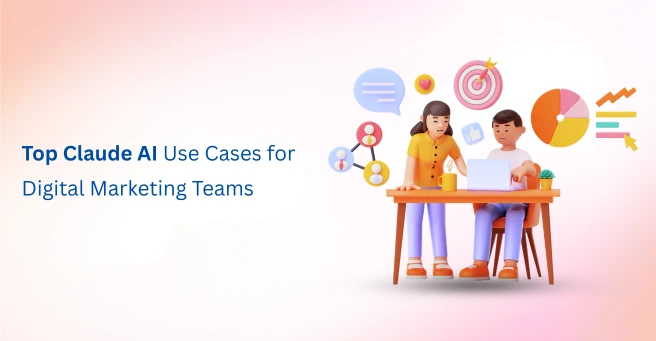
| Claude AI is Anthropic’s large language model used by digital marketing agencies to accelerate content creation, SEO keyword research, campaign planning, seo audits, social media content, and proposal writing. In 2026, agencies are using claude ai for marketing to reduce execution time, improve content quality, and build AI visibility strategies including GEO (Generative Engine Optimization) and answer engine optimization. |
The way digital marketing agencies work is changing faster than most teams can keep up with. Budgets are tighter, client expectations are higher, and the volume of content, campaigns, and reports that agencies are expected to produce has doubled in the last two years alone.
Enter claude ai for marketing – Anthropic’s large language model that is quickly becoming the go-to AI tool for agency teams that need speed without sacrificing strategic depth. Unlike generic AI writing tools, Claude is built for reasoning, nuance, and structured output – exactly what marketing professionals need when handling complex, multi-client workloads.
This blog covers the most impactful use cases of Claude AI for digital marketing agencies in 2026, and how your team can start putting it to work today.
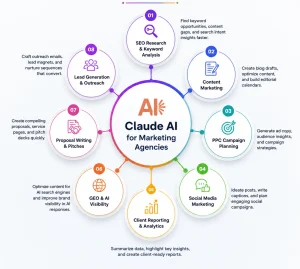
Image Source: Created using Napkin AI.
Why Agencies Are Choosing Claude AI for Marketing in 2026
There are dozens of AI tools competing for attention in the agency space right now, but claude ai for digital marketing has carved out a distinct position – and for good reason.
The first advantage is context. Claude supports an exceptionally large context window, which means you can paste an entire website audit, a 5,000-word client brief, or a month’s worth of campaign data into a single conversation and get coherent, structured outputs in return. For agency teams managing complex accounts, this is a game-changer.
The second is output quality. When agencies compare ChatGPT vs Claude AI on nuanced writing tasks – brand voice replication, long-form SEO content, strategy documents – Claude consistently produces fewer hallucinations, better paragraph structure, and more consistent tone across extended outputs.
The third is versatility. Claude is not just a content tool. Agency teams are using it across seo audits, campaign planning, lead generation strategy, client reporting, and even proposal writing. It functions less like a text generator and more like a highly capable junior strategist who never gets tired.
Finally, Claude’s compliance-friendly outputs matter for agencies working in regulated sectors like healthcare, finance, and legal. The model is trained with a stronger guardrail set, which reduces the editorial burden on account teams.
In 2026, agencies are not asking whether to use AI. They are asking which tools earn a permanent spot in their workflows. Claude is earning that spot.
Top Use Cases of Claude AI for Digital Marketing Agencies
Agencies are integrating Claude across their full service stack. Here are the high-impact use cases proven to save time, sharpen strategy, and improve client outcomes.
| Use Case | Primary Benefit | Time Saved |
|---|---|---|
| SEO Keyword Research | Faster clustering and content gap analysis | 3-5 hours/week |
| Content Planning | Automated editorial calendars | 2-4 hours/week |
| Blog Writing | Faster content creation and optimization | 5-10 hours/week |
| PPC Campaign Planning | Ad copy and audience strategy generation | 3-6 hours/week |
| SEO Audits | Client-ready recommendations | 4-8 hours/week |
| Social Media Content | Multi-platform content creation | 4-6 hours/week |
| GEO & AI Visibility | Optimize for AI search engines | Competitive advantage |
| Proposal Writing | Faster client acquisition workflows | 2-5 hours/proposal |
1. SEO Keyword Research and Content Gap Analysis
Keyword research is one of the most time-consuming tasks in any SEO engagement. Mapping seed terms, clustering topics, and finding content gaps takes hours manually. Claude dramatically accelerates this entire process.
With claude ai for seo keyword research, you can paste a competitor’s sitemap into Claude. Ask it to identify topical clusters, content gaps, and intent patterns. The output is a structured keyword map – produced in minutes, not hours.
Claude also supports building topical authority frameworks from a single seed keyword. Feed it one term and ask for a complete topic cluster. It returns a pillar page, supporting cluster posts, target search intent, and recommended content depth.
Agencies using Claude are not replacing tools like Ahrefs or Semrush. They are using Claude to synthesize what those tools produce. Raw crawl exports become actionable content plans – fast.
2. Content Planning and Editorial Calendar Creation
Content planning is where many agencies lose hours every month. Brainstorming topics, aligning to campaign calendars, assigning formats – it is repetitive work. Claude handles this extremely well.
Claude ai for marketers excels at building editorial calendars from a simple brief. Provide the brand niche, target audience, content pillars, and publishing frequency. Claude returns a structured month-by-month calendar with post titles, target keywords, formats, and funnel alignment.
More importantly, Claude plans content at a strategic level. It does not just generate titles. It explains why each piece earns its place in the plan.
This makes it easier for account managers to present strategies to clients with confidence. Agencies managing ten clients simultaneously use Claude to maintain quality across accounts. Strategist burnout drops significantly.
3. Blog Writing and Long-Form Content Optimization
Blog writing is the use case most people associate with AI. But claude ai for marketing offers more than simple content generation. The deeper value is in content optimization.
Claude produces strong first drafts quickly. A well-structured 1,500-word SEO blog can be generated in under three minutes. The draft includes H2s, H3s, internal linking suggestions, and a FAQ section.
After generating the draft, agencies prompt Claude to audit it. Claude checks keyword density, semantic term coverage, readability, and E-E-A-T signals. It flags where expert perspective or intent alignment is missing.
The best workflow runs in five steps: brief, first draft, optimization audit, humanization, then publish. Claude handles the first three. Human editors handle the final two. The result ranks well and reads naturally.
4. SEO Audits and Technical Recommendations
SEO audits are a high-effort, high-value service. Claude adds significant leverage here. Agencies are cutting audit production time by more than half.
Teams feed raw crawl data and Google Search Console exports into Claude. They ask it to identify patterns, prioritize issues, and generate client-ready reports. Claude turns a spreadsheet of errors into a clear, structured narrative.
On-page seo audits are especially well-suited to Claude. Paste ten existing blog posts and ask for a full audit. Claude checks search intent alignment, keyword usage, internal linking, meta titles, and content freshness.
The output is a prioritized checklist. A junior SEO executive can execute it without senior oversight. Claude also builds fast, comprehensive seo audits for new client pitches.
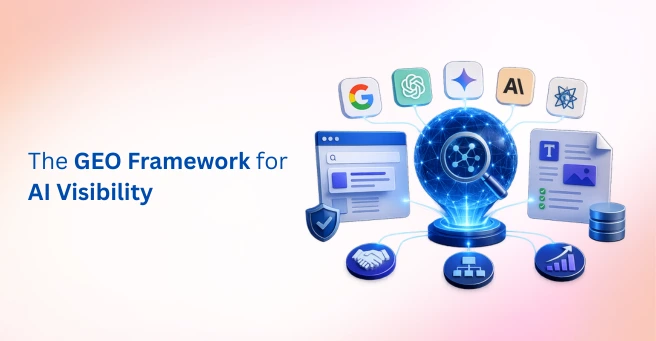
5. AI Visibility, GEO, and Answer Engine Optimization

Image Source: Created using Napkin AI.
This is the use case that separates forward-thinking agencies from those still catching up. Search is changing fast. AI-powered answer surfaces are reshaping how content gets discovered.
Google’s AI Overviews, Perplexity, and Bing Copilot are now primary discovery channels. Answer engine optimization structures content to appear in AI-generated answers. GEO (Generative Engine Optimization) focuses on appearing in large language model outputs.
Claude is uniquely positioned to help agencies build for ai visibility. It understands how AI systems process and surface information. Agencies use it to identify question-intent queries and structure content with clear entity relationships.
This is an emerging service line agencies can productize today. Clients want partners who understand AI-era content strategy. Agencies that offer GEO and AEO services stand out in new business conversations.
6. Performance Marketing and Campaign Planning
Campaign planning is where claude ai marketing strategy prompting delivers the most direct business impact. Building a full Meta Ads framework manually takes several hours. Claude produces a structured first version in minutes.
The framework covers audience segmentation, ad copy variations, A/B test hypotheses, and budget allocation logic. Marketers refine and execute rather than build from scratch. That shift alone saves hours per campaign.
For Google Ads, Claude generates RSA headline sets and description variations at scale. It covers feature-led, benefit-led, urgency-driven, and social proof angles. Teams have real options to test from day one.
Claude also supports strategic campaign planning. It identifies audience pain points and maps them to offer angles. This is especially valuable when onboarding new clients quickly.
Lead generation campaigns benefit from Claude’s ability to write lead magnet content. Guides, checklists, webinar scripts, and email nurture sequences are produced quickly. Quality stays consistent across the funnel.
7. Social Media Content and Community Engagement
Social media content production is relentless. Agencies managing multiple brand accounts need fresh content every week. Manual ideation leads to creative burnout quickly.
Claude generates platform-specific content at scale. It writes LinkedIn thought leadership posts, Instagram captions, X threads, and YouTube scripts. Each piece is formatted and toned to match the platform and brand voice.
Feed Claude a brand voice guide and a monthly content theme. It returns a full content calendar draft ready for design and scheduling. One prompt replaces hours of ideation.
Claude also supports community management. It generates templated response frameworks for common questions, complaints, and compliments. Brand voice stays consistent even when junior team members handle responses.
8. Proposal Writing and New Business Development
Claude ai for digital marketing is not just an execution tool. It is a new business tool. Agencies are winning more pitches with less time invested.
Claude writes first drafts of client proposals and scope-of-work frameworks quickly. Provide the client brief, your service capabilities, and a target budget range. Claude returns a structured proposal with strategy, deliverables, timeline, and pricing rationale.
For lead generation, Claude writes long-form lead magnet content. SEO audit templates, campaign planning guides, and whitepapers attract inbound inquiries. Outreach email sequences are personalized across different industry verticals.
The cumulative effect is significant. Agencies pitch more clients without growing their business development headcount. More proposals, faster turnaround, same team size.
How to Get Started with Claude AI for Marketing – A Practical Workflow
Getting value from Claude quickly requires structure, not experimentation.
Step 1: Identify your automation targets
List the two or three high-volume, repetitive tasks your team does every week. Content briefs, keyword lists, and client reports are the most common starting points. These tasks become your first Claude workflows. Start with tasks that are structured and predictable, not creative or relational.
Step 2: Build a prompt library
Document the prompts that produce the best outputs for your most common tasks. Treat each prompt like an SOP – a standard operating procedure any team member can pick up and run. The library grows as your team experiments. Store prompts in a shared Notion doc or Google Sheet, one row per task type.
Step 3: Layer Claude into existing tools
Claude outputs paste cleanly into Google Docs, Notion, and most project management platforms. You do not need to rebuild your workflow around Claude. You build Claude into the workflow you already have. No new tool stack needed.
Step 4: Train your team on prompt engineering
Cover four fundamentals: specificity of instruction, context-setting, output format specification, and iterative refinement. The quality of Claude’s output scales directly with the quality of the input. A vague prompt returns a vague result. Run a 30-minute team session using your own client tasks as practice prompts.
Step 5: Establish a human review layer
Before anything reaches a client, a skilled marketer reviews it. Claude does not know your client’s brand history, account context, or relationship nuances. AI output reviewed by an expert is unbeatable. AI output delivered raw is a risk. Make human review non-negotiable – build it into your delivery checklist.
Claude AI Limitations Every Agency Should Know
| Limitation | Impact | Agency Action |
|---|---|---|
| No Real-Time Data Access | Cannot fetch live rankings, trends, or competitor data. | Use tools like Ahrefs, Semrush, and Google Search Console for current data. |
| Can Make Mistakes | May generate inaccurate facts, statistics, or citations. | Verify all information before publishing or sharing with clients. |
| Cannot Replace Strategy | Lacks business context and strategic judgment. | Keep marketers responsible for planning and decision-making. |
| Needs Human Editing | Content may not fully match brand voice or compliance requirements. | Review and refine all AI-generated content before use. |
Conclusion
Claude ai for marketing is not a future investment – it is a present-day competitive advantage for agencies willing to implement it with discipline and strategy. The agencies delivering more, pitching faster, and retaining clients longer in 2026 are the ones who have embedded AI workflows across their content, SEO, performance, and strategy functions – while keeping human judgment at the center of client delivery.
At Tangence, a full-service digital marketing and seo services agency with over two decades of experience, we combine deep SEO expertise with forward-looking AI-driven workflows to build strategies that rank, convert, and grow. From seo audits and content optimization to performance marketing and ai visibility consulting, our team delivers results that are measurable and built for the long term.
Frequently Asked Questions
Q1. What is Claude AI, and how is it useful for marketing agencies?
Claude is a large language model built by Anthropic. It is designed for structured writing, reasoning, and extended context handling. For agencies, it speeds up content production, SEO workflows, campaign planning, and proposal writing.
Q2. Can claude ai for marketing replace human marketers?
No. Claude is an amplifier, not a replacement. It handles repetitive tasks at speed. Human marketers stay in charge of strategy, client relationships, and creative judgment. The best results come from combining both.
Q3. How does Claude AI compare to ChatGPT for digital marketing tasks?
Claude leads on long-form content, SEO audits, and structured documents. Its larger context window gives it an edge on complex tasks. ChatGPT is stronger on multimodal and plugin-heavy work. Most agencies use both tools together.
Q4. Is Claude AI good for SEO content writing?
Yes. Claude produces well-structured SEO drafts quickly. It supports keyword density checks, search intent alignment, and E-E-A-T audits. Human review is still needed for brand voice and factual accuracy.
Q5. Can I use Claude AI for performance marketing and Google Ads copy?
Yes. Claude generates RSA headlines, Meta ad copy, and A/B test frameworks efficiently. Give it clear audience data, offer details, and brand tone guidelines. The output quality improves significantly with a detailed prompt.
Q6. What is the difference between GEO and traditional SEO?
Traditional SEO targets search engine ranking pages. GEO – Generative Engine Optimization – targets AI-powered answer surfaces. Claude helps structure content for entity clarity and question-intent targeting. This improves visibility in Google AI Overviews and Perplexity.
Q7. How do agencies ensure AI-generated content meets quality standards?
Use a three-layer review: AI draft, human editorial check, then client sign-off. Include brand voice guides in every prompt. Verify all data and statistics independently. Never publish AI content without a skilled marketer reviewing it first.