-01.svg) SEO Services
SEO Services-02.svg) Local SEO Services
Local SEO Services-03.svg) AI SEO Services
AI SEO Services-04.svg) Technical SEO Services
Technical SEO Services-05.svg) Performance Marketing
Performance Marketing-06.svg) Social Media
Social Media-07.svg) Content Marketing
Content Marketing-08.svg) Web Development
Web Development-09.svg) App Development
App Development-10.svg) Marketing Automation
Marketing Automation-11.svg) Real Estate
Real Estate-12.svg) Ecommerce
Ecommerce-13.svg) Education
Education-14.svg) Healthcare
Healthcare B2B
B2B SAAS
SAAS Law Firm
 BFSI
BFSIblog
Writing for Humans AND Algorithms: The 2026 SEO Content Balancing Act
| Human first SEO is the practice of creating content that genuinely serves reader intent, demonstrates real expertise, and meets Google’s People-First Content standards, while still applying on-page optimisation signals that help algorithms discover, understand, and rank it. In 2026, as Google’s Helpful Content System and AI Overviews increasingly reward credible, well-structured, experience-backed content over keyword-engineered text, human first SEO has become the most reliable path to sustainable organic rankings. |
A content writer spends three hours researching, drafting, and polishing a blog post. It checks every keyword box, the focus term appears nine times, the meta is tight, the headers are stacked with LSI variations. But when a real person reads it? It feels hollow. Robotic. Like it was written for a search engine and not for humans.
This tension sits at the heart of every content marketing decision in 2026. Google’s algorithms have grown sophisticated enough to distinguish between content that genuinely helps people and content that merely performs helpfulness for crawlers. The result? The old playbook of keyword density and header stuffing is not just outdated, it actively works against you.
The answer is human first SEO: a content philosophy that puts reader value, search intent, and genuine expertise at the centre of every piece, while still meeting the technical signals that help Google understand and rank your content. In this guide, we break down exactly what that means in 2026, why it matters more than ever, and how to execute it across every blog post, landing page, and service page you publish.
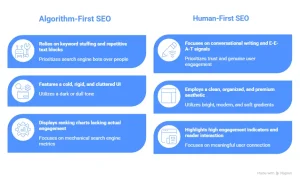
Image Source: Created using Napkin AI.
What Does “Human First SEO” Actually Mean?
Human first SEO is a content strategy that prioritises the reader’s experience, search intent, and genuine subject-matter expertise and uses keyword optimisation as a supporting layer, not the foundation. It is the practical application of Google’s own People-First Content guidelines, which the search engine has been refining through successive Helpful Content Updates since 2022.
At its core, human-first content answers a simple test: if Google’s algorithm disappeared tomorrow, would this content still be worth reading? If the answer is yes, you are on the right track. If the answer is ‘not really – it’s mostly for the bots’, you have a problem.
The distinction matters because Google’s ranking systems in 2026 are built to answer that same question at scale. Through signals like dwell time, engagement rate, return visits, and the E-E-A-T framework (Experience, Expertise, Authoritativeness, and Trustworthiness), the algorithm has become remarkably good at identifying content that was written to serve people versus content that was written to game rankings.
People-first content does not mean ignoring SEO mechanics. It means aligning those mechanics with what readers actually need so that optimisation feels invisible rather than intrusive.
Why the Old “Write for Bots” Playbook Is Dead
For years, the dominant SEO content strategy looked something like this: identify a target keyword, hit a specific density, mirror the header structure of the top-ranking pages, and ship. It worked, until it did not.
Google’s Helpful Content System, expanded and deepened through 2024 and 2025, introduced a site-wide quality signal. This means that if a significant portion of your content is assessed as low-quality, unhelpful, or primarily search-engine-oriented, every page on your domain can take a ranking hit and not just the individual posts that underperform.
Simultaneously, the rollout of AI Overviews (Google’s SGE-based answer panels) has changed which content gets featured. The content that appears in AI Overviews is not the most keyword-optimised, it is the most authoritative, well-structured, and genuinely informative. Writing for bots actively disqualifies you from these high-visibility placements.
What Google’s Algorithm Actually Rewards Now
- Expertise signals: Author bios, first-hand experience, cited data, and original research.
- Engagement metrics: Dwell time, scroll depth, low bounce rates, and return visits – all of which correlate with content people actually find useful.
- Semantic relevance: Topical depth and contextual vocabulary, not exact-match keyword repetition.
- Structured clarity: Logical heading hierarchies, short paragraphs, and scannable formatting that signals a well-organised, reader-first document.
The algorithm, in short, has become a proxy for the reader. Beat the reader, and you beat the algorithm.
How to Balance Readability and Keyword Optimisation in Practice
Knowing the principles is one thing. Executing them under client deadlines and content volume pressures is another. Here is a practical framework for applying human-first SEO at scale without sacrificing either quality or efficiency.
Start With a Content Brief, Not a Keyword List
Before any keyword research, map the topic. What question is this piece answering? What does the reader need to know before, during, and after reading it? And what do they probably already know? Only after the topical map is clear should you layer in keyword targeting fitting the terms into a narrative you have already designed, rather than building a narrative around the terms.
This approach naturally produces a human first SEO strategy in 2026 that covers topical depth, satisfies semantic search, and reads like it was written by someone who actually knows the subject.
Use Keywords as Anchors, Not Wallpaper
Place your focus keyword where it naturally belongs: the title tag, meta description, opening paragraph, one subheading, and the conclusion. For a 2,000-word post, that means 8–9 total uses, neither more nor less. Use LSI terms (people-first content, search intent optimisation, E-E-A-T content writing) throughout the body to build topical relevance without repetition.
| SEO Readability Factor | Recommended Benchmark |
|---|---|
| Flesch Reading Score | Above 60 |
| Sentence Length | Under 20 words |
| Subheading Frequency | Every 250–300 words |
| Passive Voice | Below 10% |
| Transition Words | Above 30% |
| Paragraph Length | Maximum 4 lines |
| Meta Description | 120–155 characters |
The 5 Pillars of a Human First SEO Content Strategy
Executing human-first content consistently requires a framework, not a checklist, but a set of principles that guide every content decision from brief to publish.
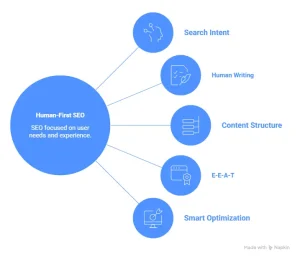
Image Source: Created using Napkin AI.
1. Lead with Search Intent, Not Just Keywords
A keyword tells you what someone typed. Search intent tells you what they actually want. These are often different things, and confusing them is one of the most common reasons well-optimised content still fails to rank.
Before you write a single word, map the intent behind your target query: is the reader looking for information, trying to navigate to a specific site, comparing options before a purchase, or ready to buy? For a query like ‘how to write SEO content for humans and algorithms’, the intent is clearly informational and how-to oriented. The content should teach and not sell, not overview, not list alternatives.
When your content structure matches the intent, readers stay longer, engage more, and trust you more. Google notices all three.
2. Write Like You’re Talking to One Person
The moment your writing starts addressing a faceless audience, it loses its pull. The most effective SEO content reads like a knowledgeable colleague explaining something clearly – not a corporate brochure broadcasting to a crowd.
Use the second person (‘you’, ‘your’). Keep sentences under 20 words wherever possible. Break up complex ideas into digestible steps. Read your draft out loud, if it sounds stiff or unnatural spoken aloud, it will read that way too. This is not just good writing advice; it directly improves your Yoast readability score, reduces passive voice flags, and increases the transition word ratio that contributes to a green readability signal.
3. Structure Content for Skimmers AND Deep Readers
On average, a reader decides within 10–15 seconds whether a page is worth their time. Structure is your first impression. A well-organised page uses H2 and H3 headings to create a scannable outline, bold text to surface key ideas, short paragraphs to signal digestibility, and contextual internal links to guide deeper exploration.
This dual structure – skimmable on the surface, rich in depth serves two audiences simultaneously: the reader who scans for the specific answer they need, and the reader who wants to understand the full picture. It also serves Google’s crawlers, which use heading hierarchy and content structure to understand topical relevance and passage-level context.
4. Build E-E-A-T Into Every Piece
E-E-A-T – Experience, Expertise, Authoritativeness, Trustworthiness is Google’s qualitative framework for evaluating content credibility. In the era of human first SEO, E-E-A-T is not an optional add-on. It is the mechanism by which your content earns trust from both readers and algorithms.
- Experience: Include first-person observations, real case examples, or original data wherever possible. Content that reflects direct, lived knowledge stands apart from aggregated summaries.
- Expertise: Use precise, domain-specific language. Cite credible industry sources. Demonstrate command of the topic beyond surface-level definitions.
- Authoritativeness: Include a detailed author bio. Earn backlinks from reputable domains. Publish consistently on a focused topic cluster.
- Trustworthiness: Be transparent about sources and publication dates. Update content when information changes. Avoid clickbait headlines that overpromise.
Every piece of content you publish is an opportunity to build these signals. Every piece that skips them is a missed compounding investment.
5. Optimise Without Over-Optimising
Keyword placement still matters but placement beats density every time. Your focus keyword should appear naturally in the SEO title, meta description, first 100 words, at least one H2, and the conclusion. Beyond that, let semantic variations and LSI terms carry the topical weight. Forcing exact-match keywords into awkward positions does not help rankings and actively degrades the reading experience.
The goal is for a reader to finish your post and not once have noticed that you were optimising it. If they can see the scaffolding, you built it wrong.
Human First SEO vs. Algorithm-First Writing
Understanding the practical differences between human first SEO and traditional algorithm-first writing helps clarify why the former consistently outperforms the latter in sustained organic growth.
| Factor | Algorithm-First SEO | Human-First SEO |
|---|---|---|
| Keyword Usage | Forced repetition | Natural placement |
| Tone | Robotic and repetitive | Conversational and engaging |
| Structure | Built around keywords | Built around search intent |
| Depth | Surface-level information | Experience-backed insights |
| E-E-A-T | Weak or missing | Strong credibility signals |
| User Engagement | High bounce rates | Better dwell time |
| Long-Term Results | Unstable rankings | Sustainable growth |
Specific Shifts Every SEO Content Writer Must Know
The fundamentals of human-first content are stable but the context in which they operate is evolving rapidly. These are the shifts that matter most for SEO writers working in 2026.
1. AI Overviews are pulling from structured, authoritative content:
Google’s AI-generated answer panels draw predominantly from content that is well-organised, clearly attributed, and demonstrably expert. Human first SEO is now an author-authority game: the entity behind the content matters as much as the content itself.
2. Voice search rewards conversational language:
As voice and conversational AI queries grow, content that reads naturally when spoken aloud gains a structural advantage. Short answers, FAQ sections, and direct ‘what / why / how’ responses are increasingly valuable content units.
3. Author entity indexing is becoming a ranking signal:
Google is investing heavily in understanding who created a piece of content and not just what it contains. Author bios linked to Google profiles, consistent bylines across a topic cluster, and expertise demonstrated through multiple published pieces are all signals in the helpful content update 2026 framework.
4. Content freshness matters more in competitive niches:
For fast-moving topics, an outdated stat or a reference to a superseded Google policy can undermine an otherwise excellent piece. Build a content refresh cycle into your editorial calendar, quarterly for high-traffic posts, annually for evergreen guides.
Common Mistakes That Kill the Human-Algorithm Balance
Even experienced SEO writers fall into patterns that undermine a solid human first SEO strategy. Watch for these recurring errors:
| SEO Mistake | Why It Hurts Rankings |
|---|---|
| Writing for keywords only | Misses actual search intent |
| Ignoring UX signals | Poor Core Web Vitals reduce engagement |
| Publishing raw AI content | Lacks E-E-A-T depth |
| Skipping schema markup | Reduces rich result eligibility |
| Using duplicate service pages | Weakens topical authority |
Final Thought
The central insight of human first SEO is this: Google’s definition of a great search result and a real reader’s definition of a great answer have never been more closely aligned. The algorithm is, in increasing measure, a proxy for your audience. When you write content that genuinely serves readers, answering their questions with depth, credibility, and clarity, you are simultaneously writing content that the algorithm is designed to reward.
Tangence is a end to end digital marketing and SEO services agency with a proven track record of helping businesses achieve sustainable organic growth through data-backed, human first SEO strategies. From comprehensive content audits and intent-led keyword mapping to full-scale blog production, on-page optimisation, and technical SEO, Tangence builds content ecosystems that align with Google’s 2026 quality standards and, more importantly, with what your audience actually needs.
Frequently Asked Questions
Q1: What is human-first SEO?
Human-first SEO focuses on reader value, search intent, and real expertise instead of keyword stuffing. It follows Google’s People-First Content guidelines and aims to help users genuinely, which improves long-term rankings and engagement.
Q2: Does human-first SEO affect keyword rankings?
No. In fact, it strengthens rankings over time. Google rewards content that satisfies user intent, demonstrates E-E-A-T, and keeps readers engaged. Helpful, reader-focused content performs better than pages written only for algorithms.
Q3: How often should I use my focus keyword?
For a 2,000-word article, use the focus keyword naturally around 8–9 times. Include it in the title, meta description, introduction, one subheading, and conclusion without forcing repetition.
Q4: What is the difference between people-first content and SEO content?
In 2026, both are closely connected. High-ranking SEO content is content that readers find useful, credible, and easy to understand. Modern SEO is no longer about writing for bots alone.
Q5: How does E-E-A-T support human-first SEO?
E-E-A-T stands for Experience, Expertise, Authoritativeness, and Trustworthiness. These signals help Google evaluate content quality through author credibility, accurate information, first-hand insights, and transparent sourcing.
Q6: Can AI-generated content rank?
Yes, if it is edited and improved by humans. AI content should include expert insights, accurate data, and strong E-E-A-T signals. Raw AI drafts without human review often lack depth and authenticity.
Q7: How can I tell if my content is too SEO-focused?
If keywords feel repetitive or unnatural while reading aloud, the content is likely over-optimised. Good SEO writing feels smooth, conversational, and useful without making optimisation obvious.