-01.svg)
-02.svg)
-03.svg)
-04.svg)
-05.svg)
-06.svg)
-07.svg)
-08.svg)
-09.svg)
-10.svg)
-11.svg)
-12.svg)
-13.svg)
-14.svg)






blog
Google March 2026 Spam Update: What Changed & How to Protect Your Rankings

Google made a move on March 24, 2026. It was not telegraphed. It was not slow. The Google March 2026 Spam Update began rolling out at 12:00 PM Pacific Time. By the following morning, it was done.
Under 20 hours. That is all it took. It is the shortest confirmed spam update rollout in the history of Google’s Search Status Dashboard and the speed alone tells you something important. Google did not need time to scan the web. It already knew exactly which sites to target.
This was the second confirmed algorithm update of 2026. It followed the February 2026 Discover update. It also marked the first spam update since August 2025 which, by contrast, took nearly 27 days to complete.
If your rankings dropped around March 24, this guide is for you. And if they did not drop, this guide is still for you because the tactics Google is now detecting more reliably are more common than most site owners realise.
|
~20 hrs Fastest spam update rollout in Google history |
Mar 24–25
Rollout start & completion date |
| Global
Applied to all languages & locations at once |
2nd Second confirmed Google algorithm update of 2026 |
Sources: Google Search Status Dashboard, Search Engine Journal, Search Engine Roundtable, Search Engine Land – March 2026
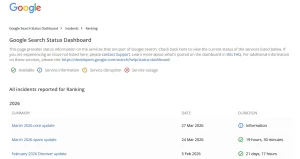
Image Source: Screenshot from Google Search Status Dashboard
What is the Google March 2026 Spam Update?
The Google March 2026 Spam Update is a targeted enforcement action. It uses Google’s AI-powered spam detection system, SpamBrain, to identify and penalise sites that violate Google’s existing spam policies.
Before going further, it is worth clarifying one thing. This was a spam update & not a core update. Many site owners confuse the two. They require different diagnoses and completely different recovery strategies.
Spam Update vs Core Update: The Critical Difference
A spam update is targeted and surgical. It enforces specific spam policy violations. Sites that are penalised by a spam update broke a rule and Google caught them.
A core update is a broad reassessment of content quality across the entire web. Sites that lose rankings from a core update may not have done anything wrong. They simply need to become more helpful, relevant, and authoritative.
Getting this distinction wrong is expensive. Treating a spam penalty like a core update, rewriting content when you should be cleaning up backlinks – wastes months and achieves nothing.
What Google Said Officially
Google’s official release note was brief. It stated: this is a normal spam update for all languages and locations.
No new spam policy categories were introduced. This is a meaningful detail. The landmark March 2024 spam update introduced three entirely new categories: scaled content abuse, expired domain abuse, and site reputation abuse. March 2026 introduced nothing new.
Instead, it refined and widened SpamBrain’s ability to detect violations that were already against policy. The rules did not change. The enforcement did.
What SpamBrain Is
SpamBrain is Google’s AI-driven spam detection engine. It does not follow a static checklist. It learns continuously from patterns across billions of pages.
Google first deployed SpamBrain at scale for link spam detection in December 2022. Each subsequent spam update improves its pattern recognition. What SpamBrain missed in 2024, it catches confidently in 2026.
Timeline & Rollout: What Happened and When
| Date & Time | Event |
|---|---|
| Mar 24 · 12:00 PM PT | Rollout begins. Google Search Status Dashboard logs active incident. |
| Mar 24 · 12:18 PM PT | Official release note published: “Released the March 2026 spam update.” |
| Mar 24 · 3:20 PM ET | Search Engine Land confirms update is live, second update of 2026. |
| Mar 25 · 7:30 AM PT | Rollout complete. Total duration: under 20 hours, shortest ever confirmed. |
| Mar 25 · 7:39 AM PT | Completion note posted to Google Search Status Dashboard. |
How This Compares to Previous Spam Updates
The speed of this rollout is historically significant. Here is how it compares to the two most recent spam updates:
| Update | Duration | Notable Feature |
|---|---|---|
| August 2025 Spam Update | ~27 days | Penalty-only, no broad ranking reset |
| December 2024 Spam Update | ~7 days | Targeted link spam specifically |
| March 2026 Spam Update | Under 20 hours | Fastest rollout in dashboard history |
What the Google March 2026 Spam Update Actually Targeted
Google’s official statement was intentionally brief. Industry analysis, Search Engine Roundtable reporting, and Search Console data from affected sites fill in the details.
Confirmed Targets
- Cloaking: Showing Googlebot a different page than what users see. This is one of Google’s most serious violations.
- Scaled content abuse: Publishing hundreds or thousands of AI-generated pages with no editorial oversight, original data, or unique value.
- Link spam: Private blog networks (PBNs), paid link insertions, and reciprocal link exchange schemes.
- Expired domain abuse: Purchasing old domains to inherit their backlink authority, then publishing content unrelated to the domain’s original purpose.
- Site reputation abuse (parasite SEO): Third-party low-quality content hosted on high-authority domains to hijack their ranking power.
- Doorway pages: Pages created purely to rank for specific queries, offering no meaningful user experience or unique information beyond a keyword match.
- Hidden text, keyword stuffing, and sneaky redirects: Classic violations that SpamBrain now catches with greater precision across more page types.
What Was NOT Targeted
Barry Schwartz of Search Engine Roundtable, one of the most reliable trackers of Google algorithm activity confirmed several important boundaries of this update.
- This update does not specifically target link spam in isolation. It targets the full pattern of spam behaviour, links are one signal among many.
- Site reputation abuse was not the primary focus of this specific update, despite being a major target of March 2024.
- AI-generated content is not automatically spam. Google’s policy targets content created primarily to manipulate rankings, not content produced responsibly with AI tools and genuine editorial oversight.
Who Got Hit
Early Search Console data from affected sites shows clear patterns in which types of pages lost rankings fastest.
- Coupon aggregator sites using scraped content lost over 80% of indexed pages within the first week.
- Sites with active PBN link schemes saw uniform ranking drops across their highest-linked pages.
- Niche sites built on expired domains with authority-mismatched content were deindexed at scale.
- Sites publishing AI content at scale without human review lost visibility on their programmatic pages.
- Sites with clean, original, expert-driven content and natural backlink profiles were largely unaffected.
How to Check if the Google March 2026 Spam Update Hit Your Site
Before attempting any recovery action, confirm that this update is actually the cause of your traffic drop. Here is how to diagnose it accurately.
| Step | Action |
|---|---|
| Step 1 | Open Google Search Console and navigate to Performance → Search Results |
| Step 2 | Click date comparison. Set March 17–23, 2026 vs March 24–30, 2026 |
| Step 3 | Go to the Pages tab and sort by largest click decline |
| Step 4 | Cross-check affected pages with content audit and backlink profile for patterns |
| Step 5 | Check Coverage report for spikes in Excluded or Crawled – Not Indexed pages |
Signals This Was a Spam Penalty
- Traffic drops begin precisely on or after March 24 & not before
- Dropping pages share a pattern: thin content, paid backlinks, or cloaking signals
- Pages with known external link schemes are among your biggest losers
- No recent technical changes, server errors, or CMS migrations on your end
- Drops are concentrated on specific page types, not a uniform site-wide fall
How to Protect Your Rankings: 7 Strategies That Work
Whether your site was affected by the Google March 2026 Spam Update or not, these seven strategies are your action plan. Apply them before the next update arrives. And based on the speed of this one, the next update may come sooner than you expect.
Strategy 1: Audit All Content for Scaled Abuse Signals
Start with a full content audit, especially if your site relies on large-scale or programmatic content.
- Export all URLs using tools like Screaming Frog
- Filter pages under 500 words
- Identify pages without a named human author
- Detect template-based pages with minor variations (e.g., city, product, date)
- Decide: improve, merge (301 redirect), or delete
AI content is not the issue, lack of human review and originality is. Google now clearly distinguishes between valuable AI-assisted content and mass-produced low-quality pages.
Strategy 2: Conduct a Backlink Audit Immediately
If your site has used paid links, exchanges, or PBNs, act quickly. By using backlink audit, you can identify toxic links and protect your site from penalties.
- Pull backlink data from Ahrefs or Semrush
- Flag links from irrelevant or low-traffic domains
- Identify PBN patterns and link insertion services
- Request removal of toxic links
- Disavow links you cannot remove
| Critical Warning |
|---|
| For link spam violations, Google has confirmed that lost ranking benefits from artificial links cannot be regained. The links are neutralised – not just ignored. Prevention and immediate cleanup are always more effective than post-penalty remediation. |
Strategy 3: Remove or Consolidate Doorway and Thin Pages
Doorway pages are a major spam signal and are heavily targeted by SpamBrain.
- Identify pages created only to rank for keywords
- Look for programmatic location pages (e.g., “service in [city]”)
- Add meaningful, localized value or consolidate into one strong page
- Delete pages with no traffic, backlinks, or user value
A lean, high-quality site consistently outperforms a bloated one.
Strategy 4: Audit for Cloaking and Redirect Issues
Cloaking is a serious violation and can lead to severe penalties.
- Use URL Inspection in Google Search Console
- Compare “Google view” vs actual user view
- Crawl your site using Googlebot and standard user agents
- Identify mismatches in content delivery
- Fix misleading or inconsistent redirects
Even unintentional cloaking signals can now trigger penalties.
Strategy 5: Strengthen E-E-A-T Across Your Entire Site
E-E-A-T is a strong defense against spam classification.
- Add detailed author bios with credentials and experience
- Build a transparent and informative About page
- Cite authoritative and credible external sources
- Update or remove content without clear authorship
Trust and credibility signals help protect your site from algorithmic penalties.
Strategy 6: End All Link Schemes Immediately
Manipulative link practices are now easier for Google to detect.
- Stop paid link placements immediately
- Exit link exchange agreements
- Shut down any PBN activity
- Review and disavow existing toxic links if necessary
- Focus on digital PR and earned backlinks
Ethical link building is now the only sustainable strategy.
Strategy 7: Build Monthly Site Audits Into Your SEO Calendar
Fast updates mean continuous monitoring is critical.
- Schedule monthly spam policy audits
- Run weekly crawls using SEO tools
- Monitor Google Search Console for traffic drops
- Check Coverage reports for indexing issues
- Maintain a clear keyword and content map
By the time you notice a drop, the update is already complete, consistent monitoring is your safety net.
| Prevention is the Strategy |
|---|
| The March 2026 update was complete before most site owners had finished their morning coffee. Monthly audits, clean link profiles, and strong E-E-A-T are not aspirational goals. They are the only reliable protection against an update that arrives and ends before you can react. |
Recovery Timeline: What to Expect After Being Hit
If your site was affected by the Google March 2026 Spam Update, set realistic expectations before beginning recovery. Google’s own documentation is clear on this.
Content-Related Violations
Recovery is possible for thin content, doorway pages, or scaled abuse but it takes time (3–6 months).
- Diagnose affected pages and identify issues
- Fix, merge, delete, or rewrite low-quality content
- Rebuild trust with expert-led, high-quality content (E-E-A-T)
Sustained compliance, not one-time changes drives recovery.
Link Spam Violations
Link-related penalties work differently.
- Lost benefits from artificial links cannot be recovered
- Google neutralizes spam links permanently
- Recovery means rebuilding authority through ethical backlinks
This takes longer but creates long-term stability.
Monitoring Your Recovery
- Resubmit fixed pages via GSC URL Inspection
- Track impressions first, clicks follow later
- Monitor rankings weekly using SEO tools
- Avoid reacting to short-term fluctuations
Recovery is gradual, measured in months, not days.
Conclusion
The Google March 2026 Spam Update is a clear signal. Google’s enforcement is getting faster, more precise, and harder to outrun. Under 20 hours from start to finish. Pre-identified targets. No warning.
The update introduced no new policies. It did not need to. SpamBrain simply got better at catching what was already against the rules. Cloaking, link schemes, scaled unreviewed content, parasite SEO, expired domain abuse, these tactics have been violations for years. March 2026 is proof that Google’s patience for them is narrowing.
The next spam update is coming. The question is whether your site will be ready when it does.
If your rankings have dropped or if you want to stay protected before the next update, this is the time to act. At Tangence, we specialize in building resilient SEO strategies designed to withstand algorithm shifts like this.
We offer comprehensive SEO services built for exactly this kind of situation: technical and spam audits that surface every policy violation across your domain, full backlink profile analysis and disavow strategy, content audits with clear remediation plans, E-E-A-T strengthening across your entire site, and long-term link building through legitimate, durable methods.
Frequently Asked Questions
Q1. What is the Google March 2026 Spam Update?
The Google March 2026 Spam Update is a targeted action using SpamBrain to penalise sites violating spam policies. It launched on March 24, 2026, and completed in under 20 hours, the fastest rollout recorded. No new policies were introduced.
Q2. How is it different from a core update?
Spam updates target specific violations. Core updates reassess overall content quality. Spam hits mean rule-breaking; core hits mean improvement is needed.
Q3. Which sites were most affected?
Sites using parasite SEO, PBNs, cloaking, expired domains, or unreviewed AI content saw major drops. Clean, expert-led sites remained stable.
Q4. Does it penalise AI content?
No, not automatically. Google’s spam policy targets content created primarily to manipulate rankings, not content produced responsibly with AI tools. High-quality AI content with original insights, human editorial review, and genuine user value is not classified as spam.
Q5. How long does recovery take?
Content fixes take 3–6 months. Link spam losses can’t be recovered, authority must be rebuilt. Initial improvements may appear in 8–12 weeks.
Q6. How to check impact?
Use Search Console to compare March 17–23 vs March 24–30. A drop beginning on or after March 24 that is concentrated on thin-content or link-heavy pages is a strong indicator of spam update impact.
Q7. Will there be more updates?
Google typically releases one to three spam updates per year. The August 2025 update was the only spam update of 2025. With the March 2026 update already confirmed, further updates are expected later in 2026.