

blog
Why Structured Data in SEO Is the Secret Weapon for Dominating Search Results

When you search on Google and see listings with star ratings, expandable FAQs, pricing details, breadcrumbs, or review counts, you’re witnessing structured data in action. These enhanced results don’t appear randomly they are powered by schema markup that helps search engines better understand the meaning behind web content.
But what exactly is structured data in SEO? And more importantly, how can you leverage it to increase visibility, improve click-through rates, and prepare your website for AI-driven search in 2026 and beyond?
In this in-depth guide, you will learn what structured data truly means, how it works behind the scenes, and why it plays a critical role in modern search optimization. We will also explore practical implementation steps, common mistakes to avoid, and how structured data aligns with semantic SEO and entity-based indexing.
If you want your content to stand out in competitive search results, this guide will show you how. Let’s get started.
What Is Structured Data in SEO?
Structured data in SEO refers to a standardized method of organizing and labeling website content so search engines can clearly interpret what your content actually represents. Instead of relying solely on visible text, search engines use structured signals to understand context, relationships, and intent behind your information.
Rather than simply “reading” your page like a human visitor, search engines process structured data through machine-readable code, most commonly implemented using schema markup. This code provides explicit clues about the type of content on your page and how different elements relate to one another.
Different types of schema markup in action – FAQ, Product, and Local Business rich results powered by structured data.

Image source: Screenshot from Google Search results.
For example:
A blog post → Article schema
A product page → Product schema
A local business website → LocalBusiness schema
An FAQ section → FAQ schema
This markup follows standardized vocabulary from schema.org, a collaborative initiative supported by major search engines like Google and Microsoft. By using this framework, websites communicate more clearly with search engines, improving eligibility for enhanced search features and rich results.
Structured Data vs Schema Markup vs Rich Snippets
To clear up the confusion, here’s a simple comparison table:
| Term | What It Means | Purpose in SEO | Example |
| Structured Data | The organized and standardized format of information on a webpage | Helps search engines understand the meaning and context of your content | Identifying a page as a product, article, FAQ, or local business |
| Schema Markup | The actual code (usually JSON-LD) added to a webpage to implement structured data | Provides machine-readable signals to search engines | Adding Product schema with price, availability, and ratings |
| Rich Snippets / Rich Results | Enhanced search results generated from structured data | Improves visibility and click-through rates in SERPs | Star ratings, FAQs dropdown, pricing, breadcrumbs |
Why Structured Data Matters for Modern SEO
Search engines are no longer simple keyword-matching systems. Today, they function using entities, relationships, context, and semantic understanding. Google’s algorithms analyze meaning, intent, and credibility, not just exact-match phrases. That’s why structured data in SEO has become a critical component of modern optimization strategies.
Here’s why it matters more than ever:
1. Improves Search Visibility
When implemented correctly, structured data makes your page eligible for enhanced search features such as:
- Rich snippets
- FAQ dropdowns
- Star ratings
- Product pricing
- Breadcrumb navigation
- Review counts
These visual enhancements increase your real estate in search results. Even if you’re not ranking in the top position, your listing can still attract attention and outperform competitors by appearing more informative and authoritative.
2. Boosts Click-Through Rate (CTR)
Industry research consistently shows that rich results can increase CTR by 10–30%.
Why does this happen? Because enhanced listings:
- Occupy more space in SERPs
- Provide immediate value to users
- Build credibility before the click
Structured data in SEO doesn’t just improve how your page ranks, it improves how compelling it appears.
3. Enables AI & Voice Search Optimization
With AI Overviews and generative search experiences evolving rapidly, search engines rely heavily on structured, machine-readable data. Schema markup helps:
- AI interpret content context
- Identify key entities
- Extract accurate answers
- Power voice assistant responses
In an AI-driven search environment, structured data becomes foundational.
4. Strengthens E-E-A-T Signals
Experience, Expertise, Authoritativeness, and Trustworthiness (E-E-A-T) are essential quality signals. Implementing:
- Author schema
- Organization schema
- Review schema
…helps search engines connect your brand identity, expertise, and credibility to your content, reinforcing long-term SEO authority.
How Structured Data Works
Search engines crawl your page.
When they encounter structured data markup, typically written in JSON-LD format, they process it separately from visible content.
Google recommends JSON-LD because:
- It’s easier to implement
- Doesn’t interfere with HTML layout
- Is easier to maintain
Here’s a simple example of FAQ schema:
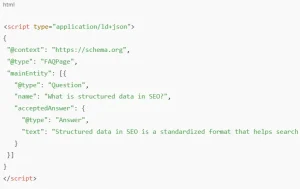
Image source: Screenshot from webpage source code.
Google then:
- Parses the code
- Validates it
- Determines eligibility for rich results
- Displays enhanced SERP features if criteria are met
Important note: Structured data in SEO is not a direct ranking factor.
But it enhances how your page is interpreted and displayed.
Structured data implementation is a critical component of modern technical optimization, and it works best when aligned with a strong technical SEO strategy.
Types of Structured Data Markup You Should Use
Different types of content require different schema implementations. Below are some of the most valuable schema types to use:
Article Schema
Best suited for blogs, news posts, and long-form editorial content.
It improves eligibility for rich headline results and increases visibility in Google Discover.
FAQ Schema
Adds expandable question-and-answer sections directly in search results.
Ideal for informational, educational, and optimization-focused pages targeting featured snippets.
Product Schema
Displays key eCommerce details such as:
- Price
- Availability
- Reviews
- Rating
This markup is essential for improving product visibility and driving purchase intent.
Review & Rating Schema
Adds star ratings beneath your search listing, increasing trust and improving click-through rates.
Breadcrumb Schema
Enhances navigation clarity and improves how URLs appear in search results.
Local Business Schema
Crucial for local SEO, helping search engines connect your business name, address, phone number, and services accurately. For businesses targeting regional visibility, combining LocalBusiness schema with professional local SEO services significantly improves search presence.
Organization & Author Schema
Strengthens brand authority, supports E-E-A-T signals, and improves entity recognition. Strategically combining multiple schema types strengthens your overall semantic footprint.
Step-by-Step Guide to Implement Structured Data in SEO
Implementing structured data in SEO requires both strategic thinking and technical accuracy. Below is a practical, step-by-step framework to help you execute it correctly.
Step 1: Identify Content Type
Start by determining the purpose of the page. Is it a:
- Blog post
- Service page
- Product listing
- FAQ page
- Local business page
Understanding the content type ensures you apply the correct schema and align it with search intent.
Step 2: Choose the Right Schema Type
Visit schema.org to select the most relevant markup. Always match the schema to the actual content on the page. Using incorrect or misleading schema can invalidate your rich result eligibility and even trigger manual actions.
Official Schema.org documentation showing Article schema properties and JSON-LD implementation example.
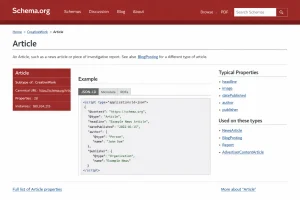
Image source: Screenshot from Schema.org documentation.
Step 3: Generate Schema Markup
You can create markup using:
- Google Structured Data Markup Helper
- Online schema generators
- WordPress SEO plugins
- Manual JSON-LD coding for full control
JSON-LD is recommended for flexibility and maintenance.
Step 4: Add It to Your Website
You can implement structured data by inserting the code in the header, using a plugin, or deploying it via Google Tag Manager.
Step 5: Test & Validate
Always test using Google Rich Results Test and Schema Markup Validator. Fix any warnings or errors immediately.
Step 6: Monitor Performance
Track enhancement reports in Google Search Console, monitor CTR, impressions, and rich result eligibility. Continuous monitoring ensures sustainable SEO growth.
Does Structured Data Improve Rankings?
This is one of the most frequently asked questions in technical SEO.
Officially, structured data in SEO is not a direct ranking factor. Google has repeatedly clarified that simply adding schema markup will not automatically push your page higher in search results.
However, that does not mean it lacks SEO value.
Structured data significantly improves:
- Click-through rate (CTR)
- Search visibility
- Overall search appearance
- Context clarity for crawlers
- Entity mapping and semantic understanding
When your listing displays enhanced elements like star ratings, FAQs, or pricing, it becomes more attractive and informative. This often leads to higher engagement compared to standard blue-link results.
Indirectly, these improvements can influence performance. If your page earns more clicks, longer dwell time, and stronger engagement signals than competing pages, search engines may interpret that as a positive user experience indicator.
Think of structured data as a visibility multiplier, not a shortcut to rankings. It enhances presentation and clarity, which can improve performance outcomes over time.
Structured Data and AI Search
Search is rapidly evolving from keyword-based matching to entity-driven understanding. Google’s AI systems now prioritize:
- Context
- Authority
- Structured signals
- Machine-readable metadata
Structured data in SEO strengthens your content’s eligibility for:
- AI Overviews
- Knowledge panels
- Voice assistant responses
- Featured snippets
As search becomes more conversational and generative, semantic clarity becomes essential. Schema markup helps search engines interpret meaning accurately, ensuring your content remains discoverable in an AI-first search landscape. Businesses are investing in AI SEO services to optimize content for entity recognition and generative search results.
Common Mistakes to Avoid with Structured Data
| Mistake | What It Means | Why It’s Risky |
| Marking content that isn’t visible | Adding schema for information not shown on the page | Violates Google guidelines and may trigger penalties |
| Using incorrect schema types | Applying Product schema to a blog or FAQ schema to non-FAQ content | Invalidates rich result eligibility |
| Keyword stuffing inside structured data | Overloading schema fields with excessive keywords | Considered spammy and manipulative |
| Adding fake reviews | Including fabricated ratings or testimonials | Can result in manual actions and loss of trust |
| Not updating schema after content edits | Leaving outdated pricing, reviews, or author info | Causes data mismatch and reduces credibility |
| Overusing FAQ schema | Adding unnecessary or low-value FAQs | May reduce visibility or lead to suppression |
Final Thoughts
Search engines are evolving rapidly.
AI, entity-based indexing, and semantic search are redefining how websites are evaluated.
Structured data in SEO ensures your website is not just crawled but understood.
It enhances:- Visibility, CTR, Authority, Context, Future AI readiness etc.
If you want to compete seriously in modern search then schema implementation is no longer optional – it’s strategic.
At Tangence, we specialize in advanced technical SEO, structured data implementation, and AI-focused optimization strategies. Our SEO services are designed to help brands gain maximum search visibility while aligning with Google’s evolving algorithms.
If your website isn’t leveraging structured data correctly, you’re leaving search performance untapped.
Frequently Asked Questions
1. What is structured data in SEO?
Structured data in SEO is a standardized format of code (schema markup) that helps search engines understand website content more clearly and display enhanced search results.
2. Is structured data a ranking factor?
No, it is not a direct ranking factor. However, it improves visibility and CTR, which can positively influence SEO performance.
3. How do I add structured data to my website?
You can add it using JSON-LD code, WordPress plugins, Google Tag Manager, or schema generators.
4. What is the best format for structured data?
Google recommends JSON-LD because it’s easier to implement and maintain.
5. Can structured data increase CTR?
Yes. Rich results often increase click-through rates by making listings more attractive and informative.
6. How do I test structured data?
Use Google Rich Results Test and Schema Markup Validator to check errors and eligibility.
7. Is structured data required for SEO success?
It’s not mandatory, but in competitive niches, it’s becoming essential for maximum search visibility.