
blog
Reputation Management SEO: How to Build, Monitor & Protect Your Online Reputation (2026 Guide)

Your reputation lives online and so do your customers’ first impressions.
Before a potential customer calls your business, books a consultation, or clicks “buy,” they Google you. What they find in those first ten results can either earn their trust instantly or send them straight to a competitor. That’s exactly why reputation management SEO has become one of the most critical disciplines in digital marketing today and why ignoring it is no longer an option.
Think about it: you could have the best product, the most skilled team, and a flawless track record but if a single negative article or a handful of bad reviews dominate your branded search results, none of that matters to the stranger encountering your brand for the very first time.
In 2026, with AI-generated content flooding search results and online reviews influencing more than 90% of buying decisions, managing what Google says about you isn’t a marketing nice-to-have – it’s a survival strategy.
The good news? You have more control than you think.
This comprehensive guide walks you through everything you need to know about reputation management SEO: what it is, why it matters enormously in today’s search landscape, and how to proactively build, consistently monitor, and confidently protect your brand’s presence in search results – backed by real, proven strategies that deliver results.
What Is Reputation Management SEO?
Reputation management SEO is the practice of influencing what appears in search engine results pages (SERPs) for branded queries – your name, your business name, or your key products. It combines traditional search engine optimization techniques with online brand management to shape the narrative around your brand.
Unlike general SEO, which focuses on ranking for keywords, reputation management SEO focuses on who controls the ranking conversation. The goal is to:
- Push positive content to the top of Google results
- Suppress or neutralize negative reviews, news articles, or forum posts
- Build a strong, trust-worthy brand presence across multiple authoritative platforms
- Own as many of the first-page results as possible for branded searches
This discipline sits at the crossroads of personal brand SEO, content marketing, link building, local SEO, and public relations.
Why Reputation Management SEO Matters in 2026
Search behavior has evolved. People don’t just look at your website, they evaluate your brand across multiple sources. The stakes have never been higher. Here’s why online reputation management deserves a top priority in your SEO strategy this year:
1. Google’s E-E-A-T Framework Rewards Trustworthy Brands
Google’s updated ranking guidelines emphasize Experience, Expertise, Authoritativeness, and Trustworthiness (E-E-A-T). Brands with a trail of positive reviews, credible press mentions, and consistent messaging rank significantly better. A tarnished reputation doesn’t just hurt your image, it actively hurts your rankings.
2. AI Overviews Are Pulling Brand Signals
Google’s AI Overviews (previously SGE) now synthesize information about brands directly from across the web. If your brand has unresolved negative signals – bad press, poor review scores, or unaddressed customer complaints – those signals can appear in AI-generated summaries at the very top of the page.
3. The Rise of Review-Based Search Behavior
Searches like “[brand name] reviews”, “[brand name] scam”, or “[brand name] complaints” have surged. If you’re not occupying those result pages with your own content, you’re leaving the narrative entirely to others.
4. One Negative Article Can Cost Real Revenue
Studies show that one negative result on the first page of Google can cause a business to lose up to 22% of potential customers. Three negative results can push that figure above 59%. SERP reputation management directly impacts your bottom line.
How Reputation Management SEO Works
Building a strong online presence requires a structured, repeatable process. Reputation management SEO isn’t a one-time fix, it’s an ongoing strategy that compounds over time. Here’s how it works step by step:
Step 1: Audit Your Online Presence
Start by searching your brand name on Google. Review the first two pages of results with fresh eyes – exactly as a potential customer would see them.
Look at:
- Search results — what content dominates page one for your brand?
- Reviews — what are people saying on Google, Trustpilot, or industry platforms?
- Social media mentions — are conversations about your brand positive or mixed?
- News articles or blog posts — is any press coverage outdated or unflattering?
This gives you a clear, honest picture of where your reputation currently stands.
Step 2: Identify Negative or Weak Content
Not all damaging content is obvious. Beyond outright bad reviews, look for:
- Poor or unresolved customer reviews
- Low-quality third-party mentions that misrepresent your brand
- Outdated pages that no longer reflect your business accurately
- Competitor comparison pages framing you unfavourably
These are the specific areas your reputation management SEO strategy needs to address, suppress, or outrank.
Step 3: Build Positive Digital Assets
To shift the narrative, you need strong, search-optimised content that earns its place on page one. This includes:
- Optimised blog posts and service pages on your website
- Press mentions and earned media coverage
- Active, keyword-rich social media profiles
- Verified business listings across authoritative directories
The more high-quality content you publish and promote, the more control you gain over what searchers find.
Step 4: Optimise Content for Search Engines
Publishing content isn’t enough, every asset needs to be technically sound. Ensure each piece includes:
- Branded keywords used naturally throughout
- Proper heading hierarchy (H1 → H2 → H3)
- Strategic internal linking between your own pages
- On-page SEO best practices — meta titles, descriptions, image alt text
Well-optimised content ranks faster and holds its position longer.
Step 5: Push Down Negative Results
You don’t always need to remove negative content, you simply need to outperform it. By consistently publishing and earning links to high-quality positive content, you gradually displace negative results to page two and beyond. This content suppression approach is one of the core principles of reputation management SEO and delivers lasting, compounding results over time.
Reputation Management SEO Checklist
| Checklist Item | Status |
|---|---|
| Brand name ranks #1 for exact match search | ☐ |
| Own 7/10 top results for brand name | ☐ |
| Google Business Profile is complete & active | ☐ |
| Social profiles are optimized & active | ☐ |
| Review score is 4.0+ across platforms | ☐ |
| Google Alerts set for brand variations | ☐ |
| Schema markup implemented | ☐ |
| No negative results in top 5 SERPs | ☐ |
| High-authority backlinks exist | ☐ |
| Crisis communication plan ready | ☐ |
Key Components of a Successful Reputation Management SEO Strategy
Beyond the process steps above, a strong online reputation management strategy is built on five core pillars that work together continuously:
Branded Keyword Optimisation
Your brand name is one of your most important keywords and you should be the one controlling what ranks for it. Optimise your content specifically for search variations like:
- brand name + reviews
- brand name + services
- brand name + location
- brand name + pricing or vs competitor
Owning these queries means owning the full conversation happening around your business in search.
Google Business Profile Optimisation
Your Google Business Profile is frequently the very first thing a potential customer sees before they even visit your website. Keep it fully optimised with:
- Accurate and consistent business information (name, address, phone)
- High-quality, regularly updated photos
- Timely posts and service updates
- A steady stream of responded-to reviews
A complete, active profile improves both local search visibility and immediate brand trust. For businesses targeting local customers, combining reputation management SEO with local SEO services ensures better visibility in Google Maps and stronger trust signals through reviews.
Review Management
Reviews are both a direct ranking signal and a trust signal for new customers. A proactive review strategy includes:
- Systematically encouraging satisfied customers to share their experience online
- Responding to every review – positive and negative – professionally and within 48 hours
- Addressing negative feedback constructively and offering to resolve issues offline
Consistent review activity signals to Google that your business is active, legitimate, and customer-focused.
Social Media Presence
Social profiles frequently rank on the first page for branded searches, making them valuable, controllable reputation assets. Maintain active, consistently branded profiles on:
- LinkedIn — critical for B2B credibility and professional authority
- Facebook — broad reach and review visibility
- Instagram — visual brand storytelling
- YouTube — video content that ranks independently in Google search
Even a modest but consistent social presence meaningfully strengthens your branded SERP footprint.
Backlink Building
Backlinks from credible, authoritative sources signal to Google that your brand is trustworthy and established. For reputation SEO, prioritise:
- Guest posts on respected industry publications
- PR mentions in news outlets and trade media
- Listings in high-authority industry directories
Each quality backlink is a vote of confidence that elevates your content in rankings and reinforces your reputation management SEO performance over time.
How to Protect Your Reputation from Negative Content
Even the best brands face negative content at some point. Your response strategy is what separates businesses that recover quickly from those that suffer lasting damage.

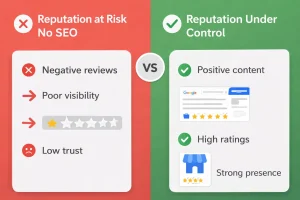
Image Source: Created using Napkin AI.
Strategy 1: Respond to Negative Reviews Professionally
Never ignore negative reviews. A thoughtful, timely response signals to both customers and Google that you take feedback seriously. Best practices:
- Respond within 24–48 hours
- Acknowledge the issue without admitting legal liability
- Offer to resolve the matter offline
- Avoid being defensive or dismissive in your tone
Strategy 2: Launch a Content Suppression Campaign
The most effective reputation repair SEO technique is to flood page one with high-quality, authoritative positive content pushing negative results to page two or beyond. Target the exact search query where the negative content ranks and publish on high-DA platforms such as:
- LinkedIn Articles and YouTube videos
- Medium and Forbes Councils contributed columns
- Wikipedia (where applicable and verifiable)
- Industry-specific publications and podcast platforms
The goal is simple: give Google better, more authoritative content about your brand to rank instead.
Strategy 3: Address the Root Cause
SEO can suppress negative content, but it cannot erase genuine product or service failures. If reviews consistently highlight the same pain points, fix the underlying problem. Authentic, visible improvement is the most durable long-term reputation strategy and it reduces the volume of new negative content at the source.
Strategy 4: Use Legal Channels When Appropriate
In cases of false, defamatory, or policy-violating content, explore:
- Google’s legal removal request process
- DMCA takedown requests for plagiarised or stolen content
- Direct outreach to site owners requesting voluntary removal
This is a last resort but an entirely legitimate one when content is genuinely false or harmful.
How to Monitor Your Brand’s Online Presence
You can’t manage what you don’t measure. Brand monitoring for SEO should be a continuous, automated process not a monthly afterthought.
Tools to Monitor Your Online Reputation
| Tool | Best For |
|---|---|
| Google Alerts | Free, basic brand mention tracking |
| Mention.com | Real-time brand monitoring across web & social |
| SEMrush Brand Monitoring | Integrated with SEO data & backlink analysis |
| BrightLocal | Local review monitoring across directories |
| Brandwatch | Enterprise-level sentiment analysis |
What to Monitor
- Branded keyword rankings (your name + “reviews,” “complaints,” “pricing”)
- Unlinked brand mentions (opportunities to earn backlinks)
- New reviews across all platforms in real time
- Press mentions — both positive and negative
- Social media conversations and comment sentiment
Set up weekly reporting dashboards and designate a team member or agency partner to review them consistently.
Common Reputation Management SEO Mistakes to Avoid
| Mistake | Why It’s a Problem | Quick Fix |
|---|---|---|
| Ignoring negative reviews | Damages trust | Respond professionally |
| No branded content | Weak SERP control | Create optimized content |
| Inconsistent brand info | Confuses users | Keep details consistent |
| No monitoring | Issues go unnoticed | Use tracking tools |
| Over-promotion | Feels unnatural | Focus on value-driven content |
Conclusion
Building, monitoring, and protecting your reputation management SEO isn’t a one-time project – it’s an ongoing investment in your brand’s most valuable long-term asset: trust.
In 2026, the brands that dominate Google’s first page for their own name are the ones that win customer confidence, earn higher conversion rates, and weather reputational challenges without lasting damage. The structured process and strategies in this guide give you a proven, actionable roadmap to get there.
Ready to take control of your online reputation?
Tangence is a full-service digital marketing agency with deep expertise in reputation management SEO, technical SEO, local SEO, content marketing, and brand authority building. Whether you’re dealing with negative search results, looking to dominate your branded SERPs, or building your digital presence from the ground up, Tangence’s expert SEO services are designed to deliver measurable, lasting results.
Contact Tangence today to schedule a free SEO reputation audit and discover exactly where your brand stands and what it will take to get to the top.
Frequently Asked Questions
1. What is the difference between SEO and reputation management SEO?
Traditional SEO focuses on ranking for non-branded keywords to drive organic traffic. Reputation management SEO specifically targets branded search queries – your name or business name to control what people find when they search for you directly.
2. How long does it take to push down negative search results?
The timeline depends on the authority of the negative content and the volume of positive content you can produce. For a moderately authoritative negative result, a focused reputation SEO campaign typically takes 3–6 months to show meaningful SERP displacement. More authoritative content (e.g., major news outlets) can take 6–12+ months.
3. Can you permanently remove negative content from Google?
Removal is possible only under specific circumstances – content that is provably false, defamatory, violates privacy laws, or breaches Google’s policies may qualify for removal through official legal processes. In most cases, the practical approach is suppression through high-quality content creation rather than outright removal.
4. What are the best platforms to build your online reputation?
The highest-impact platforms for online reputation management include: Google Business Profile, LinkedIn, YouTube, Trustpilot (or industry-specific review sites), Wikipedia (for established brands), and high-DA news sites via digital PR. Together, these tend to dominate the first page for branded searches.
5. How do online reviews impact SEO?
Reviews are a direct ranking factor for local SEO and a significant trust signal for Google’s E-E-A-T evaluation. A higher volume of recent, positive reviews improves visibility in Google Maps, the Local Pack, and standard search results. They also influence click-through rates via star ratings shown in SERPs.
6. Is reputation management SEO only for large businesses?
Not at all. In fact, personal brand SEO and small business reputation management are among the fastest-growing areas of this field. Freelancers, solopreneurs, and SMBs are just as vulnerable to the impact of a single negative review or article and often have fewer resources to weather reputational damage without SEO intervention.
7. What should I do immediately if a negative article appears about my brand on page one?
Act fast. First, audit the content – is it factually accurate? If false, begin legal removal processes. If true (or partially true), address the underlying issue publicly. Simultaneously, launch a content suppression campaign: publish authoritative content targeting the exact search query on high-DA platforms, increase review generation activity, and amplify positive press.