
blog
How to Track Keyword Rankings the Right Way in 2026
Search is evolving at an unprecedented pace. With AI-generated answers, personalized SERPs, zero-click searches, and frequent algorithm updates, ranking dynamics in 2026 are far more complex than they were just a few years ago. What worked in traditional SEO tracking no longer delivers reliable insights today.
Still, keyword tracking remains a foundational pillar of sustainable SEO growth.
The difference lies in how it’s approached. Modern keyword tracking isn’t about chasing the #1 spot for ego metrics. Instead, it focuses on true search visibility, intent alignment, competitive positioning, and revenue impact. Rankings must now be evaluated in the context of SERP features, AI summaries, device differences, and funnel stages.
In this guide, you’ll discover what keyword tracking really means in 2026, how Google rankings function today, the correct setup process, advanced tracking methods most marketers overlook, common pitfalls to avoid, and how to turn ranking data into measurable business growth.
What Is Keyword Tracking and Why Most Marketers Get it Wrong
At its core, keyword tracking is the process of monitoring how your website ranks for specific search queries over time. It helps you understand whether your SEO efforts are improving visibility, losing ground, or remaining stagnant.
However, most marketers oversimplify it to one question:
“Am I ranking #1?”
That mindset is outdated.
In 2026, keyword tracking goes far beyond checking a single position. It includes monitoring rankings across devices (desktop and mobile), tracking local versus national SERPs, identifying SERP features such as AI Overviews, featured snippets, and local packs, measuring overall search visibility trends, and mapping rankings to actual conversions and revenue impact.
Rank Checking vs. Strategic Tracking
Rank checking is manually searching in incognito mode to see where your page appears. It’s inconsistent, personalized, and often misleading.
Strategic keyword tracking, on the other hand, involves tracking keyword clusters aligned with search intent, funnel stages, and business objectives. It connects ranking movement to traffic quality and commercial outcomes.
Many brands track hundreds of keywords but ignore intent, revenue potential, and competitive landscape. The result? Vanity metrics instead of meaningful SEO performance insights that drive real growth.
How Google Rankings Work in 2026
Before you track anything, you need to understand what influences rankings today.
Core Ranking Factors Google Evaluates
| Ranking Factor | What It Evaluates | SEO Impact in 2026 |
|---|---|---|
| EEAT Signals | Experience, expertise, authority, and trustworthiness of content and authors | Critical for competitive and YMYL keywords |
| Topical Authority | Depth and breadth of subject coverage | Improves visibility across keyword clusters |
| Content Freshness | Updated information and relevance | Maintains and protects rankings over time |
| User Engagement Signals | CTR, dwell time, bounce rate | Indicates content usefulness and relevance |
| Technical SEO Health | Site speed, crawlability, indexability, Core Web Vitals | Ensures search engines can access and rank content properly |
| Internal Linking Depth | Logical content structure and contextual linking | Strengthens page authority and topical relevance |
| Backlink Authority | Quality and relevance of referring domains | Builds domain trust and ranking strength |
| Helpful Content Alignment | Content created for users, not just search engines | Essential under Google’s helpful content system |
Why Rankings Fluctuate Constantly
Keyword rankings fluctuate due to:
- Algorithm updates
- Competitor content updates
- New backlinks
- SERP feature changes
- Search intent shifts
- AI-generated search summaries
In 2026, even AI Overviews can push organic listings further down the page. That means a “#1 ranking” might not actually be the most visible result. Google frequently rolls out core updates that reshape ranking signals, as documented in Google’s official Search Status Dashboard.
This is why modern keyword ranking monitoring must include SERP feature tracking and not just position.
The Right Way to Set Up Keyword Tracking in 2026
A strong keyword tracking strategy begins long before you log into a tool. Without the right structure, even the best software will produce confusing or misleading data. In 2026, setup determines accuracy, clarity, and business impact.
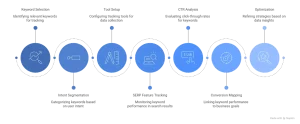
Image Source: Created using Napkin AI.
Step 1: Identify the Right Keywords
Not every keyword deserves to be tracked.
Instead of monitoring hundreds of random queries, focus on:
- Primary commercial keywords
- High-intent transactional terms
- Strategic informational content keywords
- Cluster-based keyword groups
- Brand vs non-brand keywords
Prioritize terms that align with revenue goals and core service pages. Many businesses waste time tracking long-tail phrases that generate no meaningful traffic or conversions.
Avoid that mistake.
Map each keyword to a specific landing page. This helps you identify keyword cannibalization, content gaps, and under-optimized pages. When rankings shift, you’ll immediately know which URL requires attention.
Step 2: Segment Keywords by Intent and Funnel Stage
SEO in 2026 is driven by search intent.
Organize keywords into:
- TOFU (Top of Funnel): Educational or awareness-based searches
- MOFU (Middle of Funnel): Comparison and solution-based searches
- BOFU (Bottom of Funnel): High-intent, purchase-ready searches
Additionally, segment by:
- Local vs national intent
- Mobile vs desktop performance
- Informational vs transactional queries
This structured segmentation transforms keyword tracking reports from overwhelming spreadsheets into actionable insights that guide optimization priorities.
Step 3: Choose the Right Keyword Tracking Tools
Accuracy depends heavily on the tools you use.
Google Search Console
Pros:
- Real impression and click data
- Query-level performance tracking
- Device segmentation
Limitations:
- Average position can be misleading
- Data delay
- Limited historical depth
Professional Rank Tracking Tools
Popular options include:
- Ahrefs
- SEMrush
- AccuRanker
- SE Ranking
These platforms provide:
- Daily rank updates
- Local rank tracking
- Mobile vs desktop monitoring
- SERP feature detection
- Competitor keyword tracking
The best keyword tracking tools in 2026 combine ranking data with visibility trends and competitive movement analysis.
Step 4: Track Beyond Rankings
Rankings alone do not drive growth.
Monitor:
- Click-through rate (CTR)
- Impressions
- Organic traffic
- Conversions per keyword
- Revenue per landing page
- SERP features owned
For instance, a keyword ranking #3 with strong CTR and high conversions may outperform a #1 ranking that generates no clicks.
This is where advanced SEO KPI tracking transforms raw ranking data into real business intelligence.
Advanced Keyword Tracking Techniques Most SEOs Ignore
If you want to outperform competitors in 2026, basic keyword tracking is not enough. You need deeper insights that reveal real search visibility and competitive positioning.
1. Track SERP Features Separately
Modern search results are no longer just ten blue links. Today’s SERPs include:
- AI Overviews
- Featured snippets
- People Also Ask
- Image packs
- Video carousels
- Local packs
Owning a featured snippet or appearing inside an AI Overview can drive more clicks than a traditional #1 ranking. If you are not tracking SERP feature ownership, you are missing a critical visibility metric.
SERP feature tracking allows you to measure true search dominance, not just position.
2. Monitor Ranking Volatility
Patterns matter more than single-day movements.
If multiple keywords drop at once, it may signal:
- Algorithm update impact
- Technical SEO issues
- Indexing errors
If only one page declines, the cause is often content relevance or intent mismatch.
Tracking keyword ranking volatility helps you diagnose issues quickly and respond strategically.
3. Competitor Keyword Tracking
Your real competition is other websites ranking above you.
Monitor:
- Competitor ranking changes
- Newly published content
- Keyword gap opportunities
- SERP feature ownership
Competitor keyword tracking uncovers growth opportunities you might otherwise overlook.
How Often Should You Track Keyword Rankings?
| Tracking Frequency | Best For | Why It Works |
|---|---|---|
| Daily Tracking | • eCommerce websites • News websites • Highly competitive industries |
Rankings fluctuate quickly in fast-moving industries. Daily monitoring helps detect sudden drops, competitor moves, or algorithm impacts immediately. |
| Weekly Tracking | • Most service businesses • B2B websites • Mid-sized brands |
Provides a balanced view of trends without overreacting to minor daily fluctuations. Ideal for steady-growth SEO campaigns. |
| Monthly Tracking | • Small local businesses • Low-competition niches |
Suitable when ranking changes are gradual and competition is limited. Focus remains on long-term performance rather than short-term volatility. |
Turning Keyword Tracking Data into SEO Growth
Data without action is wasted. Effective keyword tracking is not about collecting rankings, it’s about using insights to drive measurable improvements.
Here’s how to turn tracking data into real growth.
1. Identify Declining Pages
If rankings drop gradually, take proactive steps:
- Update outdated statistics
- Add relevant FAQs
- Improve internal linking
- Strengthen EEAT signals
Small, strategic updates can often recover lost positions and restore traffic.
2. Improve CTR
If impressions increase but clicks remain flat, visibility isn’t the issue – appeal is.
Optimize by:
- Rewriting title tags
- Improving meta descriptions
- Adding numbers or brackets
- Matching search intent more precisely
Higher CTR can significantly boost traffic without improving rankings.
3. Build Content Clusters
If several keywords rank between positions 5–15, support them with related articles. Strategic internal linking often pushes these pages into top positions.
4. Strengthen Topical Authority
Track keyword groups by theme and expand depth in weaker clusters to improve authority signals.
5. Monitor Conversion Trends
If rankings rise but conversions drop, intent mismatch may be the problem. This is where advanced keyword tracking evolves from reporting into revenue optimization.
Common Keyword Tracking Mistakes to Avoid
Even experienced marketers make errors.
| Mistake | Impact | Better Approach |
|---|---|---|
| Tracking too many keywords | Data overload | Focus on high-impact keywords |
| Ignoring mobile rankings | Inaccurate insights | Track device-specific data |
| Not tracking local intent | Missed geo-opportunities | Use geo-based tracking |
| Focusing only on #1 | Misleading success metric | Track SERP features + CTR |
| Manual checking | Biased data | Use professional tools |
| Ignoring revenue correlation | Vanity metrics | Track conversions per keyword |
Conclusion
SEO is no longer about chasing positions. It’s about building visibility, authority, and measurable growth.
In 2026, successful brands:- Track keyword clusters, Monitor SERP features, Align keywords with funnel stages, Correlate rankings with conversions and use data to guide optimization
Smart keyword tracking transforms SEO from guesswork into a predictable growth engine.
If you want to implement a data-driven framework that goes beyond basic ranking reports, Tangence offers advanced SEO services tailored for modern search landscapes. From enterprise SEO strategy to technical audits, content optimization, and competitive intelligence, Tangence ensures your rankings translate into measurable business growth.
Because in 2026, tracking keywords the right way isn’t optional – it’s essential.
Frequently Asked Questions
1. What is keyword tracking in SEO?
Keyword tracking is the process of monitoring how your website ranks for targeted search queries over time, while analyzing visibility, traffic, and performance impact.
2. How accurate are keyword tracking tools?
No tool is 100% accurate due to personalization and location differences. However, professional tools combined with Search Console provide reliable directional data.
3. How many keywords should I track?
Most businesses should track 50–300 strategic keywords segmented by intent and funnel stage.
4. Why do keyword rankings fluctuate daily?
Rankings change due to algorithm updates, competitor activity, SERP feature shifts, and search behavior changes.
5. Is Google Search Console enough for keyword tracking?
It provides valuable performance data but lacks advanced segmentation, competitor tracking, and real-time updates.
6. How do I track local keyword rankings?
Use geo-targeted rank tracking tools that simulate searches from specific cities or regions.
7. Can keyword tracking improve conversions?
Yes. When aligned with search intent and funnel stages, keyword tracking helps optimize pages for higher conversion rates.