
blog
HTTPS and SEO: Why Website Security Matters for Rankings (2026 Guide)

In 2026, SEO has evolved far beyond keyword placement, backlinks, and content length alone. Website security is now a core pillar of search visibility, and HTTPS plays a decisive role in how search engines assess trust, quality, and reliability. Google’s secure-first approach means websites that fail to adopt HTTPS risk losing credibility, user confidence, and organic rankings. Treating HTTPS as a one-time technical task instead of a strategic SEO asset can put your website at a serious disadvantage in competitive search results.
This guide explores the relationship between HTTPS and SEO from both a search engine and user experience perspective. It explains how secure websites influence rankings, crawling efficiency, engagement signals, and long-term organic growth. Whether you manage a blog, a business website, or a large enterprise platform, understanding https seo is essential for building trust, protecting users, and maintaining sustainable search performance in 2026 and beyond.
What Is HTTPS and Why Does It Matter for SEO?
HTTPS (HyperText Transfer Protocol Secure) is the secure, encrypted version of HTTP that safeguards data exchanged between a user’s browser and a website’s server. By using SSL/TLS encryption, HTTPS ensures that sensitive information, such as login details, form submissions, and payment data – cannot be intercepted or altered by malicious third parties. This layer of security protects both users and website owners from data breaches and privacy risks.
| Factor | HTTP | HTTPS |
|---|---|---|
| Data Security | No encryption | Encrypted via SSL/TLS |
| Browser Warning | Shows “Not Secure” | Displays secure indicator |
| SEO Trust Signal | Weak | Strong |
| User Trust | Low | High |
| Google Preference | Not preferred | Preferred for rankings |
From an SEO perspective, HTTPS plays a critical role because it directly influences how search engines and users perceive a website’s trustworthiness. Secure websites are more likely to perform well because:
- Google favors HTTPS-enabled websites in search results
- Modern browsers display warnings for non-HTTPS pages
- Users are more confident engaging with encrypted websites
In 2026, HTTPS is no longer exclusive to ecommerce or financial platforms. Any website aiming for strong search visibility, user trust, and long-term SEO performance must operate on HTTPS.
Is HTTPS a Google Ranking Factor in 2026?
Yes. Google has officially confirmed that HTTPS is a ranking signal, as outlined in its guidelines on HTTPS as a ranking factor. While HTTPS alone will not guarantee top rankings, it functions as a trust-enhancing signal that reinforces other SEO factors such as content quality, user experience, and technical stability.
In 2026, the role of HTTPS in SEO is clearly defined:
- HTTPS is a baseline requirement for search visibility
- Non-secure websites are at a clear competitive disadvantage
- HTTPS supports efficient crawling, accurate indexing, and stronger UX signals
When two pages offer similar content and optimization, search engines are far more likely to rank the secure version higher. This makes https seo a practical necessity for modern websites, not an optional technical upgrade. Websites that fail to meet this security standard risk losing both rankings and user trust in competitive SERPs.
How HTTPS Impacts SEO Beyond Rankings
HTTPS influences SEO in ways that go far beyond direct ranking signals. It shapes how users perceive your website, how they interact with it, and how search engines interpret those interactions. In 2026, these indirect signals play a major role in sustained organic performance.
HTTPS, User Trust & Click-Through Rate (CTR)
Modern browsers clearly alert users when a website is not secure. Labels such as “Not Secure” in the address bar immediately create doubt, even before a user lands on the page. This hesitation often leads to lower organic click-through rates, especially when competing results display secure URLs.
Secure URLs, HTTPS indicators, and trust signals such as padlock icons subconsciously reassure users. In competitive SERPs, users are more likely to click on websites that appear safe and reliable, directly influencing CTR and initial engagement both of which search engines closely monitor.
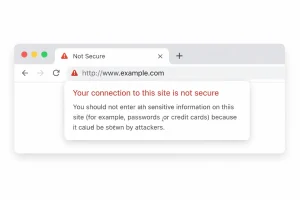
Image source: Screenshot from Google Chrome browser.
HTTPS & Bounce Rate Optimization
Users tend to exit insecure websites faster, particularly when asked to submit personal information. Security warnings trigger fear of data misuse, causing visitors to abandon pages within seconds. This behavior increases bounce rates and reduces dwell time.
HTTPS creates a safer browsing environment, encouraging users to explore multiple pages and spend more time on the site. Improved engagement metrics send positive quality signals to search engines, helping stabilize and improve rankings over time.
HTTPS and Conversion Rate Optimization (CRO)
HTTPS also functions as a powerful conversion trust signal. Lead forms, checkout pages, and contact pages perform significantly better on secure websites. When users feel confident that their data is protected, they are far more likely to complete actions. This alignment of trust, engagement, and conversions makes HTTPS a critical component of long-term SEO and growth strategy.
| Metric | Why It Matters |
|---|---|
| Organic Traffic | Measures SEO stability |
| Keyword Rankings | Detects visibility changes |
| Crawl Errors | Identifies indexing issues |
| Conversion Rate | Shows trust & UX improvement |
| Security Reports | Ensures HTTPS health |
HTTPS and Core Web Vitals: An Overlooked Connection
HTTPS plays an important role in enabling modern web performance technologies such as HTTP/2 and HTTP/3. These protocols are only supported on secure connections and help websites deliver content more efficiently. When implemented correctly, they contribute to noticeable performance improvements, including:
- Faster page loading times
- Better resource prioritization
- Improved server and network efficiency
Although HTTPS alone does not automatically make a website faster, it creates the technical foundation required for meaningful performance optimization. Secure websites are better positioned to improve Core Web Vitals, particularly metrics like Largest Contentful Paint (LCP) and Interaction to Next Paint (INP), which directly influence user experience and rankings.
When performance and security work together, users enjoy smoother interactions and faster load times. This combination strengthens UX signals that search engines value, making HTTPS an essential component of a technically sound SEO strategy in 2026.
HTTPS, Crawling & Indexing: What Googlebot Prefers
Googlebot is built to prioritize secure and trustworthy websites during crawling and indexing. HTTPS URLs are generally treated as the preferred version of a page because they provide stronger data integrity and reliability signals than HTTP. While Google can technically crawl both versions, secure URLs are more likely to be processed efficiently and indexed with confidence.
During an HTTPS migration, canonicalization becomes especially important. If key elements are misconfigured, Google may struggle to understand which version of a page should rank. This can result in:
- Duplicate content issues
- Delayed indexing of HTTPS pages
- Temporary ranking fluctuations
Secure websites also benefit from stronger indexing signals. Google places more trust in HTTPS pages when they are supported by:
- Proper 301 redirects
- Updated XML sitemaps
- Consistent internal linking to HTTPS URLs
From a crawl budget perspective, HTTPS helps reduce unnecessary URL variations. Well-structured, secure sites allow Googlebot to focus on high-value pages, improving overall index coverage and long-term SEO efficiency.
HTTPS Migration SEO Checklist
A successful HTTPS migration requires careful planning and precise execution to avoid traffic loss and ranking drops. Following a structured SEO checklist ensures that search engines and users transition smoothly to the secure version of your website.
Pre-Migration SEO Preparation
Before moving to HTTPS, it’s essential to lay a strong foundation. Start by selecting the right SSL certificate – Domain Validation (DV) works well for most sites, while Organization Validation (OV) or Extended Validation (EV) may be suitable for brands requiring higher trust indicators. Set up a staging environment, take a full website backup, and run a crawl audit to document existing URLs and issues. Finally, benchmark current keyword rankings and organic traffic to measure post-migration performance accurately.
- Choose the appropriate SSL certificate (DV, OV, or EV)
- Create backups and a staging environment
- Conduct a full site crawl and record rankings
During HTTPS Migration
Execution accuracy is critical during migration.
- Implement proper 301 redirects from HTTP to HTTPS
- Update canonical tags to reflect HTTPS URLs
- Fix mixed content issues
- Update internal links across the site
Post-Migration SEO Validation
Website owners are advised to follow Google’s official HTTPS migration best practices to avoid crawling and indexing issues.
- Add the HTTPS property in Google Search Console
- Resubmit updated XML sitemaps
- Monitor indexation, rankings, and traffic fluctuations
HTTPS for Different Website Types
| Website Type | Primary SEO Impact of HTTPS |
| Blogs & Content Websites | Builds trust, improves engagement, and supports content credibility |
| Ecommerce Websites | Secures transactions, boosts conversions, and stabilizes rankings |
| Local Business & Service Websites | Enhances form trust, local SEO signals, and user confidence |
| Enterprise & Multi-Domain Websites | Improves crawl efficiency, indexing consistency, and brand authority |
HTTPS SEO Myths Debunked
There are several misconceptions around HTTPS that often lead to poor SEO decisions. One of the most common myths is that “HTTPS alone boosts rankings.” In reality, HTTPS is a supporting signal, it strengthens trust and usability but does not replace content quality or backlinks.
Another misconception is that SSL certificates slow down websites. Modern encryption protocols like HTTP/2 and HTTP/3 actually improve performance when configured correctly.
It’s also incorrect to assume that only ecommerce websites need HTTPS. Any site collecting user data, even blogs and service pages requires encryption.
Lastly, free SSL certificates are not bad for SEO. Google treats free and paid certificates equally. What matters is proper implementation, not price.
Key takeaways:
- HTTPS is a trust signal, not a ranking shortcut
- Performance depends on configuration, not SSL type
- All websites need HTTPS
- Free SSL certificates are SEO-safe
HTTPS, Data Privacy & E-E-A-T Signals
HTTPS plays a vital role in reinforcing trust and data protection, both of which are central to Google’s E-E-A-T framework. As a trust and safety indicator, HTTPS assures users that their data is encrypted and protected from interception. This directly supports the Trustworthiness component of E-E-A-T.
Security also enhances Experience and Expertise, as professional websites are expected to follow basic safety standards. From a compliance standpoint, HTTPS aligns with GDPR-style data protection expectations, especially for forms, logins, and transactions.
Google prioritizes user protection because unsafe websites harm user confidence and the overall search ecosystem.

Image Source: Created using Napkin AI.
Why HTTPS supports E-E-A-T:
- Protects user data and privacy
- Signals professionalism and credibility
- Aligns with global data protection standards
- Reinforces Google’s user-first ranking philosophy
Measuring HTTPS SEO Impact: What to Track
The SEO impact of HTTPS should be measured over time using both technical and performance metrics. While immediate ranking changes may be subtle, long-term trends reveal the true benefits of a secure website.
Start by monitoring organic traffic trends to identify stability or growth post-migration. Track keyword ranking consistency, especially for high-intent pages. Google Search Console is essential for reviewing crawl errors, indexing status, and security-related warnings.
Conversion data is equally important, as HTTPS often improves form submissions and checkout completion rates.
Key metrics to track:
- Organic traffic and landing page performance
- Keyword ranking stability
- Crawl errors and index coverage reports
- Conversion rates after HTTPS migration
- Security issues and HTTPS status in Search Console
Consistent monitoring ensures HTTPS delivers both SEO and business value.
Common HTTPS SEO Mistakes That Hurt Rankings
HTTPS-related SEO issues often arise from small but critical oversights during implementation or maintenance. These mistakes can weaken trust signals, disrupt indexing, and lead to avoidable ranking drops. One of the most common errors is improper redirect handling, where search engines fail to transfer authority correctly. Other issues stem from misconfigurations that block crawlers or break tracking systems, making performance analysis difficult.
| HTTPS SEO Mistake | Why It Hurts SEO |
|---|---|
| Using 302 redirects instead of 301 | Prevents proper transfer of ranking signals to HTTPS URLs |
| Blocking HTTPS URLs in robots.txt | Stops search engines from crawling and indexing secure pages |
| Not updating analytics & tag manager | Causes data loss and inaccurate performance tracking |
| Allowing SSL certificates to expire | Triggers browser warnings and damages user trust |
| Leaving mixed content issues unresolved | Weakens security signals and affects indexing reliability |
Final Thoughts
In 2026, HTTPS is not an advanced SEO tactic, it’s a minimum requirement. From rankings and crawling to user trust and conversions, https seo plays a critical role in sustainable organic growth.
Businesses that treat security as part of their SEO strategy gain a clear competitive edge. For brands looking to implement HTTPS correctly while aligning it with advanced technical SEO, working with an experienced partner makes a difference. Tangence provides result-driven SEO services that combine security optimization, technical SEO, and E-E-A-T-focused strategies to help websites grow safely and sustainably in evolving search landscapes.
Frequently Asked Questions
1. Is HTTPS mandatory for SEO in 2026?
Yes. While not the only ranking factor, HTTPS is a baseline requirement for competitive SEO.
2. Does HTTPS directly improve rankings?
HTTPS alone won’t guarantee higher rankings, but it strengthens trust and usability signals.
3. Can HTTPS migration cause ranking drops?
Temporary fluctuations are common, but proper redirects and SEO setup prevent long-term losses.
4. How long does HTTPS SEO migration take?
Indexing stabilization typically takes 2–6 weeks, depending on site size.
5. Is a free SSL certificate good for SEO?
Yes. Google treats free and paid SSL certificates the same for SEO purposes.
6. Does HTTPS affect Core Web Vitals?
Indirectly, yes – HTTPS enables performance improvements through modern protocols.
7. What happens if an SSL certificate expires?
Your site may display security warnings, lose trust, and experience ranking drops.