
blog
Digital PR for SEO: How to Earn High-Authority Backlinks
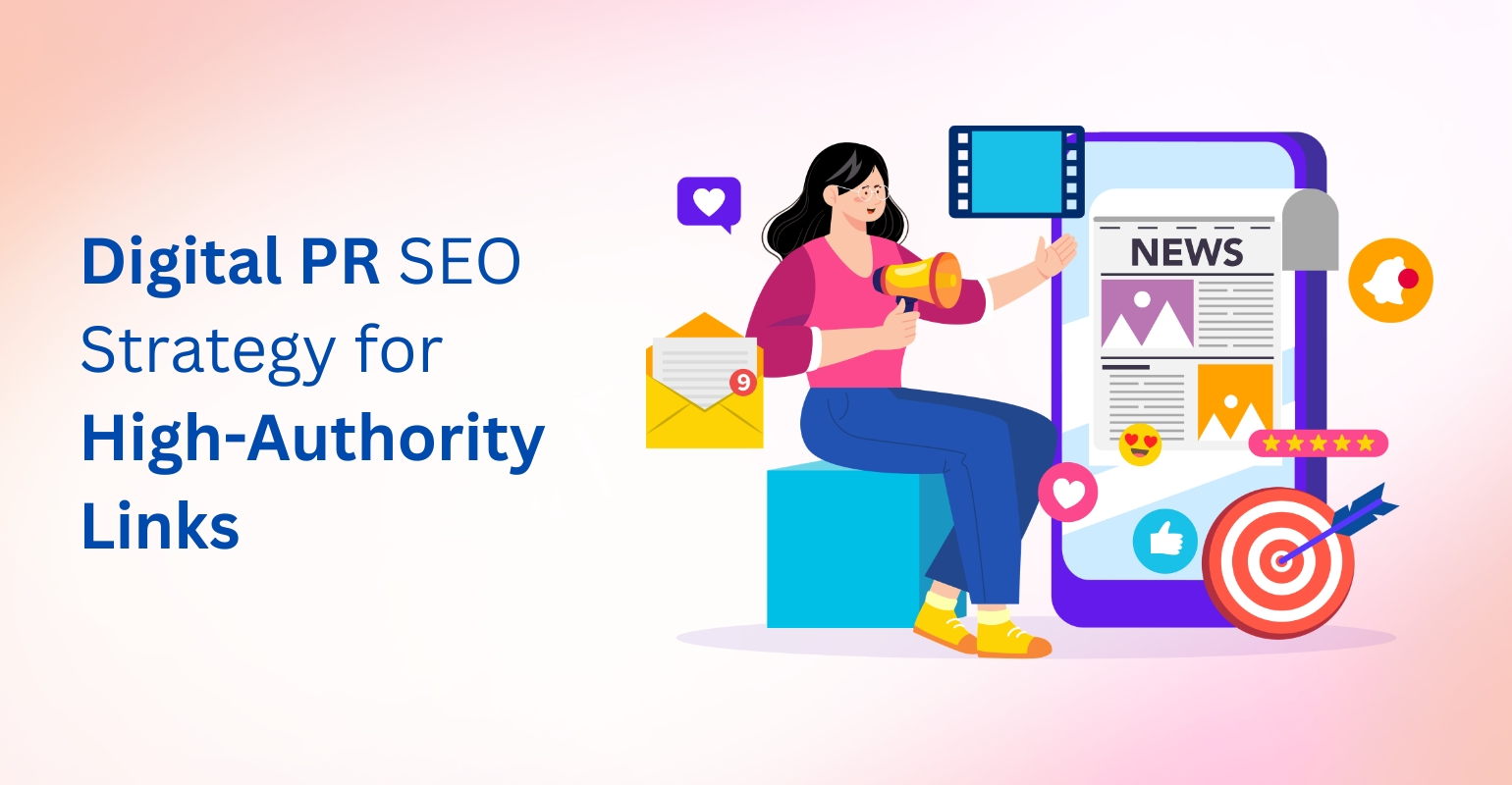
Backlinks remain one of Google’s top three ranking factors – yet most websites are still chasing them the wrong way. Buying links, spamming directories, and recycling generic guest posts may deliver short-term gains, but they create long-term risk. There is a smarter and more sustainable path.
Digital PR SEO is the practice of earning editorially placed, high-authority backlinks by combining public relations strategies with search engine optimisation goals. Instead of paying for links or begging for them, you create something genuinely newsworthy and the links follow naturally.
Over the past decade, working across industries from fintech to e-commerce to SaaS, one pattern has emerged consistently: brands that invest in a structured digital PR SEO strategy outrank competitors, build stronger domain authority, and sustain that authority even through major algorithm updates. In this guide, you will get a clear, actionable framework to do the same – from understanding what digital PR actually means, to executing campaigns that land links in publications your competitors can only dream of.
What Is Digital PR SEO? And How It Differs from Traditional Link Building
Digital PR SEO is the strategic use of public relations techniques – storytelling, media outreach, expert commentary, and data-driven content, specifically to earn backlinks from authoritative media outlets, news websites, and industry publications. Unlike traditional SEO link building, which focuses on acquiring links through transactions or outreach volume, digital PR earns links as a by-product of genuine editorial coverage.
Think of it this way: traditional link building asks for a link. Digital PR earns a link because a journalist or editor found your content genuinely worth citing. That distinction matters enormously to Google’s algorithms, which are increasingly sophisticated at identifying manufactured link patterns versus organic, editorial ones.
| Traditional Link Building | Digital PR for SEO |
|---|---|
| Paid or manipulative | Earned and editorial |
| Low-authority directories | High-DA news & media sites |
| Higher risk of penalties | Google-approved and rewarded |
| Short-term gains | Long-term authority growth |
| Quantity-focused | Quality-focused |
| Outreach-heavy, story-light | Story-first, outreach-enabled |
Google’s John Mueller has repeatedly stated that the best links come from sites that genuinely want to link to you.
Why High-Authority Backlinks Are the Currency of SEO
Not all backlinks are created equal. A single dofollow link from a nationally recognised news outlet is worth more than five hundred links from obscure, low-authority websites. This is the concept of link equity, the ranking power that passes from one domain to another through a hyperlink.
Domain Authority (DA), a metric developed by Moz, and Domain Rating (DR), Ahrefs’ equivalent, both measure how powerful a website’s backlink profile is. When a high-DA website links to yours, it passes a portion of that authority to your domain. This elevates your own authority score and signals to Google that your site is trustworthy and relevant.
| Industry insight: According to Ahrefs’ analysis of over one billion web pages, 66.5% of pages have zero backlinks. The brands that dominate the first page of Google are almost always those with the strongest, most authoritative backlink profiles. |
Rather than building links one at a time through manual outreach, a well-executed digital PR campaign can generate dozens of high-authority links from a single piece of coverage.
Beyond direct link equity, earned media coverage generates brand mentions, referral traffic, and brand awareness, all of which are increasingly important signals in Google’s evolved understanding of quality. When real people search for your brand name after seeing it in a major publication, that branded search behaviour sends powerful trust signals that reinforce your rankings.
7 Proven Digital PR Tactics to Earn High-Authority Backlinks
Digital PR has become one of the most effective ways to earn high-quality backlinks that improve search rankings and brand authority. Unlike traditional link building, these tactics work because they provide genuine value to journalists, editors, and their audiences, the core requirement for earning editorial links at scale.
Below are seven proven digital PR strategies that consistently deliver strong SEO results.
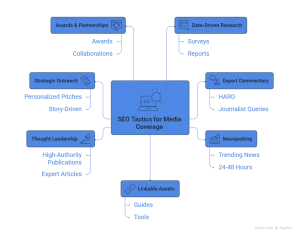
Image Soure: Created using Napkin AI.
1. Data-Driven Studies and Original Research
Journalists rely heavily on data to support their stories. If your brand can produce original research – such as surveys, industry reports, or proprietary datasets, you give them a strong reason to cite your work.
Start by identifying a question your audience cares about. Use tools like Typeform or SurveyMonkey to collect responses, then present your findings in a clear, shareable format. When pitched correctly, your research becomes a valuable news source.
This is one of the highest-ROI digital PR tactics, as a single study can generate backlinks for months or even years.
2. Expert Commentary and Reactive PR
Platforms like HARO (Connectively) allow journalists to request expert opinions for their articles. By responding quickly with relevant insights, you can earn backlinks from authoritative publications.
Speed and quality are crucial here. Monitor journalist queries daily and respond within a few hours with useful, non-promotional input. Position your founder or team as industry experts to align with Google’s E-E-A-T principles.
Over time, consistent contributions build credibility, leading to direct outreach from journalists.
3. Newsjacking and Trend-Based Content
Newsjacking involves inserting your brand’s perspective into trending or breaking news stories. When done effectively, it positions your brand as an expert while earning backlinks from timely media coverage.
The key is timing. Most opportunities exist within 24–48 hours of a story breaking. Brands that succeed in this area use tools like Google Alerts or BuzzSumo to monitor trends and respond quickly with valuable insights.
4. Linkable Asset Creation
Linkable assets are high-value content pieces designed to attract backlinks naturally over time. These include:
- Ultimate guides
- Free tools or calculators
- Templates and frameworks
- Interactive content
Although they require upfront effort, they deliver long-term benefits. A strong linkable asset can continue earning backlinks without ongoing outreach, making it a cost-efficient strategy.
5. Thought Leadership Guest Articles
There’s a clear difference between generic guest posts and thought leadership content. While generic posts often focus on backlinks, thought leadership pieces provide unique insights based on real expertise.
High-authority publications prefer content that offers value to their audience. To succeed, your pitch should highlight a fresh perspective, prediction, or framework that aligns with their readers’ interests.
When done right, this strategy strengthens both your brand authority and backlink profile.
6. Strategic Digital PR Outreach Campaigns
Effective outreach is about precision, not volume. Instead of sending mass emails, focus on building a targeted list of relevant journalists and publications.
A strong pitch should include:
- A compelling, headline-style subject line
- A clear and newsworthy angle
- Supporting data or insights
- A simple call to action
Personalization plays a major role. Building relationships with journalists over time increases your chances of getting featured and earning backlinks.
7. Awards, Partnerships, and Strategic Brand Mentions
Winning industry awards or forming partnerships can generate high-authority backlinks from trusted domains. These links often come from .org, .edu, or .gov websites, which carry significant SEO value.
Examples include:
- Industry awards and recognitions
- University collaborations
- Nonprofit partnerships
- Government initiatives
These opportunities not only improve your backlink profile but also enhance brand credibility, making them a powerful addition to your digital PR strategy.
How to Measure the SEO Impact of Your Digital PR Campaigns
One of the most common complaints about digital PR is that its ROI is difficult to measure. In reality, the metrics are clear, you simply need to know what to track and which tools to use.
The primary KPIs for a digital PR SEO campaign are: number of referring domains gained (measured in Ahrefs or SEMrush), Domain Rating or Domain Authority improvement over time, organic traffic growth to pages supported by the earned links, keyword ranking movement for target terms, and referral traffic from the specific publications that covered your story.
| Metric | Tool to Track It |
|---|---|
| Referring domains growth | Ahrefs, SEMrush, Moz |
| Domain Rating / Authority | Ahrefs (DR), Moz (DA) |
| Keyword ranking movement | Google Search Console, SEMrush |
| Organic traffic growth | Google Analytics 4 (GA4) |
| Referral traffic from PR | GA4 Acquisition Report |
| Unlinked brand mentions | Ahrefs Alerts, Google Alerts |
One often-overlooked opportunity is unlinked brand mentions – instances where a publication references your brand by name but does not include a hyperlink. These represent warm link-building opportunities because the journalist has already shown interest in your brand. A brief, polite follow-up email asking them to add a link converts at a significantly higher rate than a cold outreach pitch.
Track your campaign results monthly. Look for correlation between coverage spikes and ranking improvements. This data not only answers the question of whether digital PR improves search rankings, it builds the internal business case for sustained investment in the strategy.
Digital PR SEO for Small Businesses: Is It Worth It?
A common misconception is that digital PR SEO is reserved for large enterprises with dedicated communications teams and six-figure budgets. The reality is quite different. Small businesses can execute highly effective digital PR campaigns by focusing on niche relevance rather than mainstream reach.
A local accountancy firm does not need a link from Forbes. A link from a respected regional business publication, a national accountancy trade journal, or a well-regarded personal finance blog can be enormously impactful for ranking in their specific market. The digital PR backlink strategy for small businesses is the same in principle as for enterprises – the target publications are simply different.
| Mini case study: A regional e-commerce retailer conducted a local survey on consumer shopping habits and pitched the findings to three regional news outlets and two national consumer publications. The resulting coverage generated nine high-authority referring domains, a 23% increase in organic traffic within 90 days, and a measurable improvement in rankings for their core category keywords. |
For small businesses, the most accessible entry points into digital PR are reactive PR through journalist query platforms (HARO/Connectively), niche-specific guest articles, and local data stories. These require time and expertise but relatively modest financial investment, making them an excellent starting point for businesses building their link building strategy for the first time.
Common Digital PR SEO Mistakes to Avoid
| Mistake | Why It Hurts | Quick Fix |
|---|---|---|
| Pitching irrelevant journalists | Low response rate, wasted outreach | Build a targeted media list |
| Ignoring nofollow vs dofollow links | Weak SEO impact | Track link types and prioritize dofollow |
| Misaligned PR content with keywords | Poor ranking benefit | Align content with target keywords |
| Focusing on quantity over quality | Low authority links | Prioritize high-DA publications |
| Skipping follow-ups | Missed opportunities | Send 1–2 polite follow-ups |
| Not tracking campaign ROI | No performance visibility | Set up a reporting dashboard |
Conclusion
Digital PR SEO is not a shortcut, and it is not a quick fix. It is a long-term authority-building system that positions your brand as a trusted, credible voice in your industry and earns the kind of backlinks that Google rewards with sustained, compounding rankings.
The brands that outrank their competitors are not necessarily the ones with the best products or the biggest budgets. They are the ones that have built the deepest wells of editorial trust and digital PR is the most effective mechanism for doing that in 2026 and beyond.
If you are ready to build a results-driven digital PR SEO strategy but need expert support to execute it, Tangence is your trusted partner. Tangence offers end-to-end SEO services, from high-authority link building and digital PR campaign management to technical SEO, content strategy, and organic search optimisation. Explore Tangence’s SEO services today and start earning backlinks that genuinely move the needle.
Frequently Asked Questions
Q1: What is digital PR in SEO?
Digital PR SEO uses media outreach and content to earn high-quality backlinks from authoritative websites, improving rankings and credibility.
Q2: How does digital PR help with link building?
It earns natural backlinks through media coverage, which are more valuable and trustworthy than paid or low-quality links.
Q3: How long does digital PR take to show results?
You may see link growth in 4–8 weeks, while ranking improvements typically take 3–6 months.
Q4: What content works best for digital PR?
Original research, surveys, expert insights, and data-driven content perform best for earning backlinks.
Q5: Is digital PR suitable for small businesses?
Yes, small businesses can gain strong results by targeting niche and regional publications.
Q6: How is digital PR different from SEO outreach?
Digital PR focuses on earning media coverage, while traditional outreach focuses mainly on acquiring links.
Q7: How do I find journalists for digital PR?
Use platforms like HARO, Qwoted, and Muck Rack to connect with journalists in your niche.