-01.svg) SEO Services
SEO Services-02.svg) Local SEO Services
Local SEO Services-03.svg) AI SEO Services
AI SEO Services-04.svg) Technical SEO Services
Technical SEO Services-05.svg) Performance Marketing
Performance Marketing-06.svg) Social Media
Social Media-07.svg) Content Marketing
Content Marketing-08.svg) Web Development
Web Development-09.svg) App Development
App Development-10.svg) Marketing Automation
Marketing Automation-11.svg) Real Estate
Real Estate-12.svg) Ecommerce
Ecommerce-13.svg) Education
Education-14.svg) Healthcare
Healthcare B2B
B2B SAAS
SAAS Law Firm
 BFSI
BFSI Renewable Energy
 Tour and Travel
blog
Advanced On-Page SEO Guide: Expert Techniques for Modern Content Optimization
If you want to rank in 2026, basic SEO won’t cut it anymore. Google’s algorithm has evolved into a powerful, AI-driven system that rewards relevance, depth, and top-tier user experience. That’s where advanced on-page SEO comes in; a smarter, data-backed approach to optimizing your content, structure, and search signals.
Think of it as the “pro mode” of content optimization. Instead of stuffing keywords or tweaking title tags, advanced on-page SEO focuses on search intent, semantic signals, entities, NLP-driven optimization, and engagement metrics that actually move rankings today. After analyzing hundreds of pages and ranking patterns over the years, one thing is clear: websites that master advanced on-page SEO consistently outrank competitors, even in competitive niches.
This guide breaks down the expert-level techniques used by top SEOs, content strategists, and enterprise brands. You will learn how to map search intent like a scientist, structure content for maximum crawlability, optimize for entity-based search, and boost engagement signals that Google loves. Whether you are a marketer, SEO professional, or business owner, this is your ultimate playbook for mastering advanced on-page SEO in 2026.
What Is Advanced On-Page SEO? (And Why Basic SEO Isn’t Enough in 2026)
Most websites follow the same old on-page checklist: title tags, meta descriptions, target keywords, and a few headers. But here’s the truth – basic SEO is no longer enough to rank in 2026. Google’s systems have shifted from keyword matching to intent matching, and from basic indexing to semantic understanding. That’s where advanced on-page SEO comes in.
At its core, advanced on-page SEO goes beyond surface-level optimization. It focuses on how Google interprets meaning, context, and relationships between topics. Instead of optimizing a page for one keyword, you optimize a page for a topic, backed by semantic depth, entities, NLP signals, and relevance factors that search engines now rely on.
| Basic On-Page SEO | Advanced On-Page SEO |
|---|---|
| Keyword placement | Semantic & entity optimization |
| H1/H2 setup | Header hierarchy aligned with intent |
| Meta tags | Schema layers + structured data |
| Simple internal links | Intent-based internal linking architecture |
| Surface-level content | Deep topical authority + context completeness |
| Keyword matching | Intent and context matching |
| Image alt tags | Media optimization for engagement signals |
Why Basic SEO Fails Today
Basic on-page optimization worked when Google relied heavily on keyword frequency. But modern algorithms like BERT, RankBrain, and the Helpful Content System evaluate content like a human would. They measure:
- Whether your page satisfies the searcher’s precise intent
- How effectively you cover the topic and connected subtopics
- The entities you include and their relationships
- The clarity and usefulness of your content
- Whether users stay, read, scroll, and engage
Basic SEO doesn’t account for these, which is why so many “optimized” pages still fail to rank.
What Makes It Advanced?
Here’s what separates advanced on-page SEO from standard optimization:
1. Topic + Entity Optimization
Instead of only keywords, advanced strategies use entities; people, places, concepts, brands etc. to strengthen topical relevance. Using entities tells Google your content is authoritative and connected to real-world concepts.
2. Intent-Based Structuring
Your content architecture changes based on whether the user wants to learn, compare, solve, or buy. This drives higher satisfaction, which boosts rankings.
3. NLP-Driven Content Signals
AI models evaluate sentiment, context clarity, and content strength.
Advanced on-page SEO aligns your writing with the traits these models reward.
4. Semantic Keyword Integration
Instead of repeating the focus term, you use long-tail, LSI, and contextual phrases that build semantic richness, like:
- “semantic on-page optimization”
- “entity-based SEO strategy”
- “modern on-page SEO”
- “intent-driven content optimization”
These keywords reinforce your main topic without keyword stuffing.
5. Engagement-Focused UX
Google measures how people behave on your page. If users stay longer, scroll deeper, and interact, the page sends strong ranking signals.
Why Advanced On-Page SEO Matters More in 2026
With AI-generated content everywhere, Google now rewards depth, originality, and expert-level coverage. If your page lacks topical completeness or doesn’t satisfy search intent perfectly, it simply won’t rank, no matter how good the backlinks are.
This is why advanced on-page SEO is becoming the new standard. It bridges the gap between content and search psychology, helping your pages become the best possible result.
Deep Keyword Intent Mapping – The Backbone of Advanced On-Page SEO
When most people think of keyword research, they imagine finding a keyword with good search volume and low competition. But in advanced on-page SEO, keyword research is no longer about keywords, it’s about understanding intent, context, and topic depth. This is where Deep Keyword Intent Mapping becomes a game-changer.
If you want Google to see your content as the “best answer,” you must align your page with the precise intention behind the search. And in 2026, Google’s AI-driven engines can identify intent far more accurately than before.
Understanding Search Intent at a Granular Level
There are four basic types of search intent; informational, navigational, transactional, and commercial. But advanced on-page SEO digs deeper. Each intent type has micro-intents beneath it, such as:
| Intent Type | Micro-Intent | Example Queries |
|---|---|---|
| Informational | How-to, research, problem-awareness, concept clarification | “how to optimize content”, “what is semantic SEO” |
| Navigational | Homepage, login, tool-specific, support, brand resource | “ahrefs login”, “Google Ads help” |
| Commercial | Comparison, feature evaluation, solution research | “best SEO tools 2025”, “Surfer vs Clearscope” |
| Transactional | Purchase-ready, pricing intent, high-trust vendor check | “buy SEO tool online”, “rank tracking tool price” |
Understanding these micro-intents lets you craft content that precisely matches what the user expects.
Entity-Based Keyword Clustering
Instead of creating content around one keyword, advanced on-page SEO uses topic clusters powered by semantic search. You group keywords by the entities Google associates with them.
For example, if your focus keyword is advanced on-page SEO, related semantic clusters may include:
- Entities: Google algorithms, Core Web Vitals, E-E-A-T, schema markup, NLP
- Supporting terms: semantic keyword optimization, on-page SEO techniques, search intent alignment
- Long-tail opportunities: advanced on-page SEO strategies, how to optimize content semantically, entity-based SEO techniques
These clusters help Google understand your content’s depth and topical authority.
Using NLP to Match Content With Searcher Intent
Modern algorithms evaluate content using Natural Language Processing (NLP) models like BERT and MUM. Your job is to structure content in a way that aligns with how these models interpret context.
Advanced SEOs do this by:
- Using high-value NLP keywords (people also ask, semantic terms)
- Writing contextually rich headers
- Ensuring clear topic transitions
- Answering questions Google expects in the topic
This builds natural semantic completeness.
Long-Tail & LSI Keyword Integration
Top-ranking pages never rely on a single keyword. They use long-tail variations such as:
- “advanced on-page SEO techniques”
- “semantic on-page SEO strategies”
- “how to optimize content for search intent”
- “entity-based on-page SEO methods”
These keywords diversify your topical footprint and reduce ranking volatility.
Intent-Aligned Content Structuring
Once you understand the intent behind every keyword cluster, your content structure becomes more strategic. You can:
- Place high-intent answers early
- Use H2s for top-level intent questions
- Add comparison tables for commercial intent
- Embed conversion triggers for transactional intent
This alignment directly boosts rankings and user satisfaction.
Why Deep Intent Mapping Drives Higher Rankings
Google wants one thing: the best result for the searcher. When your content matches the intent perfectly, you reduce pogo-sticking, improve dwell time, and increase engagement – all powerful ranking signals in advanced on-page SEO.
Technical On-Page Enhancements Most SEOs Overlook
Most people think technical SEO is separate from on-page optimization, but in reality, they are deeply connected. Advanced on-page SEO isn’t just about using better keywords or structuring content smartly, it’s also about optimizing the technical elements inside the page that influence how Google crawls, understands, and ranks your content. These are the hidden ranking boosters most SEOs never touch.
Below are the overlooked technical enhancements that can significantly accelerate your rankings when implemented correctly.
1. Advanced Internal Linking Architecture
Internal linking is one of the most misused on-page techniques. Instead of adding random links, advanced on-page SEO uses:
- Topical clusters with strategic hubs
- Contextual anchors aligned with semantic keywords
- Authority redistribution to pillar pages
- Deep-linking to reduce orphan pages
This creates a structured internal map that helps Google understand topical relationships and strengthens your authority across the entire domain.

Image Source: Created using Napkin AI.
2. Schema Markup Beyond the Basics
Most sites only use basic schema like Article or FAQ. But advanced on-page SEO leverages rich, layered schema such as:
- Entity Schema
- Breadcrumb Schema
- Speakable Schema (for voice search)
- Author Schema (E-E-A-T booster)
- FAQ & How-To Schema
- VideoObject + ImageObject Schema
When used correctly, schema improves click-through rates and helps Google better interpret your page’s purpose, increasing ranking stability.
3. Core Web Vitals Impact Inside Content
Core Web Vitals isn’t just about your website’s overall performance, it’s about the actual content layout impacts metrics like LCP, CLS, and FID. For advanced on-page SEO, this means:
- Using optimized hero images
- Avoiding layout shifts caused by ads or embeds
- Preloading key assets
- Applying lazy loading intelligently
- Using responsive image ratios
A well-structured content layout can directly improve Core Web Vitals, which Google uses as a ranking signal.
4. Crawl Optimization & Indexation Efficiency
Google’s crawl budget is limited – even on small sites. A poorly structured on-page layout or messy internal linking can stop key pages from being crawled effectively.
Advanced on-page optimization includes:
- Reducing JavaScript-heavy elements in content
- Structuring HTML elements logically
- Using clean URL structures
- Ensuring important text loads without JS
- Preventing duplication via canonical tags
These small enhancements improve how Googlebot parses your page, leading to faster indexing and stronger ranking signals.
5. Silo Structure Reinforcement Inside the Page
Most SEOs build silos at the site level, but advanced on-page SEO strengthens silos inside the content.
This includes:
- Topical sections grouped logically
- Interlinking between related H2/H3 blocks
- Supporting content for each subtopic
- Reinforcing semantic clusters with entity mentions
The stronger your content silo structure, the easier it is for Google to classify and rank your content as authoritative.
Why These Technical On-Page Enhancements Matter
These are invisible ranking signals, but Google sees all of them. When your page is faster, better structured, semantically mapped, schema-enriched, and internally connected, Google gives you an instant competitive advantage. Most websites never implement these which is why advanced on-page SEO is such a powerful ranking differentiator.
Content Optimization Techniques Used by Top SEOs
If there’s one thing Google rewards consistently in 2025, it’s content depth, clarity, and topical completeness. Basic content optimization focuses on keyword placement. But advanced on-page SEO focuses on structuring your content to align with how Google’s AI evaluates meaning, expertise, and usefulness. This is where top SEOs gain an unfair advantage.
Below are the exact content optimization techniques expert SEOs use to create pages that dominate competitive SERPs.
1. Semantic-Rich Content Writing (The Heart of Advanced On-Page SEO)
Modern ranking algorithms evaluate text like a human. They look for:
- Semantic variety
- Entity completeness
- Contextual relevance
- Natural keyword distribution
This means weaving LSI keywords, long-tail variations, and contextual phrases into your content to build meaning, not stuffing your focus keyword unnaturally.
For example, instead of repeating “advanced on-page SEO,” you use variations like:
- “semantic on-page optimization”
- “entity-first content optimization”
- “intent-driven SEO content”
- “content depth and topical authority”
This tells Google you’re covering the subject comprehensively.
2. Smart Header Layering (H2, H3, H4 Hierarchy That Google Understands)
Your headers act as your page’s roadmap. Top SEOs design headers to:
- Match search intent
- Group related subtopics
- Improve readability
- Strengthen semantic structure
Header should answer a key sub-intent related to the main topic.
H3 should support the H2 above it.
H4 should expand on highly specific microtopics.
This structure boosts both user experience and algorithmic understanding.
3. The Content Refresh Strategy (Your Hidden Ranking Weapon)
Most pages decay because the information gets outdated. Top SEOs schedule refresh cycles to:
- Update statistics
- Add new semantic keywords
- Improve internal linking
- Rework examples
- Add new trends or algorithm updates
Refreshing adds freshness signals, something Google actively promotes in competitive niches.
4. The Topical Authority Method
Google doesn’t reward individual pages anymore; it rewards topic experts. To build topical authority:
- Create cluster pages around your main keyword
- Interlink cluster pages with your pillar content
- Add supporting content like glossaries, guides, and FAQ hubs
- Include related entities throughout your content
The more related content you produce, the more Google trusts you.
5. UX + SEO Combined Optimization
Top-ranking content doesn’t just satisfy queries – it satisfies users.
Advanced on-page SEO focuses on user-driven enhancements such as:
- Short paragraphs for mobile readability
- Visuals that break cognitive load
- Scroll-triggered engagement elements
- Interactive media (charts, accordions, infographics)
- Clean design that encourages long dwell time
Better UX = better engagement = better rankings.
Why Advanced Content Optimization Wins
When you combine semantic writing, smart headers, topical authority, and UX-focused design, your content becomes algorithm-proof. This is why top SEOs consistently outperform average writers, they optimize for both humans and Google’s AI systems.
Advanced On-Page Engagement Signals That Boost Rankings
You can have perfectly optimized keywords, flawless schema, and fast loading times… but if users don’t engage with your page, your rankings will eventually flatline. Google’s AI-powered ranking systems pay very close attention to how users behave on your website. These behavior patterns called engagement signals play a major role in modern ranking performance.
In advanced on-page SEO, improving engagement isn’t optional. It’s essential.
Here are the engagement-focused techniques top SEOs use to boost dwell time, reduce pogo-sticking, and create the kind of on-page experience Google rewards.
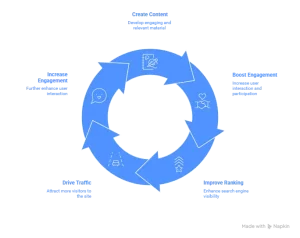
Image Source: Created using Napkin AI.
1. Understanding Modern Engagement Metrics
Google’s algorithms evaluate several engagement signals, including:
- Dwell Time: How long the user stays on your page
- Bounce Rate (Intent-Based): Did the user return immediately?
- Scroll Depth: How deep the user scrolls
- CTR: Percentage of users clicking your result
- Pogo-Sticking: Jumping back to SERP to find another answer
With AI models like RankBrain and Core Updates prioritizing user satisfaction, these metrics now influence rankings more than ever.
2. Visual Optimization to Increase Time-on-Page
Adding visuals isn’t enough; how you use them matters.
Top SEOs structure visuals to break cognitive load and enhance understanding:
| Visual Type | Why It Helps |
|---|---|
| Infographics | Summarizes complex data |
| Diagrams | Simplifies processes |
| Screenshots | Makes explanations practical |
| Interactive media | Boosts dwell time |
| Napkin sketches | Adds originality & explanation |
These elements make your content easier to digest, which increases session duration; a powerful sign of content usefulness.
3. Reducing Pogo-Sticking Through Intent-Focused Content
Users pogo-stick when results don’t match their intent.
Advanced on-page SEO prevents this by:
- Placing high-intent answers at the top
- Using bold callouts for solutions
- Matching SERP expectations with strong intros
- Adding summary tables for quick clarity
- Using FAQ snippets to answer micro-intents
If your page delivers the answer earlier and better than competitors, pogo-sticking drops dramatically.
4. Creating On-Page Conversion Funnels (Even for Informational Pages)
A conversion funnel isn’t only for sales pages; even informational blogs need a structured engagement flow.
Examples include:
- Clickable table of contents
- Sticky navigation to keep users exploring
- Inline CTAs (“Learn More,” “Explore Full Guide”)
- Internal links that lead users deeper
- Content upgrades like downloadable checklists
This reduces dead-ends and keeps visitors moving through your site, increasing total session length – a major engagement signal.
5. Interactive Elements That Boost Engagement
Google rewards content that feels interactive, not static.
Top-performing SEOs incorporate:
- Accordions
- Comparison tables
- Poll-style widgets
- Scroll-triggered highlights
- Interactive charts
- Code blocks, summaries, and “copy” buttons
These elements align with UX best practices and encourage deeper on-page interaction.
Why Engagement Signals Matter for Advanced On-Page SEO
Google wants to promote the pages people find most helpful.
When users:
- Read longer
- Scroll deeper
- Click more elements
- Explore more pages
- Take action on your suggestions
Google sees your page as a valuable resource. That directly improves ranking longevity and stability; especially during Core Updates.
In 2026 and beyond, your ability to optimize engagement signals will make the difference between ranking temporarily and ranking consistently.
Final Thoughts
The SEO landscape in 2026 is going to be radically different from what it was just a few years ago. Google’s AI-driven ranking systems don’t just look at keywords, backlinks, or basic optimization. They evaluate depth, intent alignment, entity relevance, semantic completeness, and user engagement at a level that mirrors human understanding. This is why advanced on-page SEO has become the backbone of sustainable search visibility.
From semantic writing and entity optimization to technical enhancements, Core Web Vitals alignment, structured content, internal linking, and UX-driven engagement signals – every ranking factor ties back to one simple idea: Be the best possible answer for the searcher. And that’s exactly what Tangence’s advanced on-page SEO helps you achieve.
If you want your website to rank faster, attract qualified traffic, and build long-term search authority, Tangence is the partner that gets you there.
Frequently Asked Questions
1. Is advanced on-page SEO different from technical SEO?
Yes. Technical SEO optimizes site infrastructure, while advanced on-page SEO focuses on semantic optimization, intent alignment, entity usage, content structure, engagement signals, and page-level technical enhancements.
2. How long does advanced on-page SEO take to show results?
Most websites begin seeing improvements within 30–90 days, depending on domain authority, competition, and content structure.
3. What tools are best for advanced on-page SEO?
Tools like Surfer SEO, Frase, Clearscope, Ahrefs, SEMrush, Screaming Frog, and Google NLP API help with semantic optimization, content scoring, and technical on-page insights.
4. How often should content be updated for best results?
A refresh every 3–6 months keeps your content aligned with new search trends, SERP changes, and algorithm updates.
5. What is entity-based SEO and why does it matter?
Entity-based SEO focuses on real-world concepts connected to your topic. Google uses entities to understand deeper context, making them essential for ranking competitive content.
6. Is keyword density still important in 2025?
Not in the traditional sense. Modern advanced on-page SEO prioritizes semantic relevance, not repeating the exact keyword. Intent, entities, and NLP signals matter more.
7. Can advanced on-page SEO improve E-E-A-T?
Absolutely. Semantic structure, expert authorship, factual depth, and proper schema markup all contribute to stronger E-E-A-T signals.