-01.svg) SEO Services
SEO Services-02.svg) Local SEO Services
Local SEO Services-03.svg) AI SEO Services
AI SEO Services-04.svg) Technical SEO Services
Technical SEO Services-05.svg) Performance Marketing
Performance Marketing-06.svg) Social Media
Social Media-07.svg) Content Marketing
Content Marketing-08.svg) Web Development
Web Development-09.svg) App Development
App Development-10.svg) Marketing Automation
Marketing Automation-11.svg) Real Estate
Real Estate-12.svg) Ecommerce
Ecommerce-13.svg) Education
Education-14.svg) Healthcare
Healthcare B2B
B2B SAAS
SAAS Law Firm
 BFSI
BFSI Renewable Energy
 Tour and Travel
blog
Keyword Mapping: How to Assign Keywords to Pages Correctly
Many websites fail to rank on Google not because their content is poor, but because their keywords are assigned incorrectly. Multiple pages compete for the same search terms, important pages remain invisible, and traffic fails to convert. This is where keyword mapping for SEO becomes essential.
Keyword mapping connects keyword research with content strategy, page structure, and search intent. Instead of randomly targeting keywords, it ensures that each page has a clear purpose, a unique keyword focus, and a defined role in the overall SEO strategy.
When done correctly, keyword mapping helps search engines understand your website hierarchy, improves ranking stability, and prevents keyword cannibalization. It also makes content scaling easier, especially for growing websites with blogs, service pages, and landing pages.
In this guide, you will learn:
- What keyword mapping for SEO really means
- How to assign keywords to pages correctly
- A step-by-step keyword mapping process
- Common mistakes to avoid
- How keyword mapping supports long-term SEO growth
What Is Keyword Mapping for SEO?
Keyword mapping for SEO is the process of assigning specific target keywords to individual website pages based on relevance and search intent. It ensures that each page targets a unique keyword set, improves topical clarity, and prevents keyword cannibalization. This structured approach helps search engines clearly understand which page should rank for which query.
Keyword mapping is not just about choosing keywords, it’s about assigning the right keywords to the right pages.
Instead of letting multiple pages compete for the same term, keyword mapping defines:
- One primary keyword per page
- Supporting secondary and semantic keywords
- The search intent the page is meant to satisfy
Keyword mapping creates clarity for:
- Search engines
- Content creators
- SEO teams
- Business stakeholders
This clarity directly translates into stronger rankings and more predictable SEO results.
Keyword Research vs Keyword Mapping
| Keyword Research | Keyword Mapping | |
|---|---|---|
| The process of finding keywords people search for | The process of assigning keywords to specific pages | |
| Identifies keyword opportunities | Organizes keywords for correct page targeting | |
| What keywords to target | Where each keyword should be targeted | |
| Discovers demand and search behavior | Prevents overlap and improves ranking clarity | |
| Works in isolation but lacks execution | Fails without accurate keyword data | |
| Incomplete without mapping | Ensures keyword research delivers results |
Why Keyword Mapping Matters in Modern SEO
Keyword mapping for SEO plays a critical role because it:
- Prevents multiple pages from targeting the same keyword
- Aligns content with search intent
- Improves internal linking structure
- Strengthens topical authority
- Helps Google understand page relevance
Google ranks pages based on intent satisfaction and topical clarity, not just keyword usage. Keyword mapping ensures both.
Common Problems Keyword Mapping Solves
Poor keyword mapping often leads to:
- Keyword cannibalization
- Pages ranking on page 2–3 instead of page 1
- High impressions but low clicks
- Content that attracts traffic but no conversions
A well-structured keyword mapping strategy eliminates these issues by design.
Understanding Search Intent Before Keyword Mapping
Keyword mapping fails when search intent is ignored. Even perfectly optimized pages will not rank if the content does not match what the user actually wants. That’s why understanding search intent is a non-negotiable step in keyword mapping for SEO.
Search intent explains why a user searches a particular query and Google prioritizes pages that satisfy that intent most accurately.
What Is Search Intent in SEO?
Search intent refers to the goal a user has when typing a query into a search engine. Google ranks pages based on how well they fulfill that goal, not just on keyword usage. If your page does not match the intent behind the keyword, it will struggle to rank, regardless of backlinks or content length.
Types of Search Intent You Must Consider
There are four primary types of search intent used in SEO keyword mapping.
- Informational Intent:- Users want to learn or understand something.
- Navigational Intent:- Users want to reach a specific brand or platform.
- Commercial Investigation Intent:- Users are comparing options before making a decision.
- Transactional Intent:- Users are ready to take action.
Why Search Intent Is Critical for Keyword Mapping for SEO
Keyword mapping for SEO is not just about assigning keywords, it’s about assigning intentually correct keywords to the right pages.
When intent is mismatched:
- Blog posts try to rank for commercial keywords
- Service pages target informational queries
- Landing pages receive traffic but no conversions
This leads to:
- Poor rankings
- High bounce rates
- Low engagement signals
Google interprets this as low relevance.
Search Intent Alignment:-
| Keyword | Search Intent | Correct Page Type |
|---|---|---|
| keyword mapping for SEO | Informational | Blog post |
| SEO services for businesses | Commercial | Service page |
| hire SEO agency | Transactional | Landing page |
This alignment is what allows keyword mapping to actually work.
Keyword Research: The Foundation of Effective Keyword Mapping
Keyword mapping cannot work without structured keyword research. If the keywords are weak, irrelevant, or poorly grouped, even the best mapping process will fail. This is why keyword research acts as the input layer for keyword mapping for SEO.
The goal here is not to collect as many keywords as possible but to collect the right keywords that can be cleanly assigned to pages.
What Role Does Keyword Research Play in Keyword Mapping?
Keyword research provides the data needed to decide which keywords should be mapped to which pages. Without accurate keyword research, keyword mapping becomes guesswork.
Keyword mapping for SEO relies on keyword research to:
- Identify ranking opportunities
- Understand search demand
- Match keywords with search intent
- Avoid targeting irrelevant or duplicate terms
Step 1: Collect Keyword Data From Reliable Sources
Start by gathering keywords from multiple sources to avoid blind spots.
Recommended sources include:
- Google Search Console (queries already driving impressions)
- Keyword research tools (volume, difficulty, CPC)
- Competitor ranking analysis
- Existing content performance data
Step 2: Separate Head Keywords and Long-Tail Keywords
Not all keywords play the same role in keyword mapping for SEO.
- Head keywords are broader and usually have higher competition
- Long-tail keywords are more specific and intent-driven
A single page should usually target:
- One head or primary keyword
- Multiple long-tail and semantic variations
Long-tail keywords improve topical depth and help pages rank faster.
Step 3: Group Keywords by Topic and Intent
Before assigning keywords to pages, group them logically.
Keyword grouping should be based on:
- Topical similarity
- Shared search intent
- SERP overlap
If two keywords return nearly identical Google results, they belong in the same group. If the results differ significantly, they should be mapped to different pages.
This grouping step prevents keyword cannibalization later.
Step 4: Prioritize Keywords for Mapping
Not every keyword deserves its own page.
When prioritizing keywords for keyword mapping, consider:
- Business relevance
- Conversion potential
- Ranking difficulty
- Content effort required
Step 5: Match Keywords With Existing Pages First
Before creating new content, check whether an existing page can be optimized.
Ask:
- Does a page already match this keyword’s intent?
- Can the page be expanded or re-optimized?
- Is the page already ranking on page 2 or 3?
Optimizing existing pages is often faster and more effective than publishing new ones.
Why Over-Collecting Keywords Hurts Keyword Mapping
Collecting thousands of keywords without structure leads to:
- Duplicate targeting
- Thin pages
- Intent confusion
- Poor internal linking
Effective keyword mapping focuses on clarity, not quantity. Every keyword added should have a clear destination page.
How to Do Keyword Mapping for SEO
Keyword mapping is most effective when it follows a structured, repeatable process. Below is a clear step-by-step method to assign keywords to pages correctly, improve rankings, and avoid keyword cannibalization.
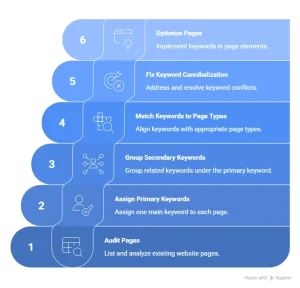
Image Source: Created using Napkin AI.
Step 1: Audit All Existing Website Pages
Start by listing every indexable URL on your website. This includes blog posts, service pages, category pages, and landing pages.
Create a simple audit sheet with:
- Page URL
- Page type (blog, service, landing)
- Current rankings (if any)
- Organic traffic and conversions
This audit helps you understand which pages already have authority and which pages need keyword reassignment or optimization.
Step 2: Assign One Primary Keyword to Each Page
Each page should target only one primary keyword. Assigning multiple primary keywords to the same page confuses search engines and weakens relevance. Instead:
- Choose one main keyword that best matches the page’s search intent
- Use related secondary and semantic keywords to support it
This is a core principle of keyword mapping for SEO and plays a major role in ranking stability.
Step 3: Group Secondary and Semantic Keywords
Once the primary keyword is assigned, add supporting keywords that naturally reinforce the topic.
These include:
- Long-tail keyword variations
- Semantic and LSI keywords
- Question-based phrases
All supporting keywords must match the same search intent as the primary keyword. If the intent differs, the keyword belongs on a different page.
Step 4: Map Keywords Based on Search Intent
Search intent determines which page type should rank for a keyword.
- Informational keywords → Blog posts
- Commercial keywords → Service pages
- Transactional keywords → Landing pages
If a keyword does not match the page’s intent, the page will struggle to rank, regardless of optimization quality.
Step 5: Identify and Fix Keyword Cannibalization
Keyword cannibalization occurs when multiple pages target the same keyword.
To fix it:
- Merge similar pages when intent overlaps
- Reassign keywords based on page strength
- Improve internal linking to clarify page hierarchy
- Use canonical tags where necessary
Proper keyword mapping for SEO ensures that each keyword has a single, authoritative page.
Step 6: Optimize Pages Using Mapped Keywords
After mapping keywords, optimize each page accordingly:
- Use the primary keyword in the title tag and H1
- Include secondary keywords in subheadings
- Strengthen internal links using relevant anchor text
- Align content depth with ranking competitors
This final step turns keyword mapping into measurable SEO performance.
Keyword Mapping for Different Page Types
Keyword mapping for SEO changes depending on the type of page you are optimizing. Blogs, service pages, landing pages, and category pages all serve different purposes and each requires a different keyword mapping approach. Assigning the same type of keywords to every page leads to intent mismatch and poor rankings.
How Does Keyword Mapping Differ by Page Type?
Keyword mapping differs by page type because each page targets a different search intent. Informational keywords belong on blogs, commercial keywords belong on service pages, and transactional keywords belong on landing pages. Matching keywords to the correct page type improves relevance, rankings, and conversions.
Blog Posts
- Target informational and long-tail keywords
- Build topical authority
- Support service pages via internal links
Service Pages
- Target commercial keywords
- Focus on trust, expertise, and conversions
- Avoid purely informational queries
Landing Pages
- Target high-intent transactional keywords
- Keep keyword focus narrow
- Optimize for actions, not depth
Category Pages
- Target broad head keywords
- Distribute authority to sub-pages
Homepage
- Target the most competitive, brand-relevant keyword
- Act as an authority hub
Keyword Mapping Comparison Table
| Page Type | Primary Keyword Type | Search Intent |
|---|---|---|
| Blog Post | Informational keywords | Informational |
| Service Page | Commercial keywords | Commercial |
| Landing Page | High-intent keywords | Transactional |
| Category Page | Broad topic keywords | Mixed |
| Homepage | Brand-level keyword | Navigational |
What Tools Are Used for Keyword Mapping for SEO?
Keyword mapping for SEO typically uses keyword research tools, performance tracking platforms, and spreadsheets to assign keywords to pages systematically and avoid duplication. The most effective setups combine data tools with manual decision-making.
Useful Tools
- Google Search Console for real performance data
- Keyword research tools for discovery and validation
- Site audit tools to detect overlap and duplication
Keyword Mapping Template Essentials
A keyword mapping sheet should include:
- URL
- Page type
- Primary keyword
- Secondary keywords
- Search intent
- Ranking status
Automation can assist, but manual intent review is essential. Keyword mapping should be reviewed every 3–6 months or after major content changes.
Common Keyword Mapping Mistakes to Avoid
Even experienced marketers make keyword mapping mistakes that silently limit SEO performance. Avoiding these errors is just as important as following the right process, especially when building a scalable keyword mapping for SEO strategy.
- Assigning one keyword to multiple pages
- Ignoring search intent
- Creating thin pages just to target keywords
- Not updating keyword maps over time
- Treating keyword mapping as a one-time task
- Ignoring internal linking
- Prioritizing search volume over business value
How Keyword Mapping Supports Long-Term SEO Growth
Keyword mapping is a scalable SEO framework, not a short-term tactic.
It helps by:
| Benefit | Without Keyword Mapping | With Keyword Mapping for SEO | SEO Impact |
|---|---|---|---|
| Builds Topical Authority | Content is scattered and overlaps across pages | Related keywords are grouped into clear topic clusters | Improves authority and rankings across entire topic areas |
| Enables Safe Content Scaling | New pages compete with existing ones | Each page has a predefined keyword role | Allows scalable growth without ranking dilution |
| Improves Ranking Stability | Rankings fluctuate and pages swap positions | Signals are consolidated to one authoritative page | Creates consistent, stable rankings |
| Strengthens Internal Linking | Links are added randomly without strategy | Internal links reinforce priority pages with relevant anchors | Improves crawl efficiency and page importance clarity |
| Aligns SEO With Business Goals | Traffic increases but conversions remain low | High-intent keywords are mapped to conversion pages | Drives leads, sales, and measurable outcomes |
| Reduces SEO Rework & Technical Debt | Teams constantly fix cannibalization and overlaps | Clear mapping prevents duplication and rework | Saves time, effort, and SEO budget long term |
Final Thoughts
Keyword mapping for SEO is not an optional optimization, it is the foundation of a sustainable search strategy. Without it, even high-quality content competes against itself, rankings fluctuate, and SEO growth becomes unpredictable.
When keywords are mapped correctly:
- Each page serves a clear purpose
- Search intent is matched precisely
- Keyword cannibalization is eliminated
- Content scales without ranking loss
- SEO efforts align with business goals
Modern SEO success depends on structure, clarity, and intent alignment, not guesswork. At Tangence, keyword mapping is treated as a core SEO framework, not a surface-level task. Our SEO services focus on building data-driven keyword maps that connect keyword research, content strategy, site architecture, and conversions into one cohesive system. This approach helps businesses grow organic traffic predictably while protecting long-term rankings.
Frequently Asked Questions
1. What is keyword mapping in SEO?
Keyword mapping is the process of assigning specific keywords to individual pages to prevent overlap and improve rankings.
2. How is keyword mapping different from keyword research?
Keyword research finds keywords; keyword mapping assigns them to pages strategically.
3. How many keywords should be mapped to one page?
One primary keyword with several closely related secondary keywords.
4. Can keyword mapping fix keyword cannibalization?
Yes, it is one of the most effective ways to resolve cannibalization issues.
5. Is keyword mapping necessary for small websites?
Yes. Even small sites benefit from intent clarity and structured targeting.
6. How often should keyword mapping be updated?
Every 3–6 months or after major content or ranking changes.
7. What tools are best for keyword mapping for SEO?
Search Console, keyword research tools, and structured spreadsheets combined with manual intent analysis.